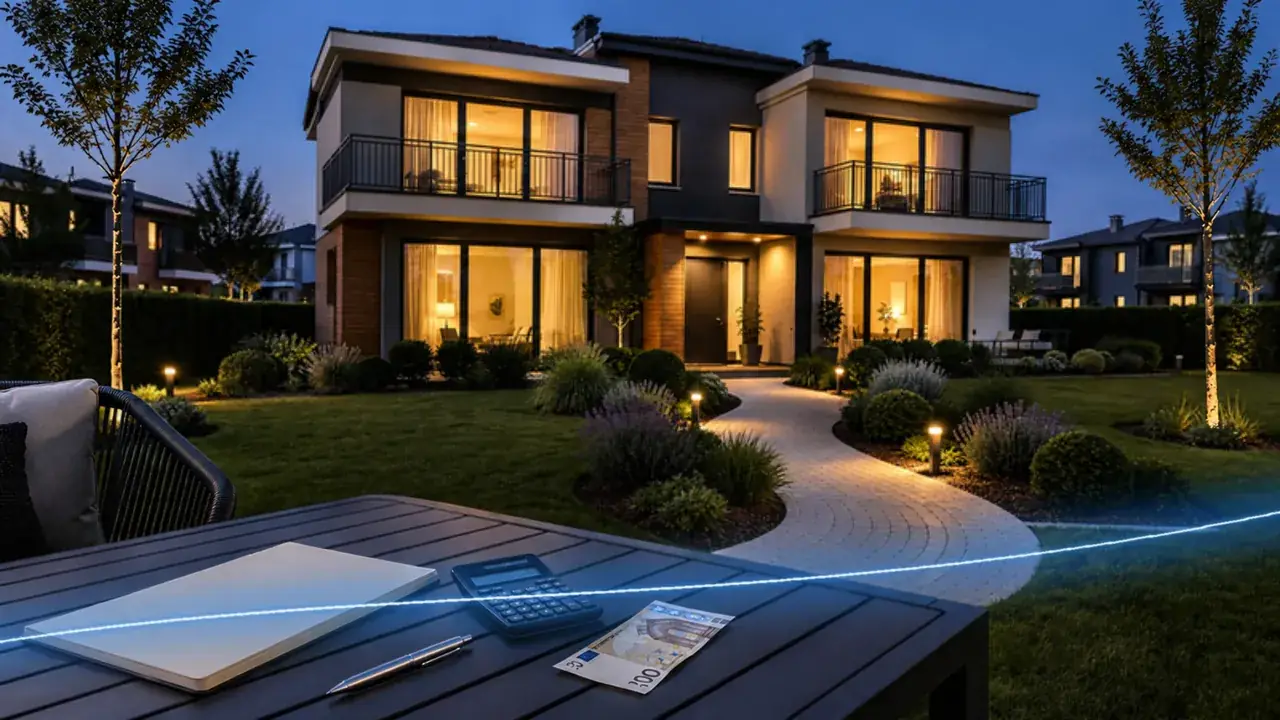
A Romanian bank finances up to 70% of the price, so on a €299,900 villa your own equity is at least 30%, about €90,000. VAT, registration, notary and the company lawyer are already in the price.
A loan of about €210,000 over 25 years at 6.5%: about €1,420 a month before insurance. The bank will expect a net income of about €3,550.
Under Article 41(3) of Emergency Ordinance 52/2016, on a housing loan the bank may not charge a penalty for early repayment, even at a fixed rate.
"It's too expensive": the short answer
You don't need €299,900 in the bank to buy a villa at Compass on the Lake in Balotești. The price, from €299,900, includes 21% VAT, the land-registry fee, notary and the company lawyer's fees. A Romanian bank finances up to 70% of the price, so your own equity is at least 30%, about €90,000 for the lowest-priced villa. On a loan of about €210,000 over 25 years, at an example rate of 6.5%, the monthly payment is about €1,420 before insurance, and the bank will expect a net income of about €3,550 a month.
So the real question is not "do I have €300,000?" but two questions: do I have about €90,000 of my own, and am I willing to take a mortgage? If you answer "yes" to both, the villa is within reach. If you answer "no" to either, keep reading, because there are solutions, and sometimes the honest answer is that this villa isn't for you.
In plain words: a €299,900 villa takes roughly €90,000 of your own money, a mortgage of up to 70% from a Romanian bank, and an income that can carry a payment of about €1,420 a month.
"It's too expensive" is the question we hear more than any other in our sales calls. This article answers it with numbers, without dressing anything up. Renderings are for illustration only. The binding price is the price in the company's price list.
How much money you need on day one
The project's price list, 29 villas, starts at €299,900 for villas 1 to 8. With financing of up to 70%, this is how the numbers look for each price group:
| Villas | Price | Financing of up to 70% | Own equity, at least 30% |
|---|---|---|---|
| 1–8 | €299,900 | €209,930 | €89,970 |
| 9–12 | €330,000 | €231,000 | €99,000 |
| 13–16 | €350,000 | €245,000 | €105,000 |
| 17–20 | €365,000 | €255,500 | €109,500 |
| 21–24 | €375,000 | €262,500 | €112,500 |
| 25–26 (detached) | €450,000 | €315,000 | €135,000 |
Villas 27 to 29, on the waterfront, start from €1,000,000 and are not included in the table.
What matters about these numbers:
- VAT, notary, the land-registry fee and the company lawyer are already in the price. Romania has no purchase tax on the buyer, so there is no such line in the calculation. The full breakdown of what is and isn't included is in our article on what the price does not include.
- "Up to 70%" is a ceiling, not a promise. Libra Internet Bank reviewed and approved the project, but every buyer is assessed separately, based on their own income.
- Beyond your equity there are a few more costs: an independent lawyer acting for you, the mortgage costs (valuation, file fee, the mortgage deed at the notary, insurance), and furniture. Plan a margin.
Why 30% in particular? Under National Bank of Romania (BNR) Regulation 17/2012 the legal minimum is lower, but in practice non-residents with income from abroad receive financing of up to 70%. The details are in our article on the down payment in Romania.
What it costs per month: the math
The monthly payment depends on the loan amount, the interest rate and the term. On variable-rate loans in lei, the rate is the IRCC index plus the bank's margin. According to the BNR, the IRCC stands at 5.57% from 1 October to the end of December 2026. The table uses equal monthly instalments (annuity), over 25 years, before insurance and fees:
| Loan | Rate 6.5% | Rate 7.57% (IRCC plus a 2% margin, for illustration) | Net income required, at the 40% cap |
|---|---|---|---|
| €209,930 (70% of €299,900) | about €1,417 | about €1,561 | €3,550–3,900 |
| €149,950 (50% of €299,900) | about €1,012 | about €1,115 | €2,530–2,790 |
This is an example only. The bank sets the rate, the amount and the terms, based on your profile.
The income column is driven by the BNR's DSTI cap: the total of your monthly payments on all your loans is limited to 40% of net income on a lei loan, and to only 20% on a foreign-currency loan. Someone who earns in shekels and borrows in euros counts as an unhedged borrower, so the loan will usually be in lei. The formula and full tables are in our article on calculating a mortgage payment in Romania, and income in shekels is covered in our article on financing when your income is in shekels.
Look at the second row of the table. A larger deposit means a smaller payment and a lower income requirement. That is the basis of the first path below.
"It's too expensive" usually doesn't mean "I don't have the money". Most of the time it means "I didn't know I only need 30%".
When you need the money
When you buy off-plan, the money doesn't leave your account in one day. Instalments during construction are paid according to the payment schedule in the preliminary contract, usually from your own equity. The mortgage is usually taken when the house is finished and can be registered in your name.
Handovers are staged: the first 8 villas in October 2027, then 8 more every six months. In other words, there is time between signing and the mortgage, and you can use it to plan: put together your income file, get an agreement in principle from the bank, and release money from another asset if needed.
And what protects the instalments in the meantime? Under Law 207/2025, whose rules are now part of the Planning and Construction Code, the instalments go into a dedicated project account, with caps on the developer's spending according to construction stages.
Three ways to get to the villa
1. Partial financing, and early repayment when it suits you. Someone with €150,000 who doesn't want a large loan can finance only 50%. The payment drops to about €1,012 a month (at 6.5%), and there is flexibility. Here a Romanian rule is worth knowing: under Article 41(3) of Emergency Ordinance 52/2016, on a housing loan the bank may not charge a penalty or fee for early repayment, even at a fixed rate. So you can take a loan and reduce it when money comes in, at no cost. The details are in our article on early repayment and refinancing a mortgage.
2. Buy together with a family member or a friend. Two buyers can be registered as co-owners of one villa. Under the Romanian Civil Code, each holds a registered share, and the shares are presumed equal unless proven otherwise, so unequal shares are written into the deed and the land book. Selling or mortgaging the whole house requires everyone, and each co-owner can ask for a partition, unless you agreed to suspend it for up to five years. The hard part is not getting in but getting out, and it needs to be agreed in writing before signing. See the guide to buying with friends.
3. Release capital from another asset first. Many people who say "it's too expensive" hold an apartment in Israel, a fund or savings that haven't been released yet. The staged handover schedule gives time to plan the sale. But for Israeli residents there is a tax side in Israel, and a question of order: sell first or buy first. We wrote a separate article on this: sell first or buy first. Before you decide, talk to a tax adviser in Israel.
When this villa is not for you
Here is the honest answer. If your budget is €80–120K in cash, and you won't take a mortgage under any circumstances, this villa doesn't fit you today. There is no route in which €100,000 without financing buys a €299,900 house, and we won't offer you a trick that pretends there is.
What does fit? In Bucharest, according to the Imobiliare.ro index, the median asking price for an apartment stood at €2,312 per m² in September 2026. In simple terms, €100,000 buys around 43 m² at the median price, meaning a studio or a small one-bedroom apartment, often in an older building. With a new apartment from a developer, check whether the price includes VAT: according to a guide published on bugetul.ro in June 2026, many developers show prices without VAT, and on a new apartment you need to add 21%.
How such an apartment compares with the villa, line by line, is in our article on a €150K apartment versus a villa. And anyone willing to wait a year or two, to save or release an asset, can come back to the question with about €90,000 of their own.
| Your situation | What probably fits |
|---|---|
| €90,000 or more, willing to take a mortgage, income that carries the payment | A villa in Balotești, with financing of up to 70% |
| €150,000, don't want a large loan | A villa with partial financing and early repayment |
| About €45,000 each, and a reliable partner | Co-ownership of a villa, with financing and a written exit agreement |
| €80–120K in cash, no mortgage under any circumstances | An apartment in Bucharest, or wait and save |
What to check before you decide
- An agreement in principle from a bank. That is the number you build the budget around, not the financing percentage in the headline.
- The payment if rates rise. Ask the bank for the payment at one percentage point above its offer, and ask yourself whether you could carry it.
- The payment schedule in the preliminary contract. When each instalment is due, and when the financing comes in.
- A signed "included and not included" list. Including mortgage costs and furniture.
- An independent lawyer acting for you. The company lawyer represents the company only, not you.
- A conversation with a tax adviser in Israel, for Israeli residents selling an asset to fund the purchase.
Frequently asked questions
How much deposit do I need for a €299,900 villa?
At least 30%, about €90,000, because a Romanian bank finances up to 70% of the price, subject to each buyer's assessment. The price already includes 21% VAT, the land-registry fee, notary and the company lawyer's fees. On top of the equity, plan for an independent lawyer, mortgage costs and furniture.
What is the monthly mortgage payment on a €299,900 villa?
On a loan of about €210,000 over 25 years at 6.5%, the payment is about €1,420 a month before insurance. At 7.57% it is about €1,560. This is an example only: the bank sets the rate and terms based on your profile.
How much income will the bank require?
Under BNR rules, total payments on all loans are capped at 40% of net income on a lei loan. With a payment of about €1,420, the bank will expect a net income of at least about €3,550 a month. On a foreign-currency loan for someone earning in shekels the cap is 20%, so the required income doubles.
Can I repay the mortgage early without a penalty?
Yes. Under Article 41(3) of Emergency Ordinance 52/2016, on a housing loan to a private consumer the bank may not charge a penalty, compensation or any other cost for early repayment, even at a fixed rate. Ask for the terms in writing before signing.
I have €100,000 and don't want a mortgage. Is there an option for me in the project?
No, and it's better we say so up front. Without financing, €100,000 doesn't buy a €299,900 villa. The options are a small apartment in Bucharest, co-ownership with a partner, or building up capital and returning to the question later.
When do I need to pay my own equity?
When buying off-plan, instalments are paid according to the payment schedule in the preliminary contract, usually from your own equity, and the mortgage is taken when the house is finished. The first handovers are planned for October 2027, followed by 8 more villas every six months.
The bottom line
"It's too expensive" usually doesn't mean "I don't have the money". Most of the time it means "I didn't know I only need 30%", or "I'm not sure I want a mortgage". The numbers answer the first: about €90,000 of your own and financing of up to 70%. The terms answer the second: partial financing, and early repayment without a penalty. And if, even after the math, it's too much for you, that's nothing to be ashamed of. It's the right decision, and Bucharest has properties that fit it.
If you'd like to go through your own numbers, we'd be glad to meet you with the developers, on Zoom or in Balotești.
Moti Azulay, Compass Group Romania
Sources: cursbnr.ro: IRCC index from BNR data, updated 1 October 2026 · BNR Regulation 17/2012, Romanian legislation portal · Emergency Ordinance 52/2016, Romanian legislation portal · Imobiliare.ro index, Bucharest · bugetul.ro: VAT on apartments in 2026 (in Romanian) · Compass Group Romania: calculating a mortgage payment in Romania
This article is for general information only and is not legal, tax or financial advice. The information is correct as of 18 November 2026. The calculations are for illustration only, and the rate, loan amount and terms are set by the bank for each borrower. Renderings are for illustration only. The binding price is the price in the company's price list. Before deciding, consult an independent lawyer and a tax adviser.
Now you know more.
This article is general information, not legal, tax or financial advice. Consult local professionals before any transaction.