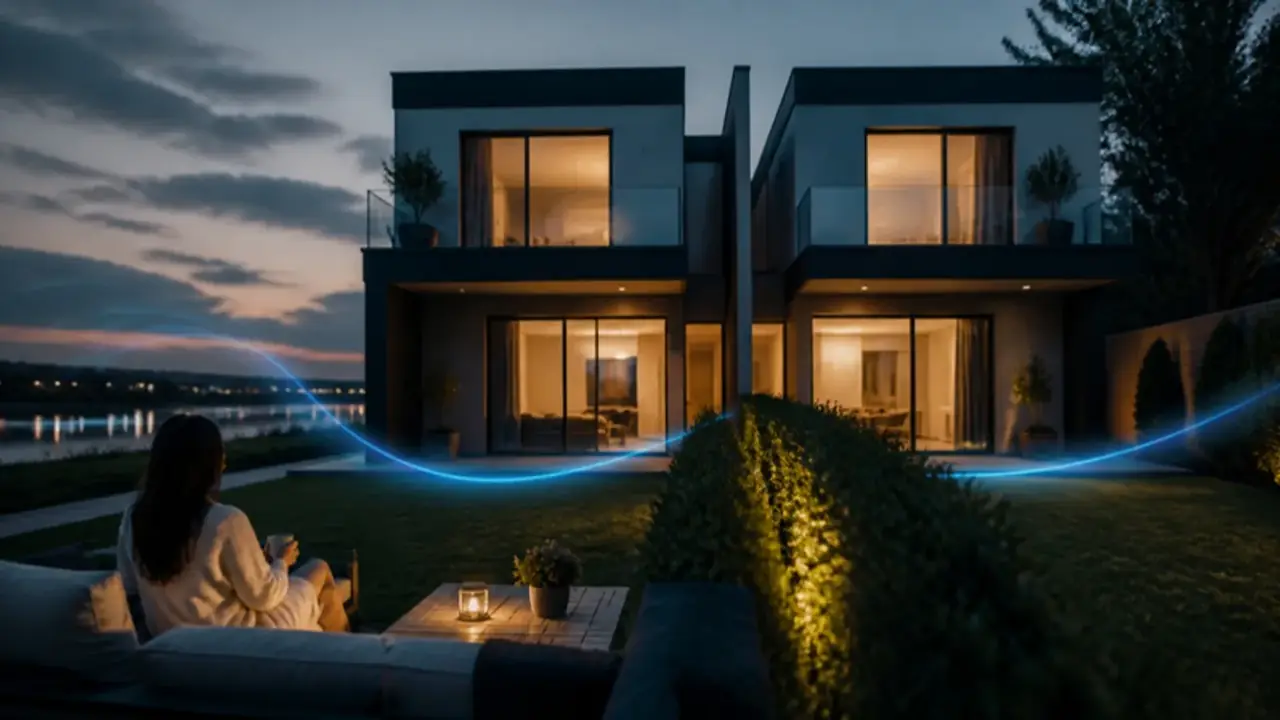
A wall between two plots is presumed to be co-owned by both neighbours, unless the title, a sign of non-common ownership or prescription shows otherwise.
Co-owners pay to maintain and repair the shared wall in proportion to their rights. If your house rests on the wall, you cannot opt out.
A window or balcony facing the neighbour's land needs at least 2 metres from the boundary, or 1 metre if not parallel to it. No window at all in the common wall without consent.
The party wall in Romania: the short answer
When you buy a semi-detached villa in Romania, you share one wall with the house next door. Under Article 660 of the Romanian Civil Code, a wall between two plots is presumed to be owned in common by the two neighbours (zid comun), unless the title deed says otherwise, the wall carries a "sign of non-common ownership", or one owner has acquired it by prescription. This is a form of forced co-ownership (Article 646): you cannot sell your share of the wall separately from your house.
In practice, both owners pay to maintain and repair the wall (Article 663), and neither may open a window in it without consent (Article 614). How much noise passes between the homes depends on the wall's design and construction, governed by the acoustic norm C 125-2013, not by the Civil Code.
In plain words: the shared wall belongs to both of you, costs both of you, and the contract, the cadastral plan and the wall's construction detail are the three documents that tell you how well it will work.
Still choosing a villa type? Start with our guide on how to choose a villa type. This article covers what comes after: living with a shared wall.
Who owns the shared wall: the presumption and its exceptions
Under Article 660(1), the wall, the ditch and "any other partition between two plots" are presumed common. The presumption gives way in three cases:
- The title says otherwise. If the sale contract or the land register entry states that the wall belongs to one plot, that prevails.
- A sign of non-common ownership. Under Article 661, a wall whose top is vertical on one side and sloped towards the other is presumed to belong to the owner on the sloped side. Any other sign that one owner built it alone also counts.
- Prescription. One owner may, under the conditions of the law, become the sole owner through long possession (uzucapiune).
For new-build villas, the first case matters most. Does the boundary line in the contract and cadastral documents run through the middle of the wall, or along one face?
Repairs, extensions and beams: what each owner may do
| Situation | What the Civil Code says | Article |
|---|---|---|
| Maintenance and repair | Co-owners share the costs in proportion to their rights | 663(1) |
| Not wanting to pay | You can opt out only by giving up your right in the wall. Not possible if your house rests on the wall | 663(2) |
| Beams and structures | Each owner may rest structures or beams on the wall, leaving 6 cm towards the neighbour | 664(1) |
| Raising the wall | Allowed, at the cost of the owner who raises it, including repairs caused by the work | 665 |
| Windows or openings | Not allowed in the common wall without the owners' consent | 614 |
| A neighbour who did not pay | May become a co-owner by paying half of the updated value of materials and labour | 666 |
The practical line is Article 663(2): both homes rest on the shared wall, so neither owner can walk away from repair costs.
Windows, views, rainwater and trees: the neighbour rules
The Civil Code's "legal limits" (Articles 602 to 625) also govern what you build near the boundary. The ones that matter most:
- Minimum distance for construction (Article 612). Construction works and plantings must keep at least 60 cm from the boundary line, unless the law or the urban planning regulation provides otherwise. A semi-detached house is built on the boundary because the local urban rules allow paired construction (cuplat). A derogation agreed between neighbours must be made by authentic deed, meaning before a notary.
- Windows with a view (Article 615). A window, balcony or similar work facing the neighbour's land needs at least 2 metres from the boundary. If it is not parallel to the boundary, at least 1 metre. The distance is measured perpendicular to the boundary line.
- Light windows (Article 616). A window that lets in light but is built to prevent a view onto the neighbour's land can be opened at any distance.
- Rainwater (Article 611). Eaves must be built so rainwater does not run onto the neighbour's plot. On a shared roof line, ask how the gutters are split.
- Trees (Article 613). Unless the law, urban regulation or local custom says otherwise, at least 2 metres from the boundary. Trees under 2 metres, plantings and hedges are exempt. You may cut a neighbour's roots or branches that cross onto your land, and keep fruit that falls on your side.
- The garden fence (Article 662). Either neighbour can require the other to contribute to a common partition. Without other rules, its height is set by the parties but may not exceed 2 metres, including the coping.
Where villas share roads, networks or common areas, Article 659 requires an owners' association for residential ensembles of individual or paired houses. Ask who maintains what.
The Civil Code tells you who owns the wall and who pays. Only the design and the work on site tell you how quiet the house will be.
Sound insulation: what the norm covers and what to ask
The new Planning and Construction Code, Law 169/2026, lists protection against noise among the fundamental requirements every building must meet (Article 386), and Article 400 includes protection against airborne noise from another enclosed space and against impact noise. The technical detail is in the norm C 125-2013 on acoustics in buildings and urban areas, approved by Order 3384/2013. Its Part III (C 125/3-2013) sets the protection measures for residential buildings.
Three ideas help you read the developer's answers:
- The sound reduction index (R'w), in decibels. The higher it is, the less sound passes through. Rw is measured in a laboratory, R'w is measured in the finished building, where sound also travels through floors, roof and joints. The second figure is the one you live with.
- Double wall with a gap or single wall. As a general principle of building acoustics, two separate leaves with an air gap or insulation between them, not rigidly connected, usually stop more sound than a single wall. The detail at the floor slab, the roof and the façade matters as much as the wall itself.
- Impact noise. Footsteps or a washing machine against the wall travel through the structure. Ask whether the two homes' floors and stairs are separated at the shared wall.
Ask in writing for the wall section from the technical design and its design acoustic values. For a finished house, an independent acoustic measurement is the real proof.
Semi-detached or detached: the comparison
| Criterion | Semi-detached villa | Detached villa |
|---|---|---|
| Privacy | One shared wall, a neighbour on one side | No shared wall |
| Noise | Depends on the wall design and its execution | Noise from neighbours mainly through windows and garden |
| Purchase cost | Usually lower for a similar area | Usually higher |
| Maintenance | Shared wall repairs split with the neighbour (Art. 663) | You alone, on more façade and roof |
| Decisions | Changes to the shared wall need agreement | You decide alone, within the permit and urban rules |
| Resale | Buyers will ask about the wall and the noise: documents help | Fewer questions about the neighbour |
On running costs, see villa upkeep costs; on a future sale, see selling a villa later.
What to check in the contract and the cadastral plan
- The boundary line. See where it runs in the cadastral documents and the land register extract.
- Who owns the wall. Does the contract say "common wall" or state that it belongs to one plot? If it says nothing, the presumption of Article 660 applies.
- Shared elements. Roof, gutters, garden fence, utility connections, access roads: which are common, and who maintains them.
- Restrictions. Any agreement on distances, windows or easements must be in an authentic deed and registered to bind future owners (Articles 602(2) and 612).
- The technical specification. The wall section and its acoustic values, attached to the contract or listed in the specification.
Step-by-step checklist before you sign
- Ask the developer for the plan of both plots and the boundary line.
- Get a land register extract for the plot (extras de carte funciară).
- Read in the draft contract how the wall and the shared elements are described.
- Ask for the shared wall section from the technical design, with its acoustic values.
- Ask whether there is, or will be, an owners' association, and what it will cover.
- Check the window positions on the side facing the neighbour's garden against the 2 m and 1 m rules.
- If the house is finished, listen by the shared wall while someone talks on the other side. See also our villa tour checklist.
- Have an independent lawyer read the contract and the cadastral documents before you sign.
Considering one of the 24 semi-detached villas at Compass on the Lake? Ask us for these documents in writing, as you should ask any developer.
Frequently asked questions
Who owns the shared wall of a semi-detached house in Romania?
Under Article 660 of the Civil Code, it is presumed to be common property of the two neighbours, unless the title says otherwise, there is a sign of non-common ownership, or one owner acquired it by prescription.
Who pays to repair the party wall?
Both co-owners, in proportion to their rights (Article 663). An owner can avoid the costs only by giving up the right in the wall, and not if their house rests on it, which is the case for a semi-detached villa.
Can my neighbour open a window in the shared wall?
No, not without the consent of the owners (Article 614). Windows with a view towards the neighbour's land, in other walls, need at least 2 metres from the boundary, or 1 metre if they are not parallel to it (Article 615).
How do I know the wall will block noise?
Ask for the wall section in the technical design and the acoustic values it was designed for under the norm C 125-2013. In a finished house, an independent measurement of R'w on site is the strongest proof.
The bottom line
A semi-detached villa means a shared wall and a neighbour with rights. The Civil Code answers who owns the wall, who pays, and where windows and trees may go. How quiet the house will be depends on the design and the work on site.
If you are deciding on a semi-detached villa, with us or anywhere else, book a 30-minute call with me. We will go through the plot plan, the contract wording and the questions for the developer.
Moti Azulay, Compass Group Romania
Sources: Romanian Civil Code, Law 287/2009, consolidated form (legislatie.just.ro), Art. 602, 611–616, 646, 651, 659–666 · Order 3384/2013 approving norm C 125-2013 on acoustics in buildings and urban areas (Monitorul Oficial 812 bis, 20.12.2013) · Planning and Construction Code, Law 169/2026 (Monitorul Oficial 661, 10.8.2026), Art. 386 and 400 · National Agency for Cadastre and Land Registration (ANCPI)
This article is for general information only and is not legal, tax or financial advice. The rules are correct as of 22 October 2026. The urban regulation of each area can change the distances above; consult an independent lawyer before signing.
Now you know more.
This article is general information, not legal, tax or financial advice. Consult local professionals before any transaction.

