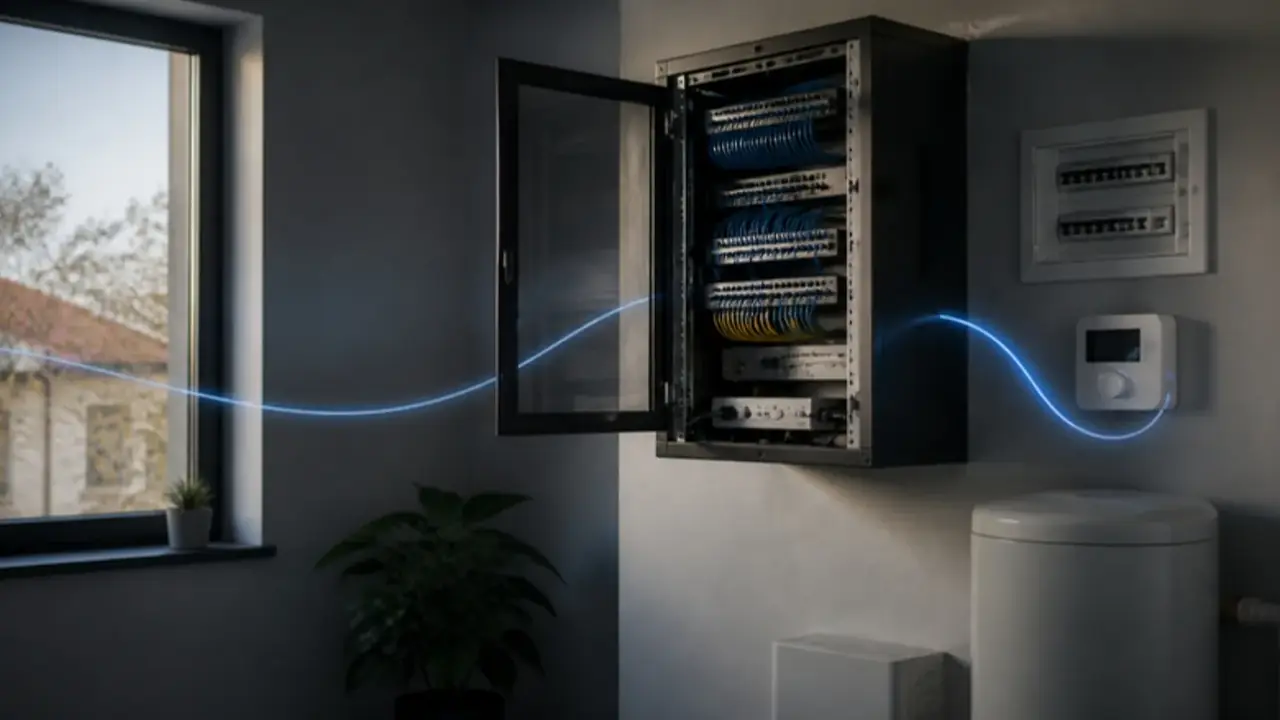
A central network point, a cable to every room, camera cabling, empty conduits to roof, parking and gate, neutral in switch boxes, shutter wiring, panel space and a cable map.
Leak, temperature, smoke and carbon monoxide, power loss and internet loss. Ideally with a main water valve that closes on its own.
The Court of Justice of the EU ruled that a home camera that also records public space is not purely household use, so data protection rules apply.
A smart villa: the short answer
A smart home in a Romanian villa earns its keep in three areas: heating and cooling control, energy management and, above all, remote monitoring. If you live abroad and the house stands empty part of the year, remote monitoring is not a luxury. It is how you learn about a burst pipe, a power cut or a room close to freezing before the damage grows.
The most important part happens before you pick a single device: the infrastructure. Cables, empty conduits, space in the consumer unit and a central network point cost little during construction and a lot once the walls are closed. Devices can be replaced every few years. Opening a wall once is enough.
In plain words: infrastructure first, devices second. Whatever is not in the wall during construction will cost several times more later.
We do not recommend any brand here. The rules below work for any system.
Four areas, and what each one gives you
| Area | What it does | Who needs it most |
|---|---|---|
| Heating and cooling | A thermostat per zone, schedules, switching on from your phone before you arrive | Every house, especially with a heat pump |
| Energy management | Measuring consumption, running the water heater and appliances during solar hours, load management for an EV charger | Houses with solar panels or an electric car |
| Monitoring and alerts | Leak, temperature, smoke and carbon monoxide sensors, alerts for power and internet loss | Owners abroad |
| Security | Alarm, cameras, intercom, scheduled lights and shutters | Every villa, to a different degree |
Heating: where the real savings are
Most of a villa's winter consumption goes on heating. A few simple rules:
- A zone per floor, ideally per bedroom. A room nobody uses does not need to be as warm as the living room.
- Switch on remotely before you arrive. Instead of keeping the house warm all week, heat it the day before you land.
- An away mode with a minimum temperature. In a house left empty in winter, do not switch heating off completely. Keep a minimum that protects the pipes from freezing.
- Heat pumps like stability. They work better at a steady temperature than with frequent on and off cycles. Ask the installer how to connect a smart controller without upsetting the heat pump's own control logic.
We compared heat pumps and gas in our heating guide.
Energy management with solar panels
An energy management system measures what the house produces and consumes and moves consumption into daylight hours. The water heater, washing machine, dishwasher and car charging can run while the sun is on the roof.
Two notes:
- The rules for household producers changed in 2026. How much shifting consumption is worth depends on the offsetting rules. We covered them in our solar panels guide.
- A meter in the consumer unit gives a more accurate picture than a smart plug here and there. In a new build, ask for space in the unit for one.
Remote monitoring: what an empty house needs
This is the area that matters most to owners who live abroad. Sensors worth considering:
- Leak sensors under the water heater, sinks, washing machine and in the technical room, ideally with a motorised main valve that closes automatically.
- Temperature sensors in the technical room and the coldest rooms, with an alert below a threshold you set.
- Connected smoke and carbon monoxide detectors that send an alert to your phone instead of just beeping in an empty house.
- Alerts for power cuts and lost internet. No power means no heating, and no internet means no alerts.
- Backup connectivity: a router with a mobile SIM as fallback, and a small backup power supply for the router and hub.
Three rules that save disappointment:
Infrastructure first, devices second. Whatever is not in the wall during construction will cost several times more later.
- A system that keeps working without the cloud. If the manufacturer's server goes down, the house should keep its basic functions.
- Someone nearby. An alert on your phone in Tel Aviv or London does not close a tap in Balotești. You need a neighbour, a property manager or a maintenance firm with a key. We covered the options in our property management guide.
- Shared access. Give at least two people access so an alert never goes unseen.
Cameras: what you may film
Cameras are a natural part of a smart home, but there is a limit. In 2014 the Court of Justice of the European Union ruled (in the Ryneš case) that a camera an individual installs on the family home, which also records a public space, is not a "purely personal or household activity". That means data protection rules (GDPR) apply to it.
In practice:
- Point cameras at your own property: the entrance, the garden, the drive.
- Do not film the street or the neighbour's garden. Most cameras let you mask parts of the image.
- Do not post recordings of other people online.
On alarms, monitoring centres and lighting, and on the law that sets who may install an alarm, see our villa security guide.
What to prepare during construction: the checklist
This is the part you cannot postpone. Ask the developer or builder, in writing, before the walls are closed:
- A central network point: a cabinet or shelf in the technical room, with power, ventilation and space for the router, switch and hub.
- A network cable to every main room and to the TV position, from that single point.
- Cables for cameras and ceiling Wi-Fi access points, ideally ones that carry power over the network cable, so you do not need a socket next to each camera.
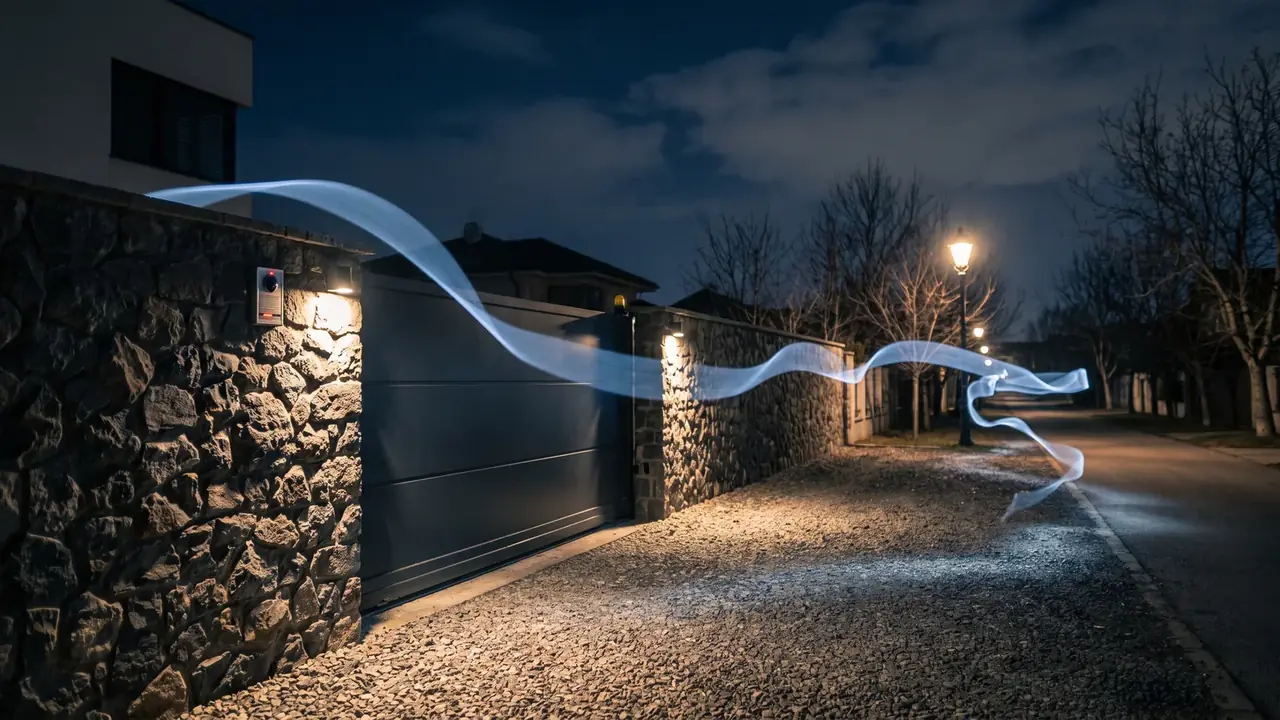
- Empty conduits from the technical room to the roof (solar), the parking space (EV charger), the gate and the fence (intercom and cameras).
- A neutral wire in switch boxes. Many smart switches need one. It is a small detail that is easy to forget.
- Wiring for motorised shutters and outdoor lighting, with the option of central control.
- Spare space in the consumer unit for a meter, extra protection and future circuits.
- An "as-built" drawing of cable routes. In five years someone will want to know where each cable runs.
| Item | During construction | After the walls are closed |
|---|---|---|
| Network cable to a room | Pulled through a conduit, a small job | Opening walls or visible trunking |
| Empty conduit to roof or parking | A few metres of pipe | Chasing, patching, repainting |
| Neutral in a switch box | Almost no cost | Rewiring or a limited choice of switches |
| Wireless sensors | Can be added later | Can be added later |
The last row matters: sensors, thermostats and smart locks now come in wireless versions. What really needs planning in advance is cables, conduits and power.
Frequently asked questions
Is a smart home worth it in a villa that stands empty part of the year?
Yes, mainly for monitoring: leak, temperature and smoke sensors, plus power-cut alerts. In an empty house, a small fault nobody notices becomes major damage. But you also need someone nearby with a key.
What is the most important thing to prepare during construction?
Network cables from one central point, empty conduits to the roof, the parking space and the gate, and a neutral in the switch boxes. Devices can be replaced. Cables inside a wall are hard to add.
May I film the street in front of my house?
Under the 2014 ruling of the Court of Justice of the EU, a home camera that also records public space is not a purely household activity, so data protection rules apply. The simple approach: point cameras at your own property and mask the street and the neighbours.
Does a smart home lower the electricity bill?
It can help, mainly through zoned heating, remote switching instead of constant heating, and shifting consumption to solar hours. How much depends on the house, the heating system and your habits, so we will not promise a figure.
Do I need a single-brand system?
Not necessarily. It matters more that the system works without the cloud, supports open standards, and lets you replace one component without replacing everything.
The bottom line
In a villa, a smart home starts with infrastructure and ends with devices. Lay cables and conduits during construction, put monitoring and heating first, and make sure someone nearby can always respond to an alert.
If you are looking at a villa in Romania, with us or anywhere else, book a 30-minute call with me. We will go through what to ask the developer for before the walls close.
Moti Azulay, Compass Group Romania
Sources: Court of Justice of the EU, Case C‑212/13 (Ryneš), 2014 (EUR-Lex) · EU General Data Protection Regulation (GDPR), Art. 2(2)(c) (EUR-Lex)
This article is for general information only and is not legal, tax or financial advice. The rules are correct as of 22 October 2026. Smart home systems, alarms and cameras should be installed by qualified professionals. For any data protection question, consult an independent lawyer.
Now you know more.
This article is general information, not legal, tax or financial advice. Consult local professionals before any transaction.

