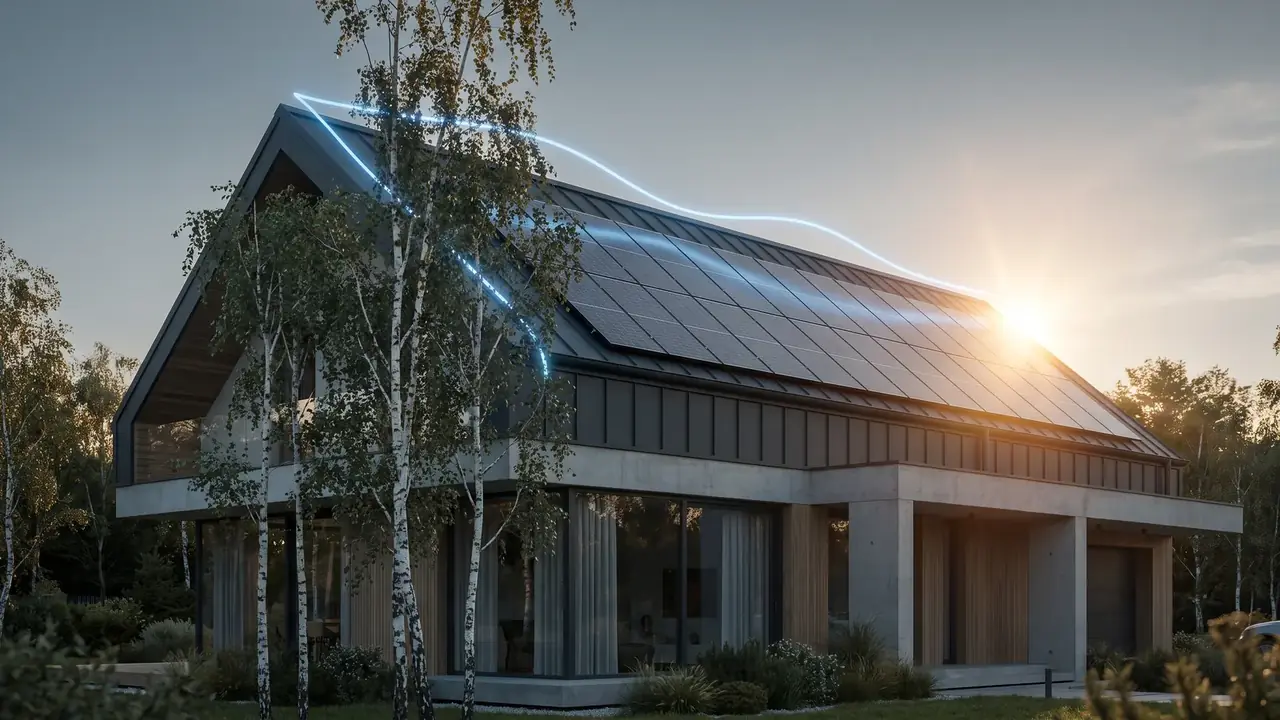
Law 160/2026 amended Romania's electricity and gas law and entered into force on 26 July 2026.
Installations up to 200 kW keep quantitative compensation, at the same contract price, until 31 December 2030.
Above 200 kW, and up to 400 kW, surplus is paid at a market-based price instead.
Household prosumers can use surplus credit against a gas bill from the same supplier.
The classic Casa Verde subsidy for new solar systems received no allocation for new applications in 2026.
Solar panels on a villa in Romania: the short answer
In Romania, a household that installs solar panels and connects them to the grid becomes a "prosumer": it uses its own electricity and sends the surplus to the grid. Under Law 160/2026, in force since 26 July 2026, installations of up to 200 kW keep quantitative compensation, energy sent offset against energy taken at the same contract price, until 31 December 2030, and household prosumers can use surplus credit against a gas bill from the same supplier. The classic Casa Verde subsidy for new systems has no session in 2026.
A villa has something an apartment rarely has: a roof of your own. So when buyers sit with the plans, one of the questions is almost always "Can we add solar?" The answer is usually yes. But the rules for what happens to the electricity you send to the grid changed this summer, so it is worth understanding them before you sign a contract with an installer.
What is a prosumer?
A prosumer (prosumator) is a consumer who also produces electricity, typically from rooftop solar panels, and is connected to the grid through a two-way meter. The framework is set by Law 123/2012 on electricity and natural gas and by the energy regulator ANRE.
The steps, in short:
- Design and installation by a company authorised by ANRE.
- Connection to the distribution network, with the distribution operator's approval and a bidirectional meter.
- Contract with your supplier for the energy you deliver to the grid.
What changed with Law 160/2026
Law 160/2026 amended Law 123/2012 and entered into force on 26 July 2026. The main points for a household:
| Topic | Under Law 160/2026 |
|---|---|
| Compensation for installations up to 200 kW | Quantitative compensation kept until 31 December 2030 |
| How it works | Energy delivered to the grid is offset against energy taken from it, at the same contract price |
| Frequency | Compensation per billing period (monthly), applied under ANRE's methodology |
| Surplus credit | Household prosumers can use it against the gas bill if gas comes from the same supplier |
| Several homes | Offsetting between consumption points with the same supplier, under conditions |
| Installations of 200–400 kW | No quantitative compensation; surplus paid at a market-based price |
For a family villa, the key line is the first one: quantitative compensation stays until the end of 2030. After that date, the rules may change again, so do not plan beyond 2030 on today's terms.
Network charges still apply to the electricity you take from the grid. Ask your supplier how your bill will look under the new rules; ANRE's implementing methodology determines the details.
Subsidies: what exists in 2026
- Casa Verde Fotovoltaice (classic), the subsidy of the Environment Fund Administration (AFM) for new household solar systems, received no allocation for new applications in the 2026 budget.
- Casa Verde Baterii, a programme for batteries for existing prosumers, was allocated budget for 2026, with a session expected later in the year.
Programmes open and close with each budget. Do not build your plan on a subsidy until the session is open and your file is accepted.
Do not build your plan on a subsidy until the session is open and your file is accepted.
Questions to ask before you install
| Question | Why it matters |
|---|---|
| Is the roof orientation and slope suitable? | South-facing roofs without shade produce most |
| What is the installed power, in kW? | Sized to your consumption, not to the maximum the roof allows |
| Is the installer authorised by ANRE? | Required for connection |
| Who handles the connection file? | The approval from the distribution operator takes time |
| Batteries or not? | Raise the cost; useful for backup and self-consumption |
| What is the warranty? | Panels, inverter and installation are warrantied separately |
| Is it included in my insurance? | Add the system to the home insurance policy; see our guide to home insurance |
For a new villa, ask the developer whether the roof structure and the electrical installation are prepared for panels, and whether adding them later needs a building permit change under local rules.
Solar, heat pumps and an efficient home
Solar works best in a home that uses little energy to begin with: good insulation, efficient windows, a heat pump or efficient heating, and underfloor heating with low water temperatures. Romania's standard for new buildings is nZEB, nearly zero-energy buildings. We explain it, with the energy performance certificate, in our guide to energy-efficient homes in Romania. For the full annual budget, see our guide to villa upkeep costs.
Frequently asked questions
Can I install solar panels on my house in Romania?
Yes. You install them through an ANRE-authorised company, connect them to the grid with the distribution operator's approval and a bidirectional meter, and sign a contract with your supplier for the energy you deliver.
What is Law 160/2026 for prosumers?
A law amending Romania's electricity and gas law, in force since 26 July 2026. It keeps quantitative compensation for installations up to 200 kW until 31 December 2030 and lets household prosumers use surplus credit against a gas bill from the same supplier.
Is there a subsidy for solar panels in Romania in 2026?
The classic Casa Verde Fotovoltaice subsidy for new systems has no allocation for new applications in 2026. A separate battery programme for existing prosumers was allocated budget for 2026.
What happens to the electricity I do not use?
It goes to the grid. For installations up to 200 kW it is offset against the energy you take from the grid, at the same contract price, until 31 December 2030.
Do solar panels need a building permit in Romania?
It depends on the installation and the local rules. Check with the town hall and the installer before you start.
The bottom line
A villa roof is a real opportunity for solar, and Law 160/2026 gave household prosumers clear rules until the end of 2030. The decisions that matter are size, installer, connection and insurance, not the subsidy.
If you are buying a villa and want to plan solar from the start, book a 30-minute call with me. We will look at the roof, the electrical plans and the questions for the installer together.
Moti Azulay, Compass Group Romania
Sources and data: Law 160/2026 amending Law 123/2012 · Romanian legislation portal (Law 123/2012) · Energy regulator (ANRE) · Environment Fund Administration (AFM).
This article is for general information only and is not technical or financial advice. Prosumer rules depend on ANRE's methodology and may change; check the current position with your supplier and an authorised installer.
Now you know more.
This article is general information, not legal, tax or financial advice. Consult local professionals before any transaction.