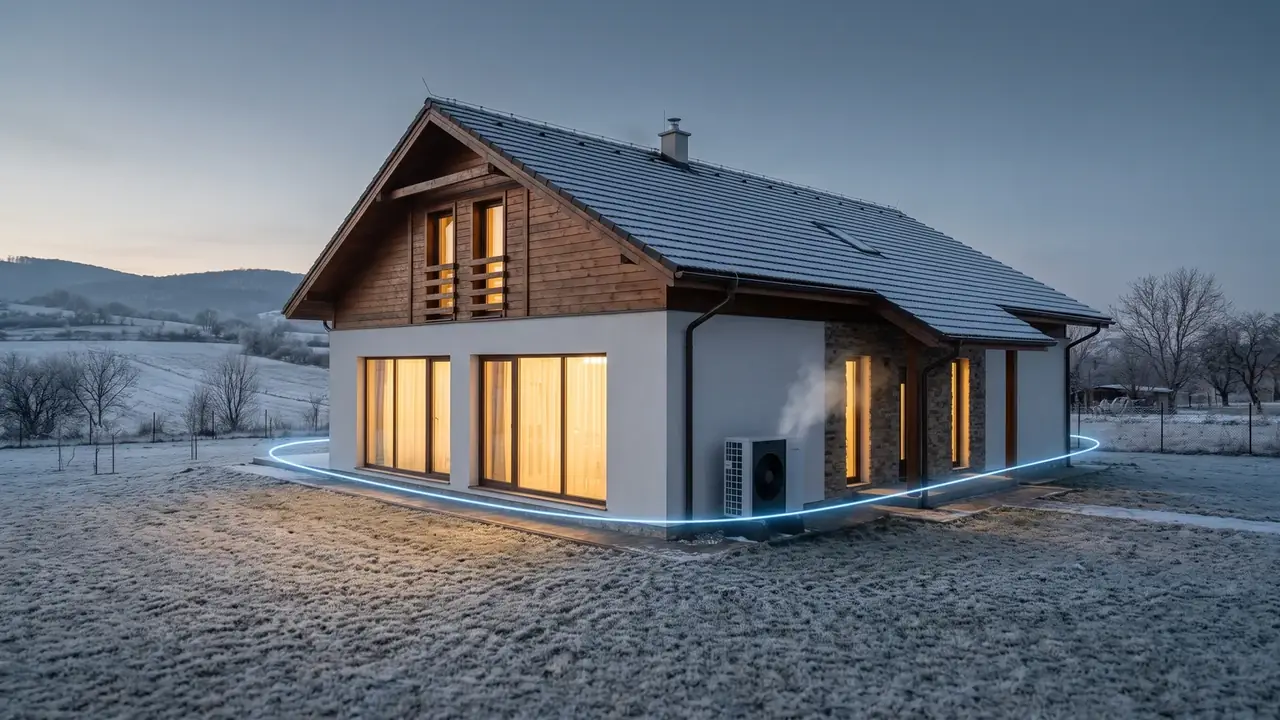
Every new building permitted after 31 December 2020 must meet the nZEB standard, under Law 372/2005 as amended.
At least 30% of final energy must come from renewable sources, on the building or within a radius of up to 30 km.
The energy performance certificate shows the class, annual consumption per m² and emissions. It is required at final acceptance and on sale.
Under EU directive 2024/1275, from 2030 every new building must be zero-emission. Public buildings from 2028.
Permit date, compliance report, renewable source, heating system, windows, insulation and the certificate date.
Energy-efficient homes in Romania: the short answer
In Romania, every new building that received its building permit after 31 December 2020 must meet the nZEB standard, a nearly zero-energy building, and at least 30% of its energy must come from renewable sources. The proof is the energy performance certificate, which notaries require in practice for every sale. From 2030, under the EU directive, new buildings will have to be zero-emission buildings.
The question everyone asks, and the answer nobody gives
"How much will it cost me to heat the house in winter?" It is one of the first questions I am asked on a villa tour.
The honest answer is that it depends on the house. Not "roughly", but on the specific house: its insulation, windows, heating system and how you use it. An energy-efficient home in Romania is not a slogan in an ad, it is a line on a certificate. In this article you will learn where to find that line, and what to ask.
What makes a home energy-efficient
Five things decide how much energy a house uses:
- Envelope: insulation of walls, roof and floor.
- Windows and doors: the quality of the profile, the glazing and the seals.
- Airtightness: how much air escapes through joints and gaps.
- Heating and cooling system: what produces the heat and how it spreads through the house. Underfloor heating, for example, works at a relatively low water temperature.
- Renewables and shading: solar panels, a heat pump, and protection from the summer sun.
None of them is enough alone. A house with excellent windows and an uninsulated roof will lose heat from above.
The standard in Romania: nZEB
Law 372/2005 on the energy performance of buildings, as amended by Law 101/2020, requires every new building that received its building permit after 31 December 2020 to be designed and built to the nZEB standard.
- Very low consumption: the building must have very high energy performance.
- 30% renewables: at least 30% of final energy must come from renewable sources, on the building or nearby, within a radius of up to 30 km.
- Compliance report: an nZEB compliance report (raport de conformare nZEB) is prepared at the design stage.
What this means for you: in a new home, nZEB is not a luxury extra. It is a legal requirement. The question is how the developer meets it.
The energy performance certificate
The energy performance certificate (certificat de performanță energetică) is issued by a certified energy auditor. It shows the home's energy class, the calculated annual consumption per m² and the carbon emissions.
- For a new home it is required at the final acceptance of the works.
- On sale and rental the seller must give the buyer a copy before the contract, and in practice notaries require it at signing.
The list of certified auditors is published by the Ministry of Development, Public Works and Administration (MDLPA). Ask for the certificate and the nZEB compliance report, and read them before you sign, not after.
An energy-efficient home in Romania is not a slogan in an ad, it is a line on a certificate.
What changes in 2030
The EU Energy Performance of Buildings Directive (EU) 2024/1275 requires every new building to be a zero-emission building: from 1 January 2028 for public buildings, and from 1 January 2030 for all others. A zero-emission building has no on-site carbon emissions from fossil fuels and very high energy performance. Member states had to transpose the directive into national law by 29 May 2026.
For today's buyer this means one simple thing: the bar is rising. A house built well now will stand up better to the requirements of the next decade.
The money: green mortgages and support programmes
Several banks in Romania offer a "green mortgage" for homes in energy class A, and sometimes for homes with a green certification from the Romania Green Building Council (RoGBC). The benefit is usually a reduced rate or better terms, and it depends on the bank, the property and your profile. On mortgages in Romania in general, see our mortgage guide.
For owners of existing homes, the Environmental Fund Administration (AFM) runs support programmes from time to time, such as Casa Verde. They open in sessions with changing terms, so check the website for what is currently open.
7 questions to ask the developer
| Question | Why it matters |
|---|---|
| When was the building permit issued? | A permit after 31.12.2020 requires nZEB |
| Can I see the nZEB compliance report? | It is the document that shows how the standard is met |
| What is the renewable energy source? | 30% renewables is a requirement, not a recommendation |
| What is the heating and cooling system? | It drives a large part of the bill |
| Which windows and doors, and what glazing? | A significant share of heat escapes there |
| How thick is the insulation in walls and roof? | The envelope is the foundation |
| When will the energy performance certificate be issued? | It is required at final acceptance and on sale |
In our project in Balotești the answers include underfloor heating, full air conditioning and REHAU windows, and the remaining questions are worth asking us too, in writing. You will find a full checklist for a villa visit in our villa tour guide, and the running costs in our guide to upkeep costs.
Frequently asked questions
What is nZEB?
nZEB is a nearly zero-energy building. In Romania, every new building that received its building permit after 31 December 2020 must meet the standard, and at least 30% of its final energy must come from renewable sources, on site or within a radius of up to 30 km.
Is an energy performance certificate mandatory?
Yes. Under Law 372/2005, the certificate is required for a new building at final acceptance, and on sale and rental. The seller must give the buyer a copy before the contract, and in practice notaries require it at signing.
What changes in 2030?
Under EU directive 2024/1275, from 1 January 2030 every new building must be a zero-emission building, and public buildings from 2028. Member states had to transpose the directive into national law by 29 May 2026.
Is there a special mortgage for an efficient home?
Several banks in Romania offer a green mortgage for homes in energy class A or with a recognised green certification. Terms vary between banks and depend on the property and your profile, so ask for a written offer.
How do I know what heating will cost?
The certificate gives a calculated annual consumption per m², which is a good starting point for comparing homes. The actual bill also depends on energy prices and how you use the house.
The bottom line
An energy-efficient home in Romania is not a promise, it is documents: the permit, the compliance report and the certificate. Those who read them before signing know what they are buying.
If you are looking at a new home and want to go through these documents together, with us or in any other project, book a 30-minute call with me.
Moti Azulay, Compass Group Romania
Sources and data: Romanian legislation portal (Law 372/2005, as amended by Law 101/2020) · European Commission, Energy (Directive (EU) 2024/1275) · MDLPA · RoGBC · AFM.
This article is for general information only and is not legal, tax or financial advice. Energy requirements and financing terms change, and the data is correct for 2026. Before deciding, consult a certified energy auditor and local professionals.
Now you know more.
This article is general information, not legal, tax or financial advice. Consult local professionals before any transaction.