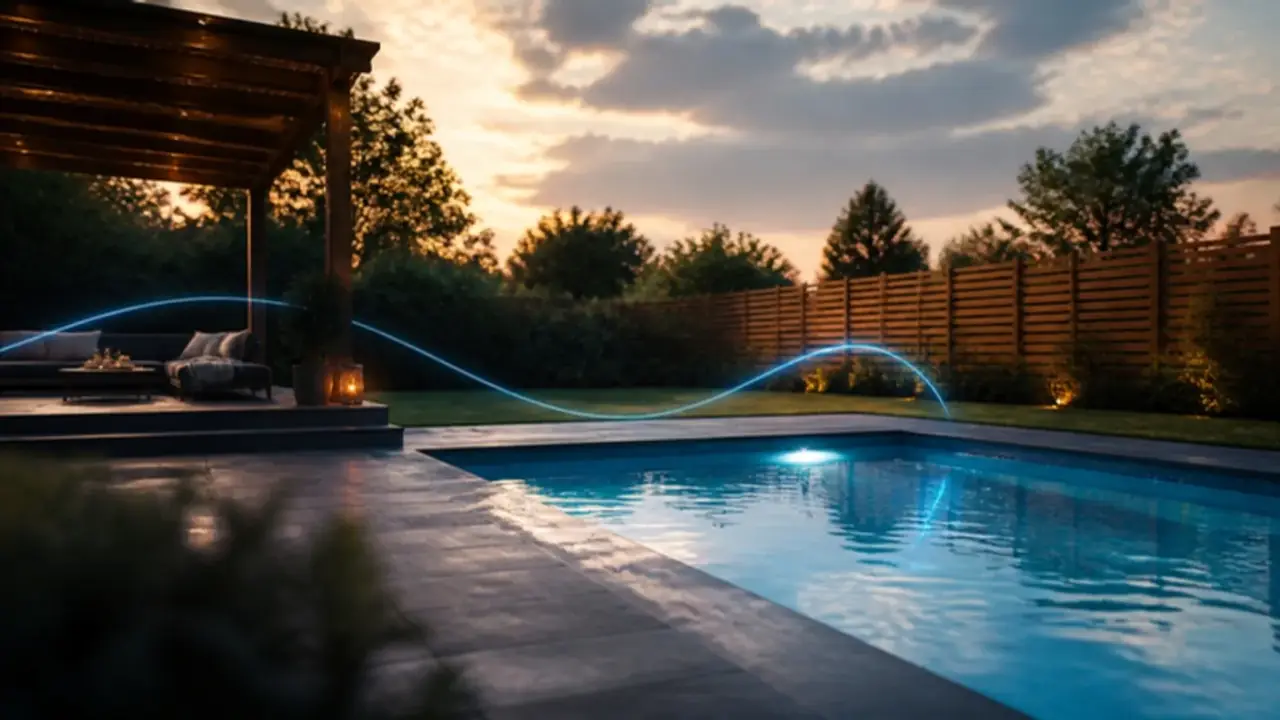
Law 169/2026 replaced Article 11 of Law 50/1991. Works with no formality at all, such as interior finishes, window replacement and demountable pergolas, are now in Article 299.
For some works, such as replacing a fence or converting an attic, a notification is enough: tacit approval after 15 working days, works start 15 calendar days later (Art. 294–296).
Whatever the permit route, the Civil Code requires at least 60 cm from the boundary for constructions and plantings, and 2 m for trees and windows that overlook the neighbour.
Villa additions without a permit: the short answer
Since 25 August 2026, Romania's building rules come from one law: the Code of Territorial Planning, Urbanism and Construction, Law 169/2026, published in Monitorul Oficial no. 661 of 10 August 2026. It repealed Law 50/1991 (Article 576(3)), so the old Article 11 list of "works without a permit" no longer applies.
The new code has three routes (Article 245(2)). Some works need a building permit. Some need only a prior notification to the town hall (Article 294). Some need no formality at all (Article 299). Interior renovation, solar panels and a demountable pergola are in the lightest route. A new pool, a real extension or a brand-new fence usually are not.
In plain words: the code tells you which route your work takes, but your plot's planning rules, your community's rules and your neighbour still have a say.
Our guide to building permits and the PUZ explains how to read a plot's planning documents. This article starts after handover, when the villa is yours and you want to improve it.
The three routes in the new code
| Route | What it means | Law 169/2026 |
|---|---|---|
| Building permit (autorizație de construire) | Planning certificate, approvals, project, permit | Art. 246, 249 |
| Notification (notificare) | A form, a simplified technical project signed by an architect or engineer, and the fees. Tacit approval after 15 working days; works start 15 calendar days later | Art. 294–296 |
| No formality | No permit, no notification | Art. 299 |
"No formality" does not mean "no rules". Planning and technical rules remain mandatory, the owner is liable together with the designer and builder, and the acceptance of the finished works must still be recorded (Article 299(3) to (5)).
Everything below applies outside protected built zones and the protection zones of historic monuments. Inside them, stricter rules apply (Articles 284 and 294(3)).
Interior renovation, windows and air conditioning
Article 299(2)(a) allows, with no formality: replacing interior finishes and floors (point 7) and interior doors (point 3); replacing exterior windows and doors if the shape and the size of the openings stay the same, even in a new material (point 4); repairing or replacing interior installations (point 9); and installing local heating, hot water systems and individual air conditioners (point 10).
Moving a non-structural wall goes through notification (Article 294(2)(b)(v)). Anything that touches the structure needs a permit.
Solar panels
Article 299(2)(a) point 13 allows photovoltaic panels on the house, on outbuildings or on the ground, for prosumers under Law 123/2012, and solar water heaters for your own use. No permit, but two conditions: prior notice to the town hall, and a structure that carries the panels, wind and snow.
For the economics and the grid connection, see our guide to solar panels on a villa.
Pergolas, terraces and garden sheds
- Demountable pergolas and exterior terraces inside your property: no formality (Article 299(2)(b) point 4). The same point covers retaining walls and ground-floor access steps.
- Small annexes in a rural locality: covered terraces, pergolas, summer kitchens, sheds and similar, up to 20 m² in total and 2.5 m high, without foundations, demountable, on a wood or metal structure: no formality (Article 299(2)(c)). You declare them for local tax (Article 299(12)).
- Up to 50 m² in total, foundations allowed: notification (Article 294(2)(a)(i)). This applies only in rural localities, and not in rural localities within metropolitan zones.
Many villa areas around Bucharest are communes. Whether yours counts as part of a metropolitan zone is a question for the town hall (primăria), in writing, through a planning certificate.
Under the code's definitions (Annex 1), pergolas do not count towards POT or CUT, unless the local planning regulation says otherwise.
The pool
A pool is not on the no-formality list. The code's definitions count pools among household annexes (anexe gospodărești), like garages and sheds. In practice:
- in a rural locality outside a metropolitan zone, a pool within the 50 m² annex limit can go through notification (Article 294(2)(a)(i) names pools);
- in all other cases, plan for a building permit.
That permit is lighter than for a house: no public health approval for household annexes (Article 267(2)(b)) and no environmental act for annexes not used for animals (Article 268(2)(b)). An uncovered outdoor pool is not counted in the floor area used for CUT (Annex 1).
The code tells you which route your work takes, but your plot's planning rules, your community's rules and your neighbour still have a say.
A seasonal above-ground pool is not addressed directly. Ask the town hall before you dig or pour anything.
Fences
| Fence work | Route | Article |
|---|---|---|
| Repair, same shape and materials | No formality | 299(2)(a) point 1 |
| New fence in place of an existing one, within the planning rules | Notification | 294(2)(b)(i) |
| A fence where there was none | Not on either list: assume a permit and confirm with the town hall | 246 |
Planning rules often set fence height and type on the street side. The planning certificate shows them.
Extensions, attics and the façade
A real extension needs a building permit. Some smaller changes go through notification under Article 294(2)(b): converting an existing attic without changing the volume or strengthening the structure (iii); a bathroom or technical room extension of up to 25 m² (x); remodelling non-load-bearing façade elements (vi); replacing the roof, or raising it by up to 0.5 m within the maximum height (ii); and energy renovation of a house with up to 3 levels (vii).
Repainting needs no formality only if you keep the façade elements and colours (Article 299(2)(a) point 5). A new colour is not on that list, so check the local rules.
POT, CUT and the planning certificate
Any extension must fit the plot's numbers. POT is the share of the plot covered by buildings. CUT is the total floor area on all levels divided by the plot area. Developers often build close to these limits, which can leave little room.
The planning certificate (certificat de urbanism) states them for your plot: land use, POT, CUT, buildable area, heights and alignments (Article 253(4)). Anyone may request one for information (Article 254). It gives no right to build, but it tells you what is possible before you pay an architect.
Rules on top of the law: your community and your neighbour
Community rules. In a gated community, rules can be stricter than the code. Law 196/2018 on homeowners' associations defines a residential ensemble (ansamblu rezidențial) as houses with both common and individual property (Article 2). Read the community regulation and your sale contract for limits on fences, colours, pools or roof equipment. See also our guide to gated community fees.
The Civil Code (Law 287/2009) applies whatever the route:
- constructions, works and plantings at least 60 cm from the boundary, unless the law or the planning regulation says otherwise; less needs the neighbour's agreement in an authenticated deed (Article 612);
- trees at least 2 m from the boundary, except trees under 2 m and hedges (Article 613);
- a window or balcony overlooking the neighbour at least 2 m away, or 1 m if not parallel to the boundary (Article 615);
- roof rainwater must not drain onto the neighbour's plot (Article 611);
- a wall or fence between two plots is presumed jointly owned (Article 660).
In a semi-detached villa the last rule matters most: anything attached to the shared wall (zid comun) involves your neighbour.
What it costs to get it wrong
Under Article 357(4), works without a required notification carry a fine of 5,000 to 50,000 lei; works without a required permit, 50,000 to 1,000,000 lei. Some works can be regularised later (Article 301), and for the code's first year other categories too, at ten times the normal fees. Until then the building tax rises by 100% (Article 301(11)). See our guide to annual property tax.
Before you build anything: 7 steps
- Check the zone. Protected built zone or near a historic monument? Then the easy routes do not apply as written.
- Check the locality. Commune or town, inside a metropolitan zone or not? This decides the 20 m² and 50 m² annex routes.
- Request a planning certificate for information. POT, CUT, heights and fence rules, in writing.
- Read your community regulation and contract. Limits on additions, colours, fences.
- Measure the distances. 60 cm from the boundary, 2 m for trees and for windows facing the neighbour.
- Pick the route. No formality, notification or permit. If the code is unclear, ask the town hall in writing.
- Keep the paperwork. Notification receipts, project, acceptance record. You will need them when you sell.
Frequently asked questions
Do I need a building permit for solar panels on my villa in Romania?
No. Under Article 299(2)(a) point 13 of Law 169/2026, prosumers can install panels on the roof, an outbuilding or the ground without a permit. You must notify the town hall beforehand, and the structure must withstand wind and snow.
Can I build a pool without a permit in Romania?
Usually not. A pool counts as a household annex. Only in a rural locality outside a metropolitan zone, within 50 m² of annexes in total, can it go through notification (Article 294(2)(a)(i)). Otherwise, plan for a permit.
Does a pergola need a permit in Romania?
A demountable pergola inside your property, outside protected zones, needs no formality (Article 299(2)(b) point 4). Its area does not count towards POT or CUT, unless the local regulation says otherwise.
Can I replace my villa's fence without a permit?
Repairs that keep the shape and materials need no formality. A new fence in place of the old one needs a prior notification (Article 294(2)(b)(i)). A fence where there was none is on neither list, so ask the town hall.
Is the old Article 11 of Law 50/1991 still valid?
No. Law 50/1991 was repealed when Law 169/2026 came into force on 25 August 2026. Works without a permit are now in Article 299, and the notification route is in Article 294.
The bottom line
The new code made small upgrades easier: solar, pergolas, interior work and small rural annexes. A pool, an extension or a new fence still go through the town hall in some form.
The order that saves money: planning certificate, community rules, neighbour distances, and only then an architect and a builder.
If you own a villa in Romania, or are about to buy one, book a 30-minute call with me. We will go through your plans and the questions to put to the town hall. For the legal side of your case, consult an independent lawyer.
Moti Azulay, Compass Group Romania
Sources: Law 169/2026, Code of Territorial Planning, Urbanism and Construction, Monitorul Oficial no. 661 of 10.08.2026 (PDF), Art. 245, 246, 253, 254, 267, 268, 294–299, 301, 357, 575, 576 and Annex 1 · Civil Code, Law 287/2009, consolidated form (legislatie.just.ro), Art. 611, 612, 613, 615, 660 · Law 196/2018 on homeowners' associations, Article 2 (text copy)
This article is for general information only and is not legal, tax or financial advice. The rules are correct as of 22 October 2026. Local planning regulations and community rules differ from place to place; ask the town hall for a planning certificate and consult an independent lawyer before you build.
Now you know more.
This article is general information, not legal, tax or financial advice. Consult local professionals before any transaction.

