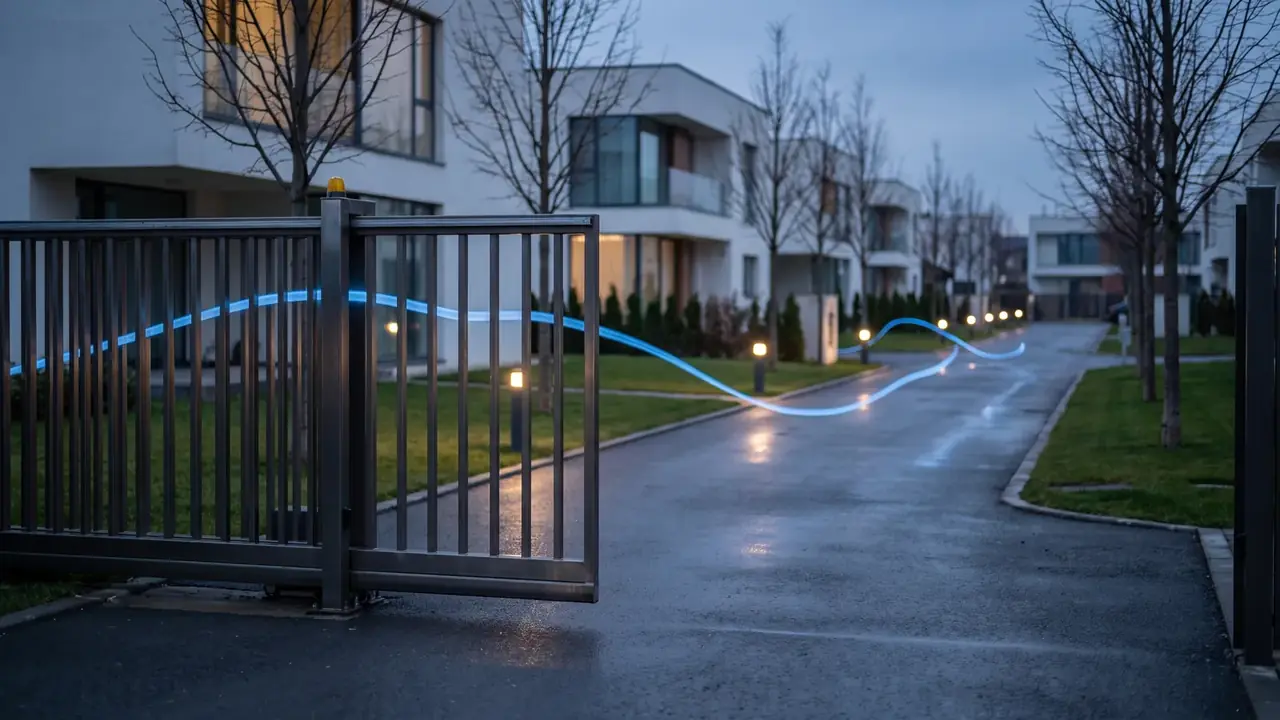
Article 646 of the Civil Code lists a shared road in a residential neighbourhood as forced co-ownership. Check the land register extract to see who it is registered to.
Article 3 of Law 196/2018 also applies it to a complex of detached houses with common property. There must be at least three units.
One management company publishes €15–25 per villa per month, with a contract minimum of €800 plus VAT.
Only if the general meeting decided on it, and only after 30 days: up to 0.2% a day, and no more than the debt itself.
Who manages in the first years, what the draft association rules say, and what the first-year budget is, line by line.
A gated villa community in Romania: the short answer
In Romania, a group of villas with a shared street, gate or landscaping is usually a "residential complex" under Law 196/2018, so the owners set up an owners' association (asociație de proprietari), elect a manager and share the costs. The private street itself is usually in forced co-ownership of the homeowners, under Article 646 of the Civil Code. Before you buy, ask to see who the street is registered to, the draft association rules and the expected annual budget.
In Israel, people are used to a house committee and a management company in an apartment building. A gated villa community is something else: there is no stairwell, but there is a road, lighting, a gate, drainage and landscaping. The question "how much does it cost?" matters, but the question "who decides?" matters more, because it determines what it will cost ten years from now.
Who owns the private street
This is the first question, and everything else follows from it. There are three main options:
| Structure | What it means | Who pays for upkeep | What to check |
|---|---|---|---|
| Co-ownership by the homeowners | Each homeowner holds a share of the street, attached to their house | The owners, by share | That your share of the street appears in your land register extract |
| The street stays with the developer, with a right of way | You have a right of use (servitute), not ownership | According to the agreement | That the right of way is entered in the land register, and what happens if the developer sells the street |
| The street was transferred to the local authority | It is no longer private | The authority | What this means for a gate, a barrier and security |
Article 646 of the Civil Code explicitly lists "a shared road in a residential neighbourhood" as an example of forced co-ownership. Under Article 647, each owner uses the street without interfering with the others' use, can sell their share only together with the house, and contributes to costs according to their share. Where there is no other agreement, the share is set by the size of the main property.
The question "who owns the street?" matters more than the size of the maintenance fee, because it determines who will decide on that fee.
When the owners' association law applies to villas
Law 196/2018 was written mainly for apartment buildings, but its Article 3 also applies it to a "residential complex" (ansamblu rezidențial): detached, terraced or semi-detached houses that share common property alongside private property. Under the law's definitions, there must be at least three units.
In other words, as soon as there is a shared street, gate or system, the law is relevant. Among other things, it provides:
- The general meeting takes decisions when a majority of members are present, in person or through a representative (condominii.blog).
- The manager needs a certificate of qualification (atestat), or management is handed to a company.
- Payment of maintenance fees within 30 days of the payment list being posted.
- A late-payment penalty only if the general meeting has decided on one, and only after 30 days: up to 0.2% a day, and no more than the debt itself (avocatnet.ro).
What you pay for in a villa community
There is no stairwell and no lift, so the cost lines are different:
- Management: a manager or management company, bookkeeping, collection.
- Street and gate lighting: electricity and maintenance of the electric gate and the intercom.
- Road and drainage: cleaning, asphalt repairs, clearing ditches, and snow clearance in winter.
- Shared landscaping: the entrance, verges, green areas.
- Security: cameras, and in some communities a guard. This can be the heaviest line in the budget.
- A repair fund: money collected in advance for major works.
What is not included: the local property tax, home insurance, and the house's own electricity and water bills. Those are yours, separately. We listed them in the guide to a villa's annual upkeep costs.
What it costs: one reference point
There is no official price list, and the price depends heavily on the services. As a reference point, a management company in Bucharest and Ilfov publishes a price list for managing villa communities:
The question "who owns the street?" matters more than the size of the maintenance fee, because it determines who will decide on that fee.
| Community size | Management fee per unit per month |
|---|---|
| Up to 20 villas | €15 |
| 20 to 50 villas | €20 |
| Over 50 villas | €25 |
| Contract minimum | €800 a month, plus VAT |
Note the last line. In a community of 30 villas, €20 per unit is €600 a month, below the minimum, so in practice the contract will be at least €800, about €27 per house before VAT. In a small community, the management company's minimum sets the price, not the number of houses.
And that is only management. Security, landscaping and road maintenance come on top. The price list is undated, so ask for a current quote.
Who decides, and how not to end up in the minority
Once the association exists, decisions are taken at the general meeting. That is good, because no one decides alone. It is also the risk: if most owners want a 24-hour guard, those who did not want one will pay as well.
Three questions that protect you:
- Who manages in the first years? Sometimes the developer manages while houses are still being handed over. Ask when and how management passes to the owners.
- What does the draft of the association rules say? How costs are split: equally, or by plot or house size.
- What is the budget for the first year? In writing, line by line, not "roughly this much a month".
What to ask to see before you buy
- A land register extract for the street from the land registry (ANCPI): who it is registered to, and whether your share appears in the extract for the house. On reading an extract, we wrote here.
- A registered right of way, if the street is not owned by you.
- A draft of the association rules and a first-year budget.
- A management contract if a company has already been chosen, including the term and exit conditions.
- Who maintains the infrastructure up to the connection to the public network: pipes, drainage and street lighting.
Honestly: who a gated community suits, and who it suits less
It suits families with young children, people who live there part of the year and want someone keeping an eye on things, and people who prefer a quiet street with no through traffic.
It suits less people who dislike shared decisions, people who want full control over every euro, or people planning a facade renovation that needs approval under the community's rules. And also: the more services there are, the higher the monthly cost, and it does not disappear when market prices fall.
Frequently asked questions
Does Law 196/2018 apply to a villa community?
Under Article 3 of the law, it also applies to a residential complex of detached, terraced or semi-detached houses that share common property. The law's definitions require at least three units.
Who owns the private street in the community?
It depends on the registration. It is usually in forced co-ownership of the homeowners, under Article 646 of the Civil Code, but it can stay with the developer with a right of way, or be transferred to the local authority. Check the land register extract.
How much does managing a villa community in Romania cost?
There is no official price. One management company in Bucharest and Ilfov publishes €15 to €25 per villa per month, with a contract minimum of €800 a month plus VAT. Security, landscaping and road maintenance come on top.
What happens if a homeowner does not pay?
If the general meeting has decided on it, the association can charge a late-payment penalty after 30 days, up to 0.2% a day and no more than the debt itself, and pursue collection by the means the law allows.
Who manages the community before all the houses are handed over?
This is set in the contract and in the developer's arrangements. Ask for it in writing: who manages during the interim period, who pays for what, and when management passes to the owners' association.
The bottom line
A gated community is more than a gate. It is a street with an owner, an association that takes decisions and a budget that changes over the years. Those who check all three before signing know what they are buying.
I will mention it once: Compass on the Lake is 29 villas on a private street, Strada Lacului, so these are exactly the questions worth asking us too, and getting answered in writing. If you are considering a gated community, ours or any other developer's, book a 30-minute call with me and we will go through the documents together. On the day-to-day management of the house itself, read our article on who will manage your property.
Moti Azulay, Compass Group Romania
Sources and data: Law 196/2018, Article 3 (condoflow.ro) · Law 196/2018, text (condominii.blog) · Romanian legislation portal · Civil Code, Articles 646–647 · Civil Code, Article 755 (servitude) · avocatnet.ro: late-payment penalties under the associations law · Bloc Expert: price list for managing villa communities · National Agency for Cadastre and Land Registration (ANCPI).
This article is for general information only and is not legal, tax or financial advice. The prices mentioned are from a single provider, undated, and are given as a reference point only. Correct as of October 2026; before buying, check the registration and the association rules with a Romanian lawyer.
Now you know more.

This article is general information, not legal, tax or financial advice. Consult local professionals before any transaction.