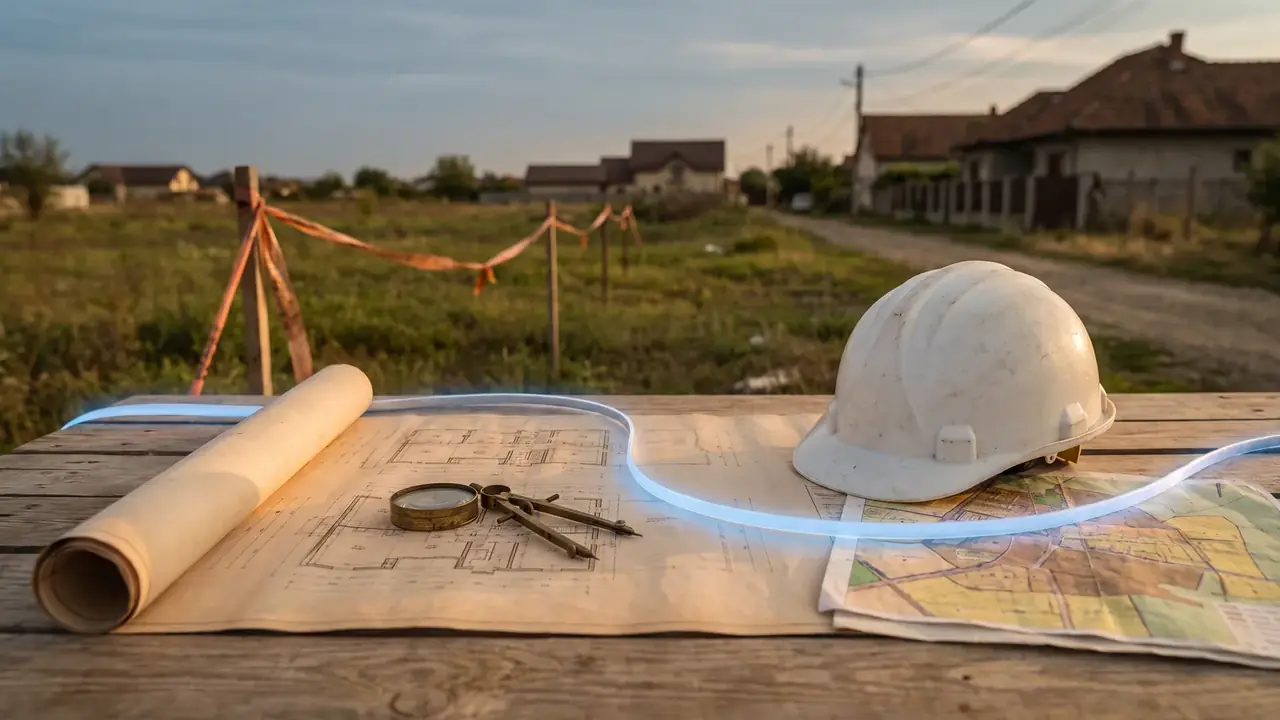
Law 169/2026 came into force on 25 August 2026 and repealed Law 50/1991 and Law 350/2001. An old checklist checks against a repealed law.
Under the new code a building permit is valid for 3 years from issue, and is extended for the whole construction period after notice of start of works.
When a PUZ changes existing rules, the increase in POT and CUT is limited to 20%, and in protected areas to 10%.
Within 30 days of a permit being issued, its details are published: POT, CUT, distances, height, site plan and elevations.
Developers and contractors must hold 10-year liability insurance for defects after acceptance, and present it at the start of construction.
Building permits in Romania: the short answer
In Romania you check three documents: the planning certificate (Certificat de urbanism), which sets out what may be built on the plot; the building permit (Autorizație de construire), which allows actual construction; and the plans above them, the PUG for the whole locality and the PUZ for a specific area. As of October 2026 a new planning code applies, Law 169/2026, from 25 August 2026. You can request an information planning certificate for any plot, even one that is not yours, and lists of permits are published on the authority's website.
I hear the question "what will be built opposite me?" on almost every viewing. It is a good question, because the view, the quiet and the parking on the street depend less on the house you buy and more on the plots around it. The good news: in Romania you can check this yourself, in official documents.
What changed in 2026: a new planning and building code
On 10 August 2026, issue 661 of the Monitorul Oficial published the Code of Territorial Planning, Urbanism and Construction (Law 169/2026), which came into force on 25 August 2026. It repealed the two laws the field had relied on for thirty years: Law 50/1991 on building permits and Law 350/2001 on planning and urbanism.
Why does this matter to you? Because guides written before August 2026 quote validity periods, deadlines and procedures that have since changed. Anyone checking a project in Romania today with an old checklist is checking it against a repealed law.
Alongside this, some reassurance: under the transitional provisions (Article 582), planning certificates issued before the code keep their validity, and permits granted under the previous law were not cancelled and remain valid on the terms of that law, according to a summary by AICPS. A project that received a permit in 2025 did not become illegal overnight.
The three documents, and what each tells you
| Document | What it is | Validity under the new code | What to check in it |
|---|---|---|---|
| Information planning certificate (Certificat de urbanism pentru informare) | A planning snapshot of the plot | General information, for any applicant | Land use, POT, CUT, permitted height, utilities |
| Planning certificate for construction | The conditions and approvals required for a specific project | 12 to 36 months, extendable by up to 24 months | That the project matches the plan |
| Building permit (Autorizație de construire) | Permission to actually build | 3 years from issue, extended for the whole construction period after notice of start of works | Number, date, areas, storeys, site plan and elevations |
The definitions and deadlines are taken from Articles 253, 254, 257 and 309 of the code. Note: under Article 309, extending the permit's validity before construction starts is prohibited. If works have not started within three years, the permit lapses.
The planning certificate does not give a right to build. It only tells you what is allowed. Someone who shows you an "approval" and means a planning certificate has not yet shown you a permit.
PUG, PUZ and PUD: three levels of planning
- PUG (Plan Urbanistic General): the general plan of the locality. It sets which areas are designated for housing, commerce or green space, and the boundary of the built-up area (intravilan).
- PUZ (Plan Urbanistic Zonal): a plan for a specific area, which can detail and change the PUG rules. The new code sets a cap: when a PUZ is meant to change existing rules, the increase in the land coverage ratio (POT) and the floor area ratio (CUT) is limited to 20%, and in protected areas to 10% (Article 66 of the code).
- PUD: under the new code this is now a "detailed urban project", a tool at the level of a single plot.
Two terms worth remembering: POT is the percentage of the plot that may be covered by buildings, and CUT is the ratio between the total built area on all floors and the plot area. If the empty plot opposite is marked in a zone with a high CUT, more will probably be built there than you imagine.
How to check it yourself: five steps
- Locate the plot. Using the cadastral number from the extract, on the ANCPI geoportal. On reading the extract, see our guide to the land register extract.
- Open the PUG. Many authorities publish it on an online map. In Balotești, for example, the commune's GIS portal shows the general plan, and the town hall website publishes notices of intention to prepare a new PUZ.
- Request an information planning certificate. Under Article 254, anyone may request it; it is issued within 10 working days where the authority has no computerised system, and 5 days where it does. It includes land use, POT, CUT, permitted height and utilities.
- Check the permit lists. Under Article 314, the list of planning certificates is updated monthly on the authority's website, and within 30 days of a permit being issued its details are published: number, POT and CUT, distances from the plot boundaries, areas, height, site plan and elevations.
- Look on site and on the extract. Before works begin, the developer must register the permit in the land register, publish it in a newspaper and put up a project identification board on site. No board? Ask why.
An off-plan project: what to ask the developer for
When you buy a house that has not yet been built, the check has two parts: the legality of the project itself, and what will go up around it.
- A copy of the permit with all its annexes, including the site plan. Compare the number of storeys and the areas with what is shown in the presentation.
- Notice of start of works. The construction period is counted from it.
- The ten-year insurance. Under Article 556 of the code, developers and contractors must hold 10-year civil liability insurance for defects that appear after acceptance, and present it at the start of construction. Ask to see the policy.
- The completion acceptance report (recepție la terminarea lucrărilor). Under Article 280, construction that has not passed acceptance is not considered complete. This is the document that opens the way to registering the house in your name. For what happens on handover day, see our guide to handover of a new home.
For checking the developer itself, beyond the permit, I wrote a separate guide to checking a Romanian developer.
The right question is not "will anything be built next to the house", but "what does the plan allow to be built there".
"Will they build a block in front of my view?" The scenario and the counter-scenario
The worrying scenario: an empty plot opposite the house, in an area where the plan allows tall buildings, and nobody told you. This happens mainly when people buy from a presentation rather than from the plan.
The counter-scenario: an area where the PUG allows only low-rise private houses, with a low POT. There, even if the plot opposite is built on, what goes up will be a house similar to yours. The new code also limits the ability to inflate rights through a PUZ.
The right question is not "will anything be built next to the house", but "what does the plan allow to be built there". The answer to the second question can be obtained in writing.
In Israel it is an "information file", in Romania a Certificat de urbanism
Anyone who has built or renovated in Israel knows the idea: before a permit, you request planning information from the local planning committee. In Romania the logic is similar, with two differences that work in your favour: the information planning certificate is open to anyone, and the code requires the details of permits granted to be published. The difference that works against you: some documents are available only in Romanian, so it is worth having a local lawyer or architect read them with you.
I will mention it once
In our project, Compass on the Lake, 29 villas on a private street by the lake in Balotești, ask to see the permit and the plan before the contract. That is how you should work with any developer, and if someone hesitates to show you, that is already an answer. For the broader legal checks, see what to check before signing.
Frequently asked questions
What is the difference between a Certificat de urbanism and an Autorizație de construire?
The planning certificate is an information document: it sets out what may be built on the plot and which approvals are required, and it does not allow construction. The building permit is the permission itself. Under the new code it is valid for three years from issue, and is extended for the whole construction period after notice of the start of works.
Can I request a planning certificate for a plot that is not mine?
Yes. Under Article 254 of Law 169/2026, an information planning certificate is issued to any person or company wishing to know what applies to the plot, and its content is the same for all applicants. You attach a cadastral number, or a location plan if the plot is not registered.
What is a PUZ, and why does it matter to a buyer?
A PUZ is a zonal plan that details or changes the rules of the locality's general plan. It can allow denser or taller construction. Under the new code, when a PUZ changes existing rules, the increase in POT and CUT is limited to 20%, and in protected areas to 10%.
The project's permit was granted before the new code. Is it still valid?
Yes. The code's transitional provisions (Article 582) state that earlier planning certificates keep their validity, and permits granted under the repealed Law 50/1991 remain valid on the terms of that law. What is worth checking is that works started on time and that the permit has not lapsed.
How do I know the house was built according to the permit?
At the end of construction an acceptance report is drawn up with a representative of the authority that issued the permit. Under the code, construction without acceptance is not considered complete, and construction that deviated from the permit cannot pass acceptance. Ask to see the report before handover.
The bottom line
In Romania you can know in advance, and from official documents, what may be built on your plot and on the plots around it. Since 25 August 2026 this is done under a new code, so it is worth checking that whoever advises you knows it.
If you are considering a home in Romania and would like to go through a permit, a plan or a neighbourhood map together, ours or any other project, book a 30-minute call with me. We will go through the documents and build a list of questions for your lawyer.
Moti Azulay, Compass Group Romania
Sources and data: Code of Territorial Planning, Urbanism and Construction, Law 169/2026, Monitorul Oficial 661 of 10.08.2026 · AICPS: the code came into force on 25.08.2026 · Petcu & Partners: what changes in the 2026 code · JURIDICE.ro: the new code · ANCPI geoportal · Balotești town hall · Balotești GIS portal · Law 50/1991, last version before repeal (OAR).
This article is for general information only and is not legal, tax or financial advice. The new code came into force in August 2026 and its implementing rules are still being updated. Before buying, ask a local lawyer or architect to check the documents for the specific property.
Now you know more.

This article is general information, not legal, tax or financial advice. Consult local professionals before any transaction.