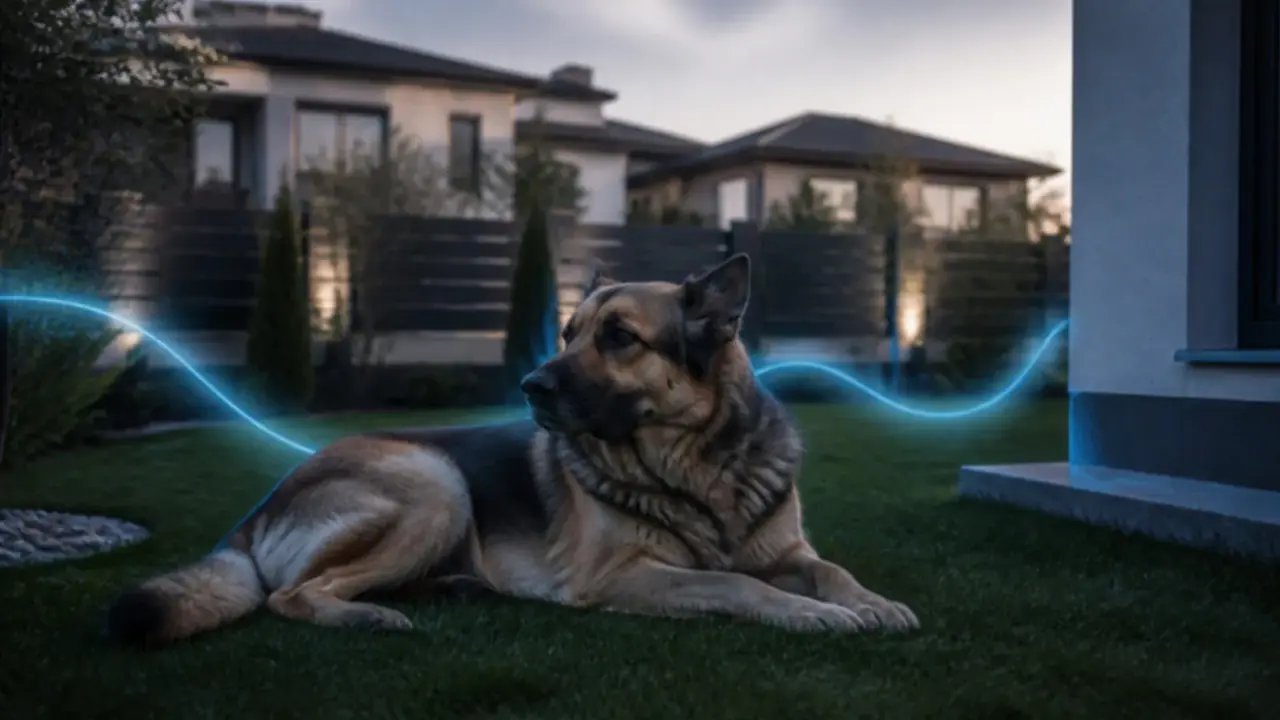
Every owned dog is microchipped and registered in RECS by a vet. The register is run by the College of Veterinary Physicians.
OUG 55/2002 requires a muzzle and leash in public places and common areas, plus a police declaration and a "dangerous dog" sign.
The EU regulation published on 10 August 2026 requires a microchip and registration for dogs and cats, with transition periods for owners.
Pets in a villa community: the short answer
For many families, the garden is one of the main reasons to move to a villa, and the dog is the first to enjoy it. Romanian law has a few clear rules, though. Every owned dog is identified by microchip and registered in the national register of owned dogs (RECS), run by the College of Veterinary Physicians. Mixed-breed and common-breed dogs must be neutered. And for breeds classed as dangerous, OUG 55/2002 adds duties: a muzzle and leash in common areas and on public roads, a declaration to the police and, for Pit Bull, Boerbull or Bandog types, neutering and liability insurance.
For cats, we found no national microchip requirement in Romania when we checked. That is changing at EU level: Regulation (EU) 2026/1818 introduces identification and registration of dogs and cats across the Union, with transition periods.
In plain words: microchip and RECS for the dog, rabies vaccination up to date, neutering if it is a mixed breed, and for a Cane Corso, a Rottweiler or a Caucasian Shepherd, a muzzle and leash outside the garden. The rest is common sense and the community's rules.
Bringing a pet from Israel, with the microchip, rabies vaccine and titre test, is covered in our guide to moving to Romania with belongings and pets. This article is about life after you arrive.
The rules at a glance
| Topic | The rule | Basis |
|---|---|---|
| Identification | Microchip for every owned dog, registered in RECS by a vet | OUG 155/2001; ANSVSA Order 1/2014 |
| Neutering | Compulsory for common-breed and mixed-breed dogs, except for medical reasons | OUG 155/2001 |
| Dangerous breeds, category I | Pit Bull, Boerbull, Bandog types and crosses: neutering, insurance, no access to public venues | OUG 55/2002, art. 1, 4, 6, 10 |
| Dangerous breeds, category II | e.g. Rottweiler, Cane Corso, Caucasian Shepherd: muzzle and leash in public places and common areas | OUG 55/2002, art. 1, 6 |
| Welfare | Shelter, food, water, exercise, care and veterinary care | Law 205/2004, art. 5 |
| Cats | No national microchip duty found; an EU rule is coming | Regulation (EU) 2026/1818 |
The microchip and RECS
The microchip is a small device with a unique code, implanted under the skin and read with a scanner. Only a licensed private vet implants it, writes the number in the health booklet or passport, and registers the dog in RECS. The register is run by the College of Veterinary Physicians (CMV).
Practical points for a family arriving from abroad:
- A dog from Israel already has an ISO microchip, implanted before the rabies vaccine under the EU travel rules. Ask a Romanian vet to register that chip in RECS with your Romanian address and phone number.
- If the dog gets lost: the CMV's RomPetID portal lets you look up register data by microchip number.
- The fine: under OUG 155/2001, art. 14(1)(b), as quoted in local regulations, failing the identification, registration and neutering duties is fined 5,000 to 10,000 lei.
Neutering mixed-breed dogs
Common-breed and mixed-breed dogs must be neutered, unless their health does not allow the operation, in which case the vet records the reason. Pedigree dogs with recognised papers are outside this rule. Some local councils run free or subsidised neutering campaigns for registered dogs; ask the town hall of the commune you move to.
Dangerous breeds: OUG 55/2002
The ordinance divides dangerous dogs into two categories:
| Category I | Category II | |
|---|---|---|
| Breeds | Fighting and attack dogs of the Pit Bull, Boerbull and Bandog type, and their crosses | American Staffordshire Terrier, Tosa, Rottweiler, Dogo Argentino, Neapolitan Mastiff, Fila Brasileiro, Mastiff, Caucasian Shepherd, Cane Corso and their crosses |
| Public places and venues | Banned, except public roads | Allowed with muzzle and leash |
| Common areas and roads | Only with muzzle and collar with leash, or harness; may not be left in common areas | Only with muzzle and leash |
| Neutering | Compulsory, male or female | Not required by OUG 55/2002 |
| Liability insurance | Compulsory | Not required by OUG 55/2002 |
| Import and sale | Banned | Allowed |
Duties for both categories:
The law asks for little, but clearly. The rest is a good fence and happy neighbours.
- the owner is at least 18, has full legal capacity and has no conviction for a crime against a person;
- the dog is registered with the Romanian Kennel Association, and a "dangerous dog" sign of at least 15 x 25 cm is placed at the entrance or on the fence;
- the owner files with the local police a certificate from the Kennel Association and a sworn declaration with the microchip number and rabies vaccination;
- after a move, these documents go to the police at the new address within 48 hours.
This matters in villa areas: the Caucasian Shepherd and the Cane Corso, breeds sometimes chosen to guard a garden, are both in category II. And if a dog attacks a person because the owner did not take the precautions in article 6, it is a crime, punishable by 6 months to 3 years in prison or a fine (art. 12).
What is coming for cats
Regulation (EU) 2026/1818 on the welfare of dogs and cats and their traceability was published in the EU Official Journal on 10 August 2026. According to the Federation of Veterinarians of Europe, it requires all dogs and cats to be identifiable by microchip and registered in interoperable national databases. For private owners, the deadlines are long, and the exact application dates should be checked in the published text. In practice, if you have a cat, chip it now: it is simple, and it helps if the cat wanders out of the garden.
Choosing a vet in north Bucharest
We do not recommend specific clinics, but a few criteria help:
- Check that the vet and the practice are registered with the College of Veterinary Physicians.
- Ask whether they can implant a chip and register it in RECS on the spot.
- Find the nearest 24-hour unit; the College publishes a list of non-stop units on its site.
- Ask about home visits, useful for a large dog or several animals.
- Ask whether someone at the practice speaks English, if you need it.
- Keep the health booklet, with vaccinations and parasite treatments, in one place.
Life in the community: written and unwritten rules
In a gated villa community, the law is only the base. The community's or owners' association rules set the rest, and they are worth reading before you sign:
- Common areas: dogs are usually walked on a leash on shared paths, and owners clean up after them.
- Noise: persistent barking, especially at night, is the most common source of disputes between neighbours.
- The fence: a dog that jumps the fence or slips under the gate is your responsibility; under art. 1375 of the Civil Code, the owner is liable for damage caused by the animal.
- Security staff: if the community has guards, tell them you have a dog and what it looks like.
We covered community fees and rules in our article on gated community fees and management, and fences, gates and garden safety in our guide to villa security in the Bucharest suburbs.
A moving checklist
- Check the microchip and update RECS with your new address.
- Bring the rabies vaccination and parasite treatment up to date.
- If the dog is a mixed breed and not neutered, book the operation or ask about the council's campaign.
- If it is a breed listed in OUG 55/2002, prepare the police declaration, the sign and a muzzle.
- Read the community rules before you sign.
- Check the fence, the gate and any gap the dog could use.
- Chip the cat as well.
- Find a vet near the house and the nearest 24-hour unit.
Frequently asked questions
Is a microchip compulsory for dogs in Romania?
Yes. Owned dogs are identified by microchip and registered in RECS by a vet. Failing the identification, registration and neutering duties carries a fine of 5,000 to 10,000 lei under OUG 155/2001.
Do I have to neuter my dog?
If it is a common breed or a mixed breed, yes, except for medical reasons recorded by the vet. Pedigree dogs are outside this rule. For Pit Bull, Boerbull and Bandog types, neutering is compulsory under OUG 55/2002.
Is the Caucasian Shepherd classed as dangerous in Romania?
Yes. OUG 55/2002 lists it in category II, with the Cane Corso, the Rottweiler and other breeds. In public places and common areas it must wear a muzzle and be on a leash, and the owner files a declaration with the police.
Does my cat need a microchip?
When we checked, we found no national requirement for cats. Regulation (EU) 2026/1818 will require a microchip and registration for cats too, with transition periods for private owners.
Who is liable if my dog causes damage?
The owner, under the Civil Code (art. 1375). If a dangerous dog attacks a person because the owner did not take the measures the law requires, it is a crime, punishable by 6 months to 3 years in prison or a fine.
The bottom line
A dog in a villa in Ilfov usually has a better life than in a flat. The law asks for little, but clearly: microchip and RECS, vaccination, neutering for mixed breeds and strict rules for the dangerous breeds. The rest is a good fence and happy neighbours.
If you are considering a villa with a garden in north Bucharest, with us or elsewhere, book a half-hour call with me. We will talk about the garden, the fence and daily life with pets too.
Moti Azulay, Compass Group Romania
Sources: OUG 55/2002 on keeping dangerous or aggressive dogs, republished (legeaz.net) · Law 205/2004 on animal protection, art. 5 (legeaz.net) · Satu Mare local regulation, HCL 257/2023, citing OUG 155/2001, HG 1059/2013 and ANSVSA Order 1/2014 · RomPetID, College of Veterinary Physicians: RECS lookup · European Parliament, adopted text on Regulation (EU) 2026/1818 · FVE on the new EU pet welfare and traceability rules
This article is general information only and is not legal, tax or financial advice. Rules are current as of 22 October 2026. Local and community regulations can add obligations; check them with the town hall and the community management.
Now you know more.

This article is general information, not legal, tax or financial advice. Consult local professionals before any transaction.

