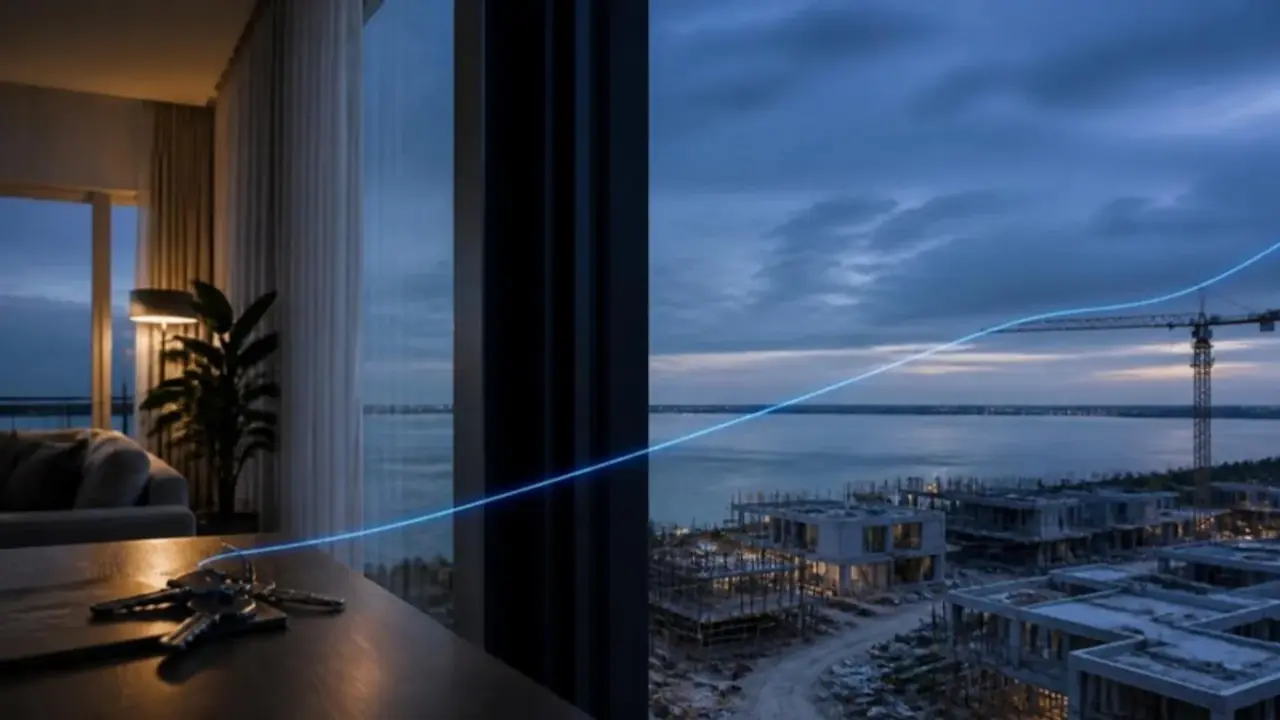
Control and exposure, what you check, capital and financing, timeline, team, regulation, exit and emotional load.
Local lawyer, architect, engineer, contractor, accountant and agent. An investor mainly needs an independent lawyer.
Under Law 169/2026, a preliminary contract with a buyer is signed only after the building permit is noted in the land register (Article 422(6)).
Economic feasibility, a planning and physical check, and a legal check. A deal that fails one of them is rejected.
Investor or developer: the short answer
An investor buys a finished product, or a product someone else commits to finish. A developer builds the product themselves. The difference sounds small, but it changes almost everything: what you check, how much capital you need, how long your money is tied up, who works for you, and who is responsible when something goes wrong.
As an investor, your main risk is the developer. As a developer, you are the risk. There is no one else to blame.
Put simply: real estate development abroad is not "a bigger investment". It is a different profession.
The 7 differences at a glance
| # | Topic | Investor | Developer |
|---|---|---|---|
| 1 | Control and exposure | Little control, exposure limited to the property you bought | Full control, exposure to the whole project |
| 2 | What you check | The property, the developer and the contract | The land, the permit, the contractor, the market and the financing |
| 3 | Capital and financing | Equity and a mortgage on one property | Equity for the land and the design, and financing for construction |
| 4 | Timeline | From signing to handover | From finding the land to selling the last unit |
| 5 | Team | An independent lawyer, and sometimes an agent | A whole hive: lawyer, architect, engineer, contractor, accountant, agent |
| 6 | Regulation | A law that protects you as a buyer | A law that places duties on you as a seller |
| 7 | Exit and emotional load | You sell one property, when it suits you | You sell a project, when the market decides, and carry every decision |
The 7 differences, one by one
1. Control versus exposure
As an investor, you choose a property, sign and wait. Almost every decision is made by someone else: the design, the contractor, the materials, the pace of work. That is limiting, but it also protects you. If something gets stuck, you have a contract and someone to hold to it.
As a developer, the decisions are yours. You decide what gets built, how and when. That control is also the exposure: every wrong decision costs you, and there is no developer above you to sue.
2. What you check: a property versus land, a permit and a contractor
An investor checks an existing or planned property: the land register extract, the permit, the contract, and who the developer on the other side is. We gathered these questions in the questions to ask a developer before you sign.
A developer checks one layer deeper. What may be built on the land, and what the local authority will actually require. Who the contractor is, and what they have delivered before. And who will buy what you build.
Attorney Ilan Leibovitch writes in his weekly column that buying a home to live in is nothing like buying a plot to build on, and that knowing the specific field you work in lowers the risk of mistakes.
3. The capital and financing profile
An investor finances one property: equity, and sometimes a mortgage. The amount is known in advance, and so is the payment schedule.
A developer finances stages. First the land and the design, when there is usually no income yet. Then construction, when you need funds available even when something is delayed. So a developer's first question is not "how much does it cost?", but "what happens to the cash flow if the timeline gets longer?"
In Romania this also has a legal side. Since 25 August 2026, under Law 169/2026, a developer cannot sign a preliminary contract with buyers before the building permit has been noted in the land register (Article 422(6)). What this means for a developer: the stage before the permit is financed without buyers' money.
4. The timeline
For an investor, the clock starts at signing and ends at handover, or at the sale.
For a developer, the clock starts much earlier: finding land, checks, design, the permit process, construction, marketing and handover. Most stages depend on authorities and other people, so a developer's timeline needs room for delays, not just target dates.
Real estate development abroad is not "a bigger investment". It is a different profession.
5. The team: the hive
A careful investor mainly needs an independent lawyer who works only for them.
A developer needs a whole team in a foreign country: a local lawyer, an architect, an engineer, a contractor, an accountant or tax adviser, and an agent who knows the buyers. Ilan calls this team "the hive". As he writes:
"The professional hive that surrounds the developer is an important part of the project's success." Adv. Ilan Leibovitch, from his weekly column
In one of his columns he tells of an investor who had bought more than 10 apartments in several countries, and then decided to buy a 3-storey house and convert it into 6 apartments. He chose to work with the professionals the agent brought in, because they were cheaper. When the works were finished, the municipality refused to issue an occupancy certificate, because the parking spaces required by the building permit had not been arranged. We took the full story apart, and what would have caught it in advance, in the analysis of the 6-apartment deal. Ilan's conclusion from that column: you do not judge professionals only by price, because "what comes cheap ends up costing dear".
6. Exposure to regulation
As an investor, the law works for you. In Romania, for example, Law 169/2026 provides that a reservation agreement with a developer lasts at most 60 days, and the reservation payment cannot exceed 5% of the price (Article 422(9)).
As a developer, the same article works the other way. It does not protect you. It defines what you may do, when you may sell, and which duties you owe buyers. A developer who does not know these rules before starting will discover them halfway through.
7. The exit and the emotional load
An investor can decide when to sell one property. A developer has to sell a whole project, when the market decides, and often before construction is even finished.
And there is the side that does not appear in the business plan. An investor gets an update. A developer gets a phone call at seven in the morning about a problem on site, and decides. Ilan writes that in a foreign country the gaps in language, culture and familiarity with regulation increase the pressure, and that a developer's ability is measured by their ability to adapt and to lean on the team that supports them.
Signs you are ready to switch sides
- You have already bought property abroad, and you understand what a contract, an extract and a permit look like.
- You have equity you can leave tied up for several years without it changing your life.
- You are ready to come to the site, more than once.
- You are ready to pay good professionals, even when there is a cheaper offer.
- You can say "no" to a deal you love when it fails the checks.
Signs you are not there yet
- You are looking at development because it sounds like a faster route.
- You expect someone else to check the land and the permit for you.
- Your timeline leaves no room for delay.
- You do not yet have a local lawyer who works only for you.
- The decision has already been made, and now you are only looking for approval.
How to check a deal before you switch sides
In the method we work with, every deal passes three filters, in order: economic feasibility, with a conservative business plan that includes every expense. A planning and physical check of the site: what may be built and who will build it. And a legal check of the land, the registration and the charges. A deal that fails one of the filters is rejected, before anyone gets on a plane.
If you are weighing your first development deal abroad, book a 30-minute call with me. We will go through your deal and the questions to put to your lawyer. Before that, run the deal through the three filters in our free deal check.
The guide for developers abroad, in five parts
This article is part of a series on moving from investing to real estate development abroad:
- Checking land in Romania before you buy it for development
- A Romanian company (SRL) for a foreign developer: the structure
- A building permit in Romania for developers, step by step
- Off-plan sales and the developer's cash flow in Romania
Frequently asked questions
What is the difference between a real estate investor and a developer?
An investor buys a property that someone else designed and built. A developer finds land, designs, builds and sells, and carries responsibility for every stage. So the developer checks more, finances in stages and is more exposed to delays and regulation.
How do you become a real estate developer abroad?
You start from your experience as an investor, choose one country and one field, and build a local team before buying land. Every first deal passes an economic, planning and legal check, and only then do you commit.
Can you be a developer abroad without living there?
You can, but not without coming over. Ilan recommends in his column that you fly out and see the plot with your own eyes, and not rely only on what you are shown. The local team does the day-to-day work, and you make the decisions.
Can a developer in Romania sell apartments off-plan?
Only under conditions. Under Law 169/2026, in force since 25 August 2026, a preliminary contract with a buyer is signed only after the building permit has been noted in the land register (Article 422(6)). We gathered more questions from investors and developers in the questions from Ilan's column.
Do you need experience as an investor before moving into development?
It helps a lot. Someone who has already bought property abroad knows the contracts, the registration and the way developers work. Even so, experience as an investor does not replace experience in design and construction. That is what the hive is for.
The bottom line
Moving from investor to developer is not a jump in deal size. It is a move from the buyer's side to the side that builds, sells and is responsible. Control grows, and so does exposure.
Those who switch sides in an orderly way choose one field, build a hive before buying land, and put every deal through three filters. And those who are not there yet have lost nothing. You can keep investing, and look at the developers across the table with a developer's eyes.
Moti Azulay, Compass Group Romania
Sources: Law 169/2026, Planning and Construction Code, Article 422: summary of the law on the Compass Group Romania site · Law 169/2026 (Monitorul Oficial no. 661, 10.8.2026) · Attorney Ilan Leibovitch, weekly column "2 international real estate stories a week", 16.3.24
This article is for general information only and is not legal or investment advice. The rules are correct as of 18 October 2026. Before any decision on an investment or a project, consult a lawyer and a tax adviser who work only for you.
Now you know more.
This article is general information, not legal, tax or financial advice. Consult local professionals before any transaction.

