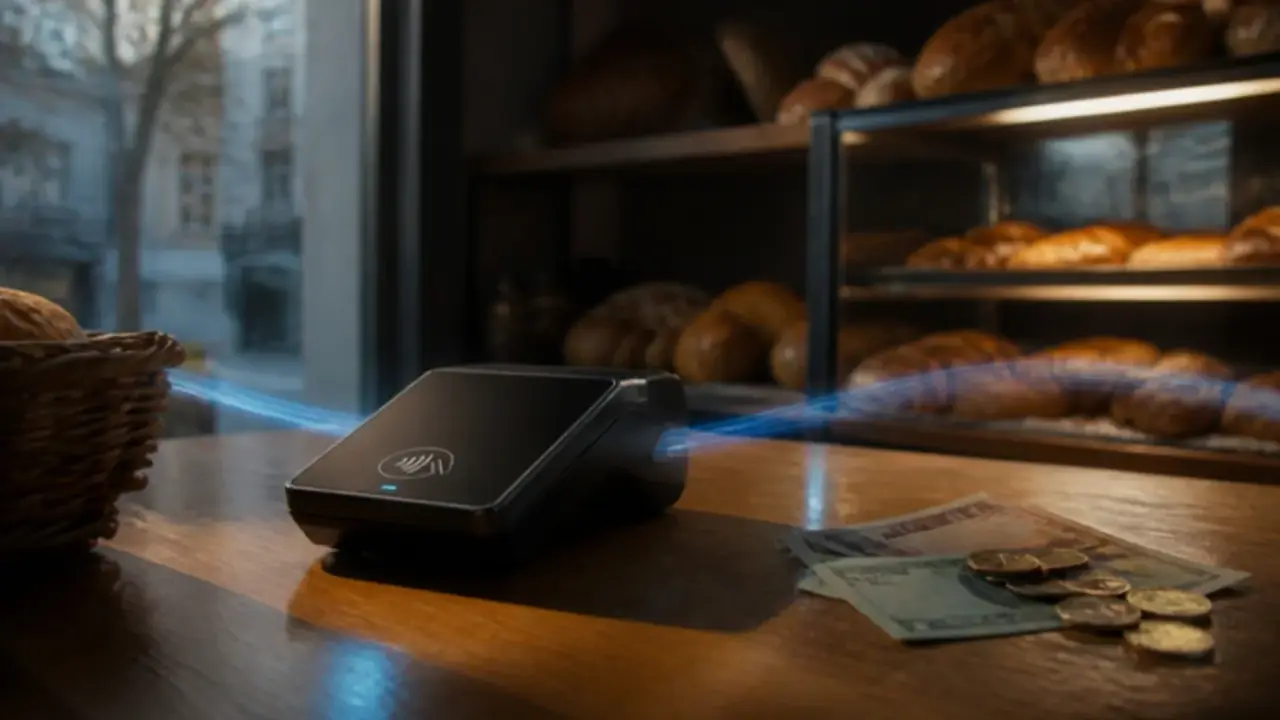
Cash between a business and a private person is capped at 10,000 lei a day, to or from one person (Law 70/2015, Art. 4).
Cash between private individuals for a sale, a service or a loan is capped at 50,000 lei per transaction, per day. Splitting is prohibited (Art. 10).
Breaking a cash ceiling is fined at 25% of the amount above it, with a minimum of 500 lei (Art. 12, as amended in 2023).
Paying in Romania: the short answer
Everyday payments in Romania are made mostly by card, often contactless, and by bank transfer. Since 1 January 2026, businesses must accept modern means of payment, such as debit and credit cards, whatever their annual cash turnover.
Cash is legal, but Law 70/2015 caps it. Between a business and an individual, cash payments and receipts are limited to 10,000 lei a day per person. Between two private individuals, cash for a sale, a service or a loan is limited to 50,000 lei per transaction. Splitting a larger payment into smaller cash amounts is prohibited, and the fine is 25% of the amount above the ceiling.
In plain words: pay the coffee by card, pay the plumber by card or transfer, and pay any property price by bank transfer only. In a Romanian property deal, cash is not a real option.
Our guide to transferring money to Romania covers international transfers, exchange rates and the €10,000 cash declaration at the EU border. This article covers payments inside Romania.
The cash ceilings in one table
| Who pays whom | Cash ceiling | Rule |
|---|---|---|
| Business to business (companies, sole traders, freelancers) | Non-cash as a rule; limited cash exceptions (5,000 lei a day per person, 10,000 lei in total) | Law 70/2015, Art. 1 and 3 |
| Business and an individual, in either direction (goods, services, dividends, loans) | 10,000 lei a day, to or from one person | Art. 4(1) |
| Loans between a company and its shareholders, directors or other individuals | Non-cash only | Art. 4(4) |
| Between private individuals (sale of goods or rights, services, loans) | 50,000 lei per transaction, per day | Art. 10 |
| Cash held in a company's cash desk at the end of the day | 50,000 lei; the excess is deposited within two working days | Art. 4² |
Amounts in euros or other currencies count too: they are converted at the National Bank of Romania (BNR) rate on the day of the payment (Art. 1(3)). At current rates, 50,000 lei is roughly €10,000.
Splitting is prohibited. Two payments of 40,000 lei for one 80,000 lei transaction break the rule. Under Art. 12, a breach is fined at 25% of the amount above the ceiling, with a minimum of 500 lei, unless it is a criminal offence.
Property deals: why cash does not work
Apply the table to a home purchase and the answer is clear.
- Buying from a developer. The developer is a company, so cash from an individual is capped at 10,000 lei a day. A villa price is many times that, and fragmenting it is prohibited.
- Buying from a private seller. Cash between individuals is capped at 50,000 lei per transaction, and splitting a larger transaction into cash instalments is prohibited. A property price is far above the ceiling.
- Paying advances on an off-plan home. Under Law 207/2025, advances under a preliminary contract go to the project's dedicated account. See our guide to payment protection without escrow.
- The anti-money-laundering checks. Under Law 129/2019, cash transactions of €10,000 or more are reported by the notary, the bank and the developer, and each of them must understand where the money comes from. See source of funds for a property.
So the price, the advances and the balance all go by bank transfer, from an account in the buyer's name to the account named in the contract. Cash is reasonable only for small, everyday costs.
Cards and contactless
Romania is a card country. In shops, supermarkets, petrol stations, pharmacies and most restaurants in Bucharest and Ilfov, you can pay by card, and contactless is the norm.
In a Romanian property deal, cash is not a real option.
What changed in 2026:
- Businesses must accept modern payment means (debit, credit and prepaid cards, and account-to-account payment apps), whatever their cash turnover. The old threshold of 50,000 lei a year in cash receipts was removed.
- Refusing modern payment means is fined 5,000 to 7,500 lei for businesses, according to the tax authority's summary of the 2026 changes.
- An exception: businesses that make and receive all payments only through bank accounts do not have to accept cards.
Practical points for buyers from abroad:
- A foreign card works, but check your bank's foreign-currency fee. When the terminal offers to charge you in your home currency, choosing lei usually avoids an extra conversion margin.
- Small contactless payments usually go through without a PIN. Above the limit set by your bank, the terminal asks for the PIN.
- Keep a little cash for markets, tips and small local services, well below the limits.
Bank transfers: the default for anything large
Bank transfers are the normal way to pay rent, the builder, the furniture supplier and, above all, the property.
- Take the account details from the contract or invoice, not from an email or a message. Payment fraud often starts with "new bank details".
- Pay from an account in your name. Third-party payments raise questions under the anti-money-laundering rules.
- Write a clear reference: contract number, invoice number, unit number.
- Keep the confirmation. For international transfers, the SWIFT confirmation; for local ones, the bank statement.
A Romanian bank account makes local payments simpler, but it is not required to buy. See a bank account in Romania for non-residents.
Taxes and public bills
Payments to the state, such as local property tax, fees and fines, sit outside the ceilings described above. For businesses, Article 5 of Law 70/2015 says so expressly. In practice, local taxes can usually be paid at the town hall, by bank transfer or online through the national platform ghiseul.ro, where the town hall is registered.
A checklist before your first payments
- Check your card's foreign-currency fees, or open a lei or euro account.
- Pay in lei at the terminal.
- Keep only small amounts of cash.
- For any professional service above 10,000 lei, pay by card or transfer, and ask for an invoice.
- For the property: bank transfer only, from your own account, to the account in the contract.
- Keep every confirmation in one folder for the notary, the bank and your tax adviser.
Frequently asked questions
What is the cash limit between individuals in Romania?
Under Article 10 of Law 70/2015, cash between private individuals for the sale of goods or rights, services or loans is limited to 50,000 lei per transaction, per day. Splitting a larger transaction into several cash payments is prohibited.
How much cash can a business accept from me?
A business can receive or pay cash to an individual up to 10,000 lei a day per person, under Article 4 of Law 70/2015. Above that, payment must be by card or bank transfer.
Can I pay for an apartment or villa in cash in Romania?
In practice, no. A developer, as a company, can take only 10,000 lei a day in cash from an individual, and a private seller only 50,000 lei per transaction, with splitting prohibited. Property prices are paid by bank transfer.
What is the fine for breaking the cash limits?
Under Article 12 of Law 70/2015, as amended in 2023, the fine is 25% of the amount above the ceiling, with a minimum of 500 lei, unless the act is a criminal offence.
Do shops in Romania have to accept cards?
Since 1 January 2026, businesses must accept modern payment means, such as cards, whatever their cash turnover. Businesses that make all their payments only through bank accounts are an exception.
The bottom line
Romania is an easy place to pay by card, and the law pushes in the same direction. Cash is fine for small amounts, but the ceilings are low, splitting is prohibited and the fines are calculated on the excess. For a home, there is only one way: a bank transfer from your account to the account in the contract.
If you are planning a purchase and want to go through the payment schedule, from the first advance to the final balance, book a half-hour call with me.
Moti Azulay, Compass Group Romania
Sources: Law 70/2015 on cash payments, original text (Monitorul Oficial 242/2015, via legeaz.net), Art. 1, 4, 5, 10 and 12 · ANAF Brașov: amendments to Law 70/2015 by Law 296/2023 and OUG 98/2023, in force from 11 November 2023 · ANAF Ploiești: main legislative changes from 1 January 2026, including Law 239/2025 · Law 129/2019 on preventing money laundering (legislatie.just.ro) · ghiseul.ro
This article is for general information only and is not legal, tax or financial advice. The rules are current as of 22 October 2026. For a specific payment, check the consolidated text of Law 70/2015 and ask an independent lawyer or accountant.
Now you know more.

This article is general information, not legal, tax or financial advice. Consult local professionals before any transaction.

