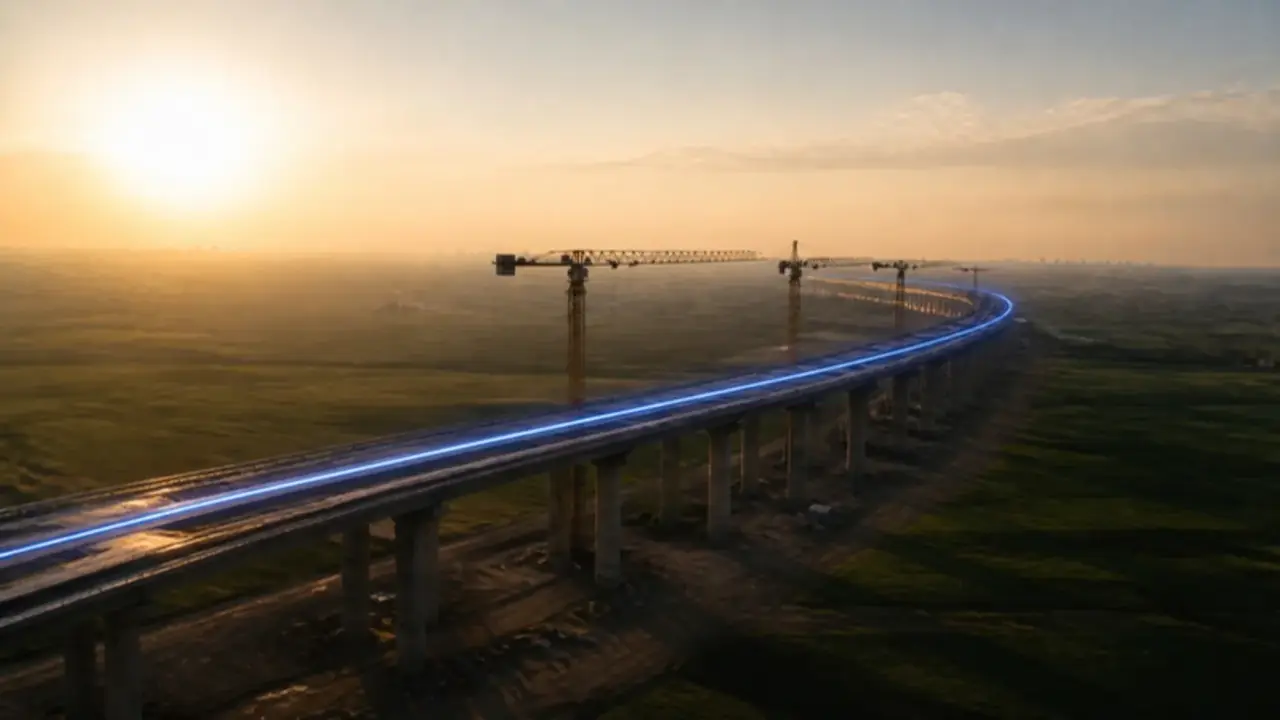
According to a summary by Romania's Ministry of Finance, Romania received €108.3 billion from the EU budget and paid in €35.9 billion.
According to the Ministry of Finance, 78.55 of 138.2 billion lei of investment spending in 2025 was financed from EU funds.
Between 2011 and 2025, the sum of household consumption's annual contributions to growth was 39.1 points, out of 46.5 (Eurostat, our calculation).
According to BNR, companies with foreign direct investment account for 73.3% of Romania's goods exports (2024).
According to Eurostat, Romania's real GDP grew by about 138% between 2001 and 2025, against about 41% for the EU as a whole.
What drives growth: the short answer
According to Eurostat, Romania's real GDP grew by about 138% between 2001 and 2025, against about 41% for the EU as a whole. That is one of the great growth stories in Europe. When growth is broken down by component, the big engine is household consumption. Between 2011 and 2025 it accounts for more than 80% of the sum of annual contributions to growth.
Two more engines work alongside it. The first is EU funds: according to Romania's Ministry of Finance, 56.6% of the state's investment spending in 2025 was financed from EU money. And according to European Commission data, the net transfer from the EU to Romania has averaged about 2% of national income every year since 2007. The second is foreign direct investment: according to the central bank (BNR), foreign-owned companies account for 73.3% of goods exports.
In plain words: consumption led GDP growth. Roads, schools and most public investment were financed mainly by the EU. Exports were built mainly by foreign companies. In recent years consumption was also supported by government spending, and the deficit, the highest in the EU, is now being brought down.
25 years of growth in numbers
| Period | Average real growth per year, Romania | EU | What happened |
|---|---|---|---|
| 2001–2008 | About 6.6% | About 2.0% | A boom before and after accession. Peak: 10.4% in 2004 |
| 2009–2010 | Minus 4.7% | Minus 1.1% | The financial crisis and austerity |
| 2011–2019 | About 3.9% | About 1.5% | Recovery. Peak: 8.2% in 2017 |
| 2020 | Minus 3.4% | Minus 5.5% | Covid |
| 2021–2022 | About 5.4% | About 5.0% | A fast rebound |
| 2023–2025 | About 1.5% | About 1.1% | Slowdown: 2.5%, 1.1%, 0.8% |
Source: Eurostat, nama_10_gdp, real change in GDP, updated 22.10.2026. The averages are our calculation from the annual data.
We set out the sector picture, from agriculture to energy, in our article on Romania's economy in numbers. Here the question is different: where the money that moved the economy came from.
Who pushed GDP: breaking growth down by component
For every year, Eurostat publishes how many percentage points of growth each component of demand "contributed". We added up the annual contributions between 2011 and 2025:
| Component | Sum of annual contributions, 2011–2025 (percentage points) |
|---|---|
| Household consumption | 39.1 |
| Investment (gross fixed capital formation) | 11.7 |
| Government consumption | 4.8 |
| Change in inventories | Minus 0.5 |
| Exports | 35.8 |
| Imports | Minus 44.5 |
| Sum of annual growth | 46.5 |
Source: Eurostat, nama_10_gdp, unit CON_PPCH_PRE. Adding up annual contributions is our approximation, not an official measure.
What the table says: private consumption contributed about 39 of the 46.5 points. Exports contributed a lot, but imports grew even more, so net trade subtracted about 8.7 points from growth. In other words, a considerable part of consumption went on imported goods. In 2017, the peak year, private consumption alone contributed 7.2 of 8.2 points. In the same year, according to Eurostat, public investment was only 2.6% of GDP.
In other words, GDP growth, in Eurostat's accounting, is mainly growth in consumption: households earning more and buying more. The next question is what financed consumption and investment.
EU funds: how much money, and where it went
The total
According to a summary by Romania's Ministry of Finance, as published by StartupCafe in March 2026, Romania received a total of €108.3 billion from the EU budget between 1 January 2007 and 31 December 2025, and paid in €35.9 billion. The net balance: about €72.4 billion. This is money that builds the future: in 2025, according to the Ministry of Finance, 56.6% of state investment was financed from EU funds. It can also be seen as a sign of the EU's confidence in the Romanian economy, into which it has kept channelling money for almost 20 years.
Year by year
| Year | EU spending in Romania (€ billion) | Net, after Romania's payment | Net as a share of national income |
|---|---|---|---|
| 2007 | 1.6 | 0.7 | 0.6% |
| 2012 | 3.4 | 2.1 | 1.6% |
| 2016 | 7.4 | 6.0 | 3.6% |
| 2019 | 5.1 | 3.4 | 1.6% |
| 2022 | 10.9 | 8.5 | 3.1% |
| 2023 | 11.4 | 8.9 | 2.8% |
| 2024 | 6.3 | 3.5 | 1.0% |
| 2025 | 8.8 | 5.9 | 1.6% |
Source: European Commission, "EU spending and revenue 2000–2025" file. Spending includes NextGenerationEU. The net figure is our calculation: spending minus Romania's national contribution (excluding customs duties). The Commission's official definition of the "operating budgetary balance" may differ slightly.
The simple average over the 19 years: about 2% of national income a year. That is a lot of money, but it is not constant. In 2024, for example, the net transfer fell to about 1%, as the previous budget period closed and the new one was only beginning.
The recovery plan (PNRR) and the 2021–2027 period
According to the same Ministry of Finance summary, by the end of 2025 €6.4 billion had been received of the recovery plan's €13.6 billion in grants, plus €4.3 billion in loans. From the 2021–2027 budget, €13.5 billion had been received, 26.8% of the allocation. After the latest revision in June 2026, the plan stands at about €20 billion, as we set out in our article on EU funds and infrastructure around Bucharest.
The infrastructure engine: public investment
This is where EU funds are the central engine.
Consumption led GDP, foreign companies built exports, and EU funds are building the infrastructure.
According to the Ministry of Finance's budget execution data for 2025, as published by Economedia on 27 January 2026, state investment spending reached a record 138.2 billion lei. Of this, 78.55 billion lei, 56.6%, was financed from EU funds.
78.55 billion lei is about 4.1% of 2025 GDP, and about 16% of all gross fixed capital formation in the economy, private and public together. That is our calculation, and it is an approximation: "investment spending" in the budget is not identical to the national accounts definition.
According to Eurostat, public investment in Romania rose from 2.5% of GDP in 2018 to 6.0% in 2025. In Poland it was 4.8% and in Hungary 4.4% (2024). Most of this rise came with European money.
Foreign investment: the export engine
According to BNR's annual report, published in autumn 2025:
- The stock of foreign direct investment reached €125 billion at the end of 2024, twice the 2014 level (€62 billion). About 35.3% of GDP, the lowest level in a decade.
- The annual flow in 2024: €5.6 billion, about 1.6% of GDP, down 17% from 2023. The peak was €10.6 billion in 2022. According to preliminary balance of payments data, in 2025 the flow rose to €8.15 billion, about 2.1% of GDP.
- Exports: companies with foreign investment account for 73.3% of Romania's goods exports, and 68.7% of imports.
- Employment: about 1.3 million workers on average in 2024.
- Concentration: 65.4% of the stock is registered in Bucharest-Ilfov. BNR notes that registration is by registered office, not necessarily by place of activity.
One more figure: according to BNR, foreign investors' income from companies in Romania in 2024 was €10.9 billion, 1.9 times that year's new flow. In other words, foreign companies in Romania are profitable, and part of the profit is distributed to owners abroad.
Foreign investment has accompanied the leap in exports: according to Eurostat, exports rose from 21.6% of GDP in 2000 to a peak of 43.7% in 2022, and stood at 35.2% in 2025. For the history of the transition to a market economy, see the chapter on 1989 and the transition.
Remittances from the diaspora
According to the World Bank, remittances from Romanians abroad reached $10.6 billion in 2025, about 2.5% of GDP. From 2014 to 2019 they hovered around 3% of GDP. Note: the World Bank series has a sharp jump in 2013, which looks like a change in measurement method, so we did not compare with earlier years.
The context: the deficit and the road to cutting it
| Indicator | 2019 | 2024 | 2025 |
|---|---|---|---|
| Government deficit (share of GDP) | 4.4% | 9.2% | 7.8% |
| Average EU deficit | 0.5% | 3.1% | 3.1% |
| Government debt (share of GDP) | 35.4% | 54.6% | 58.9% |
Source: Eurostat, gov_10dd_edpt1, release of 21.10.2026.
According to Eurostat, Romania had the highest deficit in the EU in both 2024 and 2025. Government debt rose from 35.4% of GDP in 2019 to 58.9% in 2025. According to BNR data published in February 2026, the current account deficit in 2025 was €30.1 billion, about 7.9% of GDP by our calculation.
Our interpretation: 2023 and 2024 look like growth that leaned on state spending, wages and pensions in the public sector. When the government turned to austerity in 2025, growth fell to 0.8%. That fits the picture of a consumption-driven economy, but it does not prove causality. We set out the austerity package and what it means for interest rates in our article on Romania's economy in 2026.
So who financed what? One comparison
| Source, 2025 | Approximate size | Share of GDP |
|---|---|---|
| Government deficit | €29.7 billion | 7.8% |
| EU-funded public investment | 78.55 billion lei | About 4.1% |
| Remittances from the diaspora | $10.6 billion | About 2.5% |
| Foreign direct investment flow | €8.15 billion | About 2.1% |
| Net transfer from the EU budget | €5.9 billion | About 1.6% of national income |
Sources: Eurostat, Romania's Ministry of Finance (via Economedia and StartupCafe), the World Bank, BNR, the European Commission. The percentage calculations are ours. The rows do not add up, because they measure different things: money flows, spending and a deficit.
Three engines, one role each
Consumption: the GDP engine. In Eurostat's breakdown, GDP growth was led by private consumption. In the years of fastest growth, such as 2017, it carried almost all of the growth.
Foreign investment: the export engine. Foreign companies built most of the exports, which rose from 21.6% of GDP in 2000 to 35.2% in 2025.
EU funds: the infrastructure engine. Without EU money, most public investment would not exist. In 2025 it financed 56.6% of it, and public investment rose to 6.0% of GDP, more than in Poland and Hungary. Exactly how many points of growth the funds "created" is a question for economic models, so we do not give a number here.
And the roots? What the previous regime left behind, and what has been built since 1989, we set out in the final chapter of the investigation.
Frequently asked questions
How much money has Romania received from the EU since accession?
According to a summary by Romania's Ministry of Finance, between 2007 and the end of 2025: €108.3 billion gross, and payments to the EU budget of €35.9 billion. Net: about €72.4 billion.
What share of public investment is financed from EU funds?
According to the Ministry of Finance's budget execution data for 2025, 56.6%: 78.55 of 138.2 billion lei of investment spending.
How much foreign investment is there in Romania?
According to BNR, the stock of foreign direct investment at the end of 2024 was €125 billion, about 35.3% of GDP. The flow in 2025 was €8.15 billion, according to preliminary data.
Why is Romania's deficit so high?
According to Eurostat, the deficit was 9.2% of GDP in 2024 and 7.8% in 2025, the highest in the EU in both years. Eurostat does not explain the reasons. In our analysis, it came with growth in public spending, and in 2025 an austerity package began that brought it down.
The bottom line
Romania has grown fast, on three engines working together. Consumption led GDP, foreign companies built exports, and EU funds are building the infrastructure: roads, schools and most public investment. In recent years consumption was also supported by a high government deficit, and since 2025 the state has been bringing it down. The next chapter is already planned: after the recovery plan closes this year, cohesion funds for 2021–2027 will keep flowing until the end of 2029.
Moti Azulay, Compass Group Romania
Sources: Eurostat: GDP and main components (nama_10_gdp) · Eurostat: investment by sector (tec00132) · Eurostat: government deficit and debt (gov_10dd_edpt1) · European Commission: EU spending and revenue 2000–2025 · StartupCafe: Ministry of Finance summary of EU funds, 24.3.2026 · Economedia: 2025 budget execution, 27.1.2026 · BNR: foreign direct investment in Romania in 2024 · Revista Biz: the 2025 balance of payments per BNR, 16.2.2026 · World Bank: personal remittances, Romania
This article is for general information only and is not investment, legal or tax advice. Correct as of 23 October 2026. Eurostat, BNR and Commission data are revised from time to time, and some 2025 data is preliminary.
Forget the dictatorship economy
- Forget the dictatorship economy: the new Romania
- Who earns what in Romania today
- Agriculture: Europe's breadbasket
- Finance: banks, the stock exchange and money
- Tech: from UiPath to Bitdefender
- Food and wine
- Culture: festivals, film and music
- Abundance: malls, consumption and brands
- Western brands: consulting, accounting and hotels
- What drives growth: EU funds versus investment (you are here)
- From dictatorship to market economy: what remained and what was built
Now you know more.
This article is general information, not legal, tax or financial advice. Consult local professionals before any transaction.

