According to Europa Liberă, the foreign debt, more than $11 billion, was repaid by the end of March 1989. The price: rationing of food, electricity and heating.
According to the World Bank, in constant prices, Romania's GDP fell after 1990 and only returned to its 1990 level in 2003.
Construction began in 1982, under Ceaușescu. Unit 1 entered commercial operation in December 1996, and unit 2 in October 2007 (World Nuclear Association).
According to Romania's Ministry of Finance, in 2007 to 2025 Romania received €108.3 billion from the EU and paid in €35.9 billion.
According to Eurostat, GDP per head in purchasing power terms rose from 44% of the EU average in 2007 to 78% in 2025.
From dictatorship to market economy: the short answer
Today's Romania is built from two layers. The first layer is what the communist regime left behind: a metro, a nuclear power plant whose construction began then, a canal and a tradition of engineering and mathematics. Most of these assets were completed, renovated or made profitable after 1989, usually with money and partners from abroad. The second layer is what has been built since, and it is the one driving growth.
The growth of recent decades was built in stages. According to the World Bank, Romania's real GDP only returned to its 1990 level in 2003. According to Eurostat, GDP per head in purchasing power terms rose from 44% of the EU average in 2007 to 78% in 2025. In those years came a flat tax, EU accession, foreign investment, European funds and money from Romanians working abroad.
In plain words: the regime left Romania infrastructure and skills, and also a heavy human cost and an industry that did not survive the transition. What has driven growth over the past 20 years was built after 1989.
We told the story of his rule, the palace and the 1977 earthquake in the chapter on Ceaușescu's rise and fall. The 1990s, privatisation and inflation, in the chapter on 1989 and the transition to a market economy. Here we ask one question: what of all this still works in today's economy.
At a glance: what remained and what was built
| Area | What remained from the regime | What was built after 1989 |
|---|---|---|
| Debt | The foreign debt was repaid by March 1989, at the price of rationing food, electricity and heating | Romania returned to borrowing on international markets in 1996 |
| Industry | Industry was 46% of GDP in 1989 | 25% in 2014. More than 2.5 million jobs were lost after 1990, and what survived, such as Dacia and Petrom, was renewed with foreign partners |
| Infrastructure | The metro (1979), the canal (1984), the start of construction at Cernavodă (1982) | Cernavodă 1 began operating in 1996 and Cernavodă 2 in 2007. The metro has reached five lines |
| Engineering and mathematics | A tradition that predates the regime: the first International Mathematical Olympiad was held in Romania in 1959 | A software industry that grew in the free market |
| Growth engines | €72.4 billion net from the EU in 2007 to 2025, €134.8 billion of foreign investment, a jump from 44% to 78% of EU GDP per head |
The debt: an achievement on the balance sheet, a price at home
In the 1970s Romania took loans from the West to build industry. According to Europa Liberă, the foreign debt exceeded $11 billion. In 1981 Romania stopped paying, and Paris Club sanctions were imposed on it. According to Adrian Vasilescu, an adviser at the central bank, for 15 years Romania could not borrow on international markets, until 1996.
Ceaușescu chose to repay everything, and fast. According to the same article, the early repayment was completed at the end of March 1989 and announced in mid-April. The price was rationing of food, electricity and heating, and we set out the full account of those years, the queues and the darkness, in the previous chapter.
What did this leave? A country with no foreign debt, but also factories that had received no investment or new technology. According to Europa Liberă, industry was already lagging technologically and the gap with other countries in the bloc widened. This is my cautious interpretation: the zero debt of 1989 was not enough on its own as a basis for growth, because behind it stood outdated factories and an exhausted population. The basis was rebuilt in the years that followed.
Industry: what survived and what collapsed
According to data published by Ziarul Financiar in 2015, industry made up 46% of GDP in 1989 and 25% in 2014. The number of employees fell from 8.2 million in 1990 to 4.5 million. A study by Cătălin Deacu of the University of Bucharest, published in 2016 in the journal Human Geographies, describes the closure of hundreds of factories and the loss of more than 2.5 million jobs. The researcher links the collapse to a combination of internal and external factors, and to the failed policies of governments after 1990.
Output went backwards too. According to the World Bank series in constant prices, GDP fell from $116.5 billion in 1990 to $92.5 billion in 1992, and only returned to the 1990 level in 2003.
But part of the base survived, and the two best-known cases teach something:
- Dacia. The communist regime asked France for help in 1966, and the first cars rolled out in 1968 near Pitești, under a Renault licence. In 1999 Renault bought 51% of the company for $50 million, according to RFE/RL.
- Petrom. The state oil company. On 14 December 2004 Austria's OMV completed the acquisition of 51% of it, according to OMV Petrom.
The two symbols of Romanian industry survived and were renewed, with capital and management from abroad.
The metro, the canal and Cernavodă: started then, completed later
These are the assets the regime left that still work today.
The regime left Romania infrastructure and skills. What has driven growth over the past 20 years was built after 1989.
The Bucharest metro. The first line opened in November 1979, between Semănătoarea, today Petrache Poenaru, and Timpuri Noi. Today, according to Playtech, there are five lines, more than 60 km and 63 stations. The metro is infrastructure Bucharest still relies on, and its extensions, such as the M6 line to the airport, are financed partly from the European transport programme and from loans by the Japanese agency JICA.
The Danube-Black Sea Canal. According to HotNews, work began in 1949, carried out among others by political prisoners, and cost "thousands of lives". It was halted in 1953, resumed in 1973, and the canal was inaugurated on 26 May 1984, 64.4 km long. Planned capacity: more than 80 million tonnes a year. The best year up to 2009 was 2005, with about 32 million tonnes. According to the same article, the canal made a profit for the first time in December 2008.
Nuclear power at Cernavodă. According to the World Nuclear Association, a five-unit plant was planned at the end of the 1970s, using Canadian Candu technology. Construction of unit 1 began in July 1982. In 1991 work on units 3 to 5 was frozen to concentrate on unit 1, which entered commercial operation in December 1996. Unit 2 was completed by a consortium of Canada's AECL and Italy's Ansaldo, under a 2003 contract, and entered operation in October 2007. In 2023 nuclear power produced about 19% of Romania's electricity.
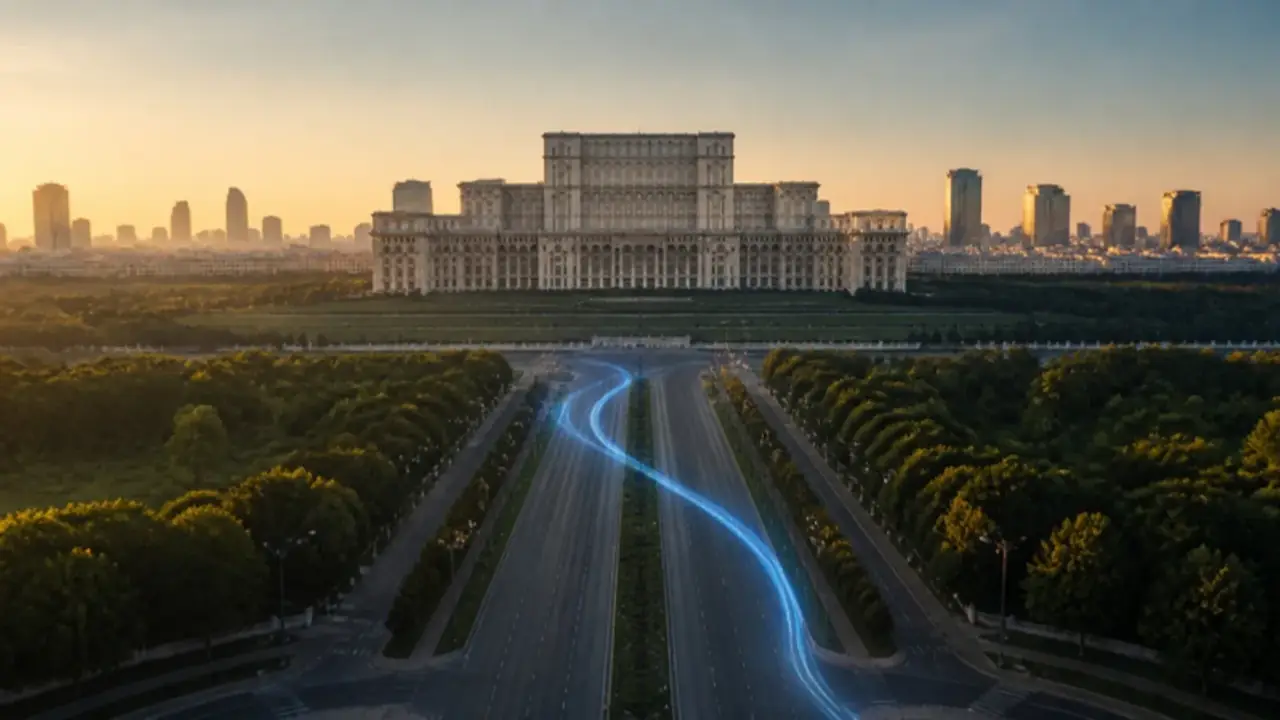
The House of the People. According to the Palace of the Parliament's website, in December 1989 the building was only 60% complete. In 1993 the Chamber of Deputies decided to move into it, and today Parliament sits there. It is the building heaviest with symbolism, and its use after 1989 is a symbol of the transition.
The engineering tradition: before the regime and after
One of the assets many people attribute to the communist era is education: engineers and mathematicians. The tradition is real, and it is older than the regime itself.
Romania hosted the first International Mathematical Olympiad, in Brașov, in 1959, according to the olympiad's official website. That was six years before Ceaușescu came to power. And the tradition did not stop in 1989: in 2023 the Romanian team finished fourth in the world, with five gold medals and one silver, according to Edupedu.
It was the free market that turned this talent into an industry. Romania's software industry grew after 1990, and for years enjoyed an income-tax exemption for programmers, which was abolished in 2025. That story is told in the chapter on tech and the chapter on who earns what.
What changed after 1989
| 1989 to 1990 | Today | |
|---|---|---|
| Foreign debt | Repaid by March 1989 | Romania borrows on the markets again, since 1996 |
| Industry's share of GDP | 46% (1989) | 25% (2014) |
| Employees | 8.2 million (1990) | 4.5 million (2015) |
| Foreign investment | Almost zero | A stock of €134.8 billion at the end of 2025 (BNR) |
| GDP per head, purchasing power, against the EU | 44% in 2007, the year of accession | 78% in 2025 (Eurostat) |
| Real GDP | $116.5 billion (1990) | $237.4 billion (2024, World Bank, constant prices) |
And what came in along the way:
- A flat tax of 16% from the start of 2005, replacing brackets of 18% to 40%, according to Economica.net.
- EU accession on 1 January 2007. We wrote about accession and Schengen in the chapter on the EU and Schengen.
- Foreign investment. According to the central bank, net direct investment of €7.9 billion came in during 2025, and the stock reached €134.8 billion.
- European funds. According to the Ministry of Finance, as reported by StartupCafe, in 2007 to 2025 Romania received €108.3 billion from the EU and paid in €35.9 billion. A balance of €72.4 billion in its favour. What this money is building around Bucharest, we set out here.
- Money from the diaspora. According to the World Bank, in 2024 Romanians abroad sent home about $9.5 billion, about 2.5% of GDP.
Which of these "caused" growth, and with what weight? The data do not allow the credit to be divided precisely, and the full picture is set out in the chapter on the growth engines. What they do show: rapid growth came together with the EU, foreign capital and openness.
Two layers of the same country
What remained: the Bucharest metro, the base of Cernavodă, the canal, a brand like Dacia, and a layer of people with technical education. And also the apartment blocks, the demolitions in central Bucharest, and a memory of shortage that, in my view, may explain part of Romanians' economic behaviour to this day, for example the desire to own a home.
What was built: the economy the regime left behind collapsed in the decade that followed, and real GDP returned to its 1990 level in 2003. Since then it has almost doubled. The old assets that work today were completed, privatised or renewed after 1989, usually with money and partners from abroad. Alongside them came a flat tax, EU accession, foreign capital and European funds, on which today's growth rests.
Frequently asked questions
Did Ceaușescu repay all of Romania's debt?
According to Europa Liberă, the early repayment of the foreign debt, more than $11 billion, was completed at the end of March 1989. The price was rationing of food, electricity and heating in the 1980s.
Which infrastructure from the Ceaușescu era still works today?
The Bucharest metro (from 1979), the Danube-Black Sea Canal (1984), the Palace of the Parliament, and the Cernavodă nuclear plant, whose construction began in 1982 but whose units began operating in 1996 and 2007.
When did Romania's economy recover after 1989?
According to World Bank data in constant prices, real GDP only returned to its 1990 level in 2003. Since then it has almost doubled.
How much money has Romania received from the European Union?
According to Romania's Ministry of Finance, in 2007 to 2025 it received €108.3 billion and paid in €35.9 billion, a balance of €72.4 billion in its favour.
The bottom line
Romania's road from dictatorship to market economy went through a deep crisis in the 1990s, and from there to one of the fastest growth stories in the EU. The regime left some infrastructure that still works today and a technical tradition that was there even before it. The economy you see in Bucharest today, the offices, the tech sector and pay that is approaching European levels, was built after 1989, on low taxes, an open market, foreign capital and European funds. Anyone arriving in Bucharest sees the two layers side by side, and can read the whole road in them.
Moti Azulay, Compass Group Romania
Sources: Europa Liberă: 30 years since the foreign debt was repaid, 22.4.2019 · Ziarul Financiar: 22 indicators of the Romanian economy since 1989, 22.12.2015 · Deacu, Human Geographies, 2016: the collapse of state industry in Romania · World Bank: GDP in constant prices, Romania · World Bank: personal remittances, Romania · RFE/RL: Dacia, 13.3.2001 · OMV Petrom: acquisition of 51% completed, 2004 · Playtech: Metrorex turns 46, 13.11.2025 · HotNews: 25 years of the Danube-Black Sea Canal, 2009 · Europa Liberă: the canal, 15.2.2026 · World Nuclear Association: Romania · World Nuclear News: Cernavodă 2 in commercial operation, 2007 · Palace of the Parliament: the building · IMO: host countries · Edupedu: fourth place at the olympiad, 2023 · Economica.net: the flat tax and the 2004 brackets · European Union: Romania · Revista Biz: foreign investment in 2025 per BNR · StartupCafe: 19 years of EU funds per the Ministry of Finance, 24.3.2026 · Eurostat: GDP per head in purchasing power, nama_10_pc and tec00114
This article is for general information only and is not investment advice. The historical data come from the sources above, and on some topics the sources give different estimates. The 44% ratio for 2007 was calculated from Eurostat data. Correct as of 23 October 2026.
Forget the dictatorship economy
- Forget the dictatorship economy: the new Romania
- Who earns what in Romania today
- Agriculture: Europe's breadbasket
- Finance: banks, the stock exchange and money
- Tech: from UiPath to Bitdefender
- Food and wine
- Culture: festivals, film and music
- Abundance: malls, consumption and brands
- Western brands: consulting, accounting and hotels
- What drives growth: EU funds versus investment
- From dictatorship to market economy: what remained and what was built (you are here)
Now you know more.
This article is general information, not legal, tax or financial advice. Consult local professionals before any transaction.

