From March 1965 to 25 December 1989: from the leader who defied Moscow and hosted Nixon to a hasty military trial and execution in Târgoviște.
4 March 1977: 1,578 dead, 1,424 of them in Bucharest, and 32 tall buildings collapsed in the capital. In 1978 a new seismic code, P100-78, was approved.
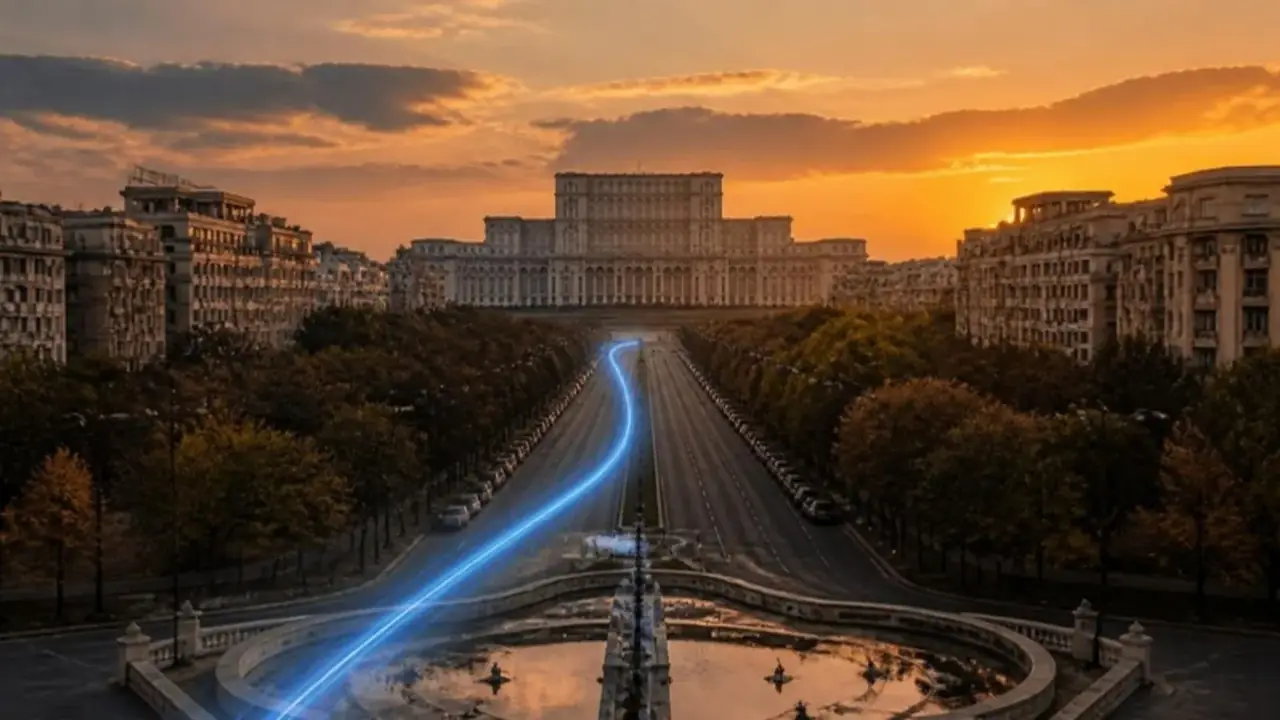
According to the palace website: a whole district demolished, almost 20,000 workers on three shifts, and only 60% of the building finished in December 1989.
19,981 of Bucharest's 27,450 apartment buildings were built between 1961 and 1990, according to the 2021 census. So the first check is the year of construction.
According to Eurostat, in 2024 94% of people in Romania lived in an owned home, the highest in the EU. On the resale market you will likely buy from a family.
Ceaușescu and Bucharest: the short answer
Nicolae Ceaușescu ruled Romania for 24 years, from March 1965 until 25 December 1989, the day he and his wife Elena were executed. He began as a communist leader the West courted, went on to put his country on rationed power and food so he could pay off its debt, razed a large part of historic Bucharest to build a palace, and fell within a single week.
Why does this matter if you are buying a flat or a house in Bucharest today? Because the city you walk through is, to a large extent, his city. The boulevards and buildings of the Civic Centre, the tens of thousands of concrete apartment blocks, the memory of the 1977 earthquake, even the fact that almost every Romanian lives in a home they own: all of these have roots in those years.
Put simply: in Bucharest you do not just buy an address. You buy a year of construction, and Ceaușescu's history is the key to reading it.
Timeline: from rise to fall
| When | What happened | Source |
|---|---|---|
| March 1965 | After Gheorghiu-Dej dies, Ceaușescu takes over the Communist Party | Britannica |
| August 1968 | Publicly condemns the Warsaw Pact invasion of Czechoslovakia | Britannica |
| 2 to 3 August 1969 | Richard Nixon visits Bucharest | Nixon Library |
| July 1971 | The "July Theses": the thaw ends and ideological orthodoxy returns | Britannica |
| 1974 | Elected to the newly created post of President of Romania | Britannica |
| 4 March 1977 | Earthquake: 1,578 dead, 1,424 of them in Bucharest | Digi24 |
| 1981 | Romania stops borrowing abroad. The debt: about $10.5 billion | Washington Post, 14.4.1989 |
| June 1984 | Foundation stone of the palace, the "House of the People" | Digi24 (Romanian) |
| April 1989 | Ceaușescu announces the foreign debt was paid off by the end of March | Washington Post, 14.4.1989 |
| 16 to 22 December 1989 | From Timișoara to Bucharest. On 22 December the army changes sides and the couple flee by helicopter | Britannica |
| 25 December 1989 | A hasty military trial in Târgoviște and execution the same day | Britannica |
1965 to 1971: the leader the West liked
In March 1965 Gheorghiu-Dej, Romania's communist ruler, died, and his protégé took over at 47, a man who had shared a prison cell with him in the underground years. In the early years Ceaușescu looked like something different. According to Britannica, in the 1960s the regime intruded less into private life, consumer goods and housing improved, and writers and scholars were given room they had not had before.
The big moment came in August 1968. When Warsaw Pact tanks rolled into Prague, Ceaușescu condemned the invasion in public. In the West he was seen as a communist leader who dared to say "no" to Moscow.
A year later, on 2 August 1969, Richard Nixon landed in Bucharest. According to the official almanac of the Nixon Library, the American president visited a farmers market, a new housing development and a model village, and on the day he left, at Otopeni airport, not far from Balotești, the two presidents parted with their arms around each other. Notice one detail: among the places shown to the most important guest in the world was a district of new apartment blocks. Even then, the block was part of the regime's image.
1971: the July Theses, and the cult
In the summer of 1971 Ceaușescu returned from a tour of Asia that included China and North Korea. In July he presented what became known as the "July Theses". According to Britannica, he demanded a return to rigid ideological orthodoxy and reasserted the leading role of the party. The thaw was over.
What followed is described by Britannica as a cult of personality unprecedented in Romanian history. Ceaușescu constantly rotated officials so that no rival power centre could grow, and appointed relatives to key posts, above all his wife Elena. In 1974 a new office was created for him: President of Romania. The secret police, the Securitate, gradually became the main prop of his rule.
4 March 1977, 21:21
On a Friday evening, at 21:21, the ground in Romania shook for about 56 seconds. The focus was in the Vrancea zone, at a depth of about 100 km. According to figures published by Digi24 on the basis of the national news agency, 1,578 people were killed, 1,424 of them in Bucharest, and 11,321 were injured. In the capital, 32 tall buildings collapsed. A 1978 World Bank report put the damage at about $2.05 billion.
The earthquake changed Bucharest twice. The first time through building standards: according to the national building research institute (INCERC), a new seismic design code, P100-78, was approved as early as 1978, followed by an improved version, P100-81. Anyone looking at a Bucharest building today is, without knowing it, asking a 1977 question: before or after.
The second time through the palace. According to the Palace of the Parliament's own website, shortly after the earthquake Ceaușescu gathered architects and specialists and presented a plan for a new political and administrative centre. The specialists told him that Uranus Hill was the safest place in the city for new construction. The palace website also says that Ceaușescu wanted a residence that was safe from earthquakes and could withstand even a nuclear attack.
The hill that was erased: Uranus and the palace
Uranus was a neighbourhood of small, sloping cobbled streets with old, well-kept Romanian houses. According to the palace website, its residents were merchants, craftsmen and small business owners. The 1980 film "Angela Moves On" captured it shortly before it was demolished.
In June 1984 the foundation stone was laid. According to the palace website, based on the book by architect Gheorghe Leahu, an area about 4.5 km long and 2 km wide, described as a fifth of Bucharest, was demolished. Digi24 lists more than 20 historic churches that were destroyed. The Mihai Vodă monastery church was saved in a different way: it was moved from its site and hidden behind apartment blocks. In April 1989 the Washington Post reported that historic districts of Bucharest and other cities were being razed and their residents evicted at short notice.
The palace itself, according to its official website: 365,000 m² of floor area, 84 metres high, and at the peak of the works almost 20,000 workers on three shifts, 24 hours a day. The chief architect, Anca Petrescu, was 28. In December 1989 the building was only 60% finished. Today it houses the parliament and institutions of Romanian democracy.
In Bucharest you do not just buy an address. You buy a year of construction, and Ceaușescu's history is the key to reading it.
The same logic awaited the villages. In 1988 Ceaușescu declared, according to the Washington Post, that "modernisation" would reach the countryside and that half of Romania's 13,000 villages would be eliminated in favour of "agro-industrial centres".
The 1980s: the debt, the queues and the dark
In the 1970s Romania borrowed heavily from the West for industrial plants. In 1981, with the debt at about $10.5 billion, Ceaușescu stopped borrowing. In 1982, according to Britannica, he ordered much of the country's agricultural and industrial output exported to pay off the debt. The result was severe shortages of food, fuel, energy and medicines.
A report by the US Congress Helsinki Commission, quoted by the Washington Post, described fuel and electricity rationed for years, and bread, milk and flour rationed, and in many places unavailable even so. Six former regime officials, who wrote Ceaușescu an open letter that winter, asked why urbanise the villages when the cities could not even be guaranteed heating, lighting and transport.
On 12 April 1989 Ceaușescu announced that Romania had repaid its entire foreign debt by the end of March. International financial institutions confirmed that the World Bank and IMF loans had been repaid. Radio Free Europe quoted sources saying about $1.5 billion was still owed to governments and institutions. Either way, the people paid the price. Eight months later, the regime fell.
December 1989: one week
In mid-December 1989 parishioners and residents gathered in Timișoara to prevent the eviction of the Hungarian Reformed pastor László Tőkés, and from 16 December it was already a demonstration. According to Britannica, the next day Ceaușescu ordered the security forces to fire on the protesters. The protests spread.
On 21 December Ceaușescu called a mass rally in front of the Central Committee building in Bucharest, broadcast live. According to the Romanian news agency Agerpres, the speech was interrupted by whistling and shouting from the crowd, and the broadcast was cut. On 22 December, according to Britannica, the army went over to the protesters, and that same day Ceaușescu and his wife fled the capital by helicopter. They were taken into custody by the army.
On 25 December the couple were hurriedly tried by a special military tribunal in Târgoviște, convicted of mass murder and other crimes, and shot by firing squad immediately afterwards.
The cost of that week was heavy. According to Radio Free Europe, 1,166 people were killed in December 1989, most of them after 22 December, that is, after Ceaușescu had already fled. The "Revolution case" is still working its way through Romania's courts more than three decades later.
What this means for you as a buyer
When you stand in front of a building in Bucharest, the first question is not "how much" but "when". According to the 2021 population and housing census, of 27,450 apartment buildings in Bucharest, 19,981, about 73%, were built between 1961 and 1990. In other words, most of the city's blocks date from the communist era.
| Period of construction | What history tells you | What to check |
|---|---|---|
| Before 1940 | Most "red dot" buildings on the city's list were built in this period | The AMCCRS list, and a report by an expert engineer |
| 1940 to 1977 | Designed before the lessons of 1977. The first systematic seismic code, P13-63, was approved in 1963 | The exact year, an engineering report, and any changes to walls |
| 1978 to 1990 | The P100-78 and P100-81 codes, written after the earthquake | The building's condition and upkeep, and what the owners' association has decided |
| New build | The P100-1/2013 code, applicable to new design contracts since 2014 | The building permit, who signed off the structure, and the defects warranty |
Your checklist:
- The year of construction, in writing. Ask the seller, the owners' association and the building's documents.
- The "red dot" list. Check the address on the official AMCCRS list. Remember that a building not on it may simply never have been assessed. Details in our article on earthquake risk in Bucharest.
- An engineering report for an old building. An expert engineer checks the structure, not an estate agent.
- The owners' association. In a block, the structure, roof and pipes are common property. Under Law 196/2018 the owners' association manages them. Ask about arrears, planned works and decisions on strengthening.
- Walls that were moved. If a wall in the flat was removed or moved, ask to see a permit.
- The chain of title. In a former state block, ownership may begin with a sale contract from the state in the early 1990s. A current land register extract shows who owns it today. See our guide to the extract and the next episode in the series.
- Mandatory insurance. Law 260/2008 requires every dwelling to be insured against earthquake, flood and landslide.
- In a new build. Check the permit, the certified designer and checker, and the defects warranty, as we explain here.
One more thing, about ownership. According to Eurostat, in 2024 94% of people in Romania lived in a home they owned, the highest share in the European Union, against an EU average of 68%. In the background is the sale of state flats to their tenants in the early 1990s. It is easy to see why, after decades of shortage, an owned home came to feel like security, but that is my interpretation, not a statistic. In practice it means that on the resale market you are likely to buy from private owners who have lived in the home for years, and to negotiate with a family, not a corporation.
Frequently asked questions
When did Ceaușescu rule Romania, and how did it end?
From March 1965, when he took over the Communist Party, until December 1989. After protests that began in Timișoara and spread to Bucharest, he fled on 22 December, was captured, and was executed with his wife on 25 December 1989 after a hasty military trial in Târgoviște.
What is the link between the 1977 earthquake and the Palace of the Parliament?
According to the palace website, shortly after the earthquake Ceaușescu presented a plan for a new civic centre, and specialists judged Uranus Hill the safest place to build. The neighbourhood was demolished, and the palace's foundation stone was laid in June 1984.
Is a Ceaușescu-era block more dangerous than a new building?
You cannot answer by period alone. Damage depends on the building: its design, the code that applied, its upkeep and the changes made to it. Check the year of construction, the AMCCRS list and an expert engineer's report.
Why do almost all Romanians live in a home they own?
According to Eurostat, 94% of people in Romania lived in an owned home in 2024, the highest in the EU. In the background is the sale of state flats to their tenants after 1990. I write about that, and the move to a market economy, in the next episode.
What do you check in an old flat in central Bucharest before signing?
The year of construction, the AMCCRS list, an engineering report, a current land register extract, the state of the owners' association and the mandatory insurance. And an independent lawyer goes through all of it with you before you sign.
The bottom line
Ceaușescu fell more than thirty years ago, but Bucharest is still built in layers from his era: the blocks, the boulevards, the palace, and the codes written after 1977. Buyers who can read those layers buy better. Not because history is frightening, but because it tells you exactly which questions to ask.
If you are considering buying in or around Bucharest, book a half-hour call with me. We will go through the property you are looking at and the checks that fit the year it was built.
Moti Azulay, Compass Group Romania
Sources: Britannica: Nicolae Ceaușescu · Britannica: Romania, National communism and the revolution of 1989 · Nixon Library: August 3, 1969 · Palace of the Parliament: the building (Romanian) · Palace of the Parliament: the Uranus district (Romanian) · Digi24: the 1977 earthquake (Romanian) · Digi24: the foundation stone of the House of the People (Romanian) · World Bank: the legacy of seismic risk, 2020 (Romanian) · INCERC: seismic design codes (Romanian) · Washington Post, "Debts Paid, Romania Says", 14.4.1989 · Agerpres: 21 to 22 December 1989 (Romanian) · RFE/RL: events in Timișoara · Europa Liberă: the Revolution case (Romanian) · 2021 census, table 7.8 (Romanian) · Eurostat: 68% of people in EU households own their home · AMCCRS: building lists (Romanian) · Law 196/2018 · Law 260/2008
This article is general information only and is not legal, engineering or financial advice. The historical account is based on the sources above, and the rules are correct as of 17 October 2026. Before you decide, consult an independent lawyer and an expert engineer.
The series: a history lesson
- From Rome and Dacia: why Romanian is a Latin language
- Three principalities and two unions: 1859 and 1918
- Nationalisation and restitution: why land claims still exist
- The rise and fall of Ceaușescu (you are here)
- 1989 and the move to a market economy
- The EU and Schengen
- Faith, holidays and business
- The Jews of Romania and the bond with Israel
- Bucharest, "Little Paris"
Now you know more.
This article is general information, not legal, tax or financial advice. Consult local professionals before any transaction.

