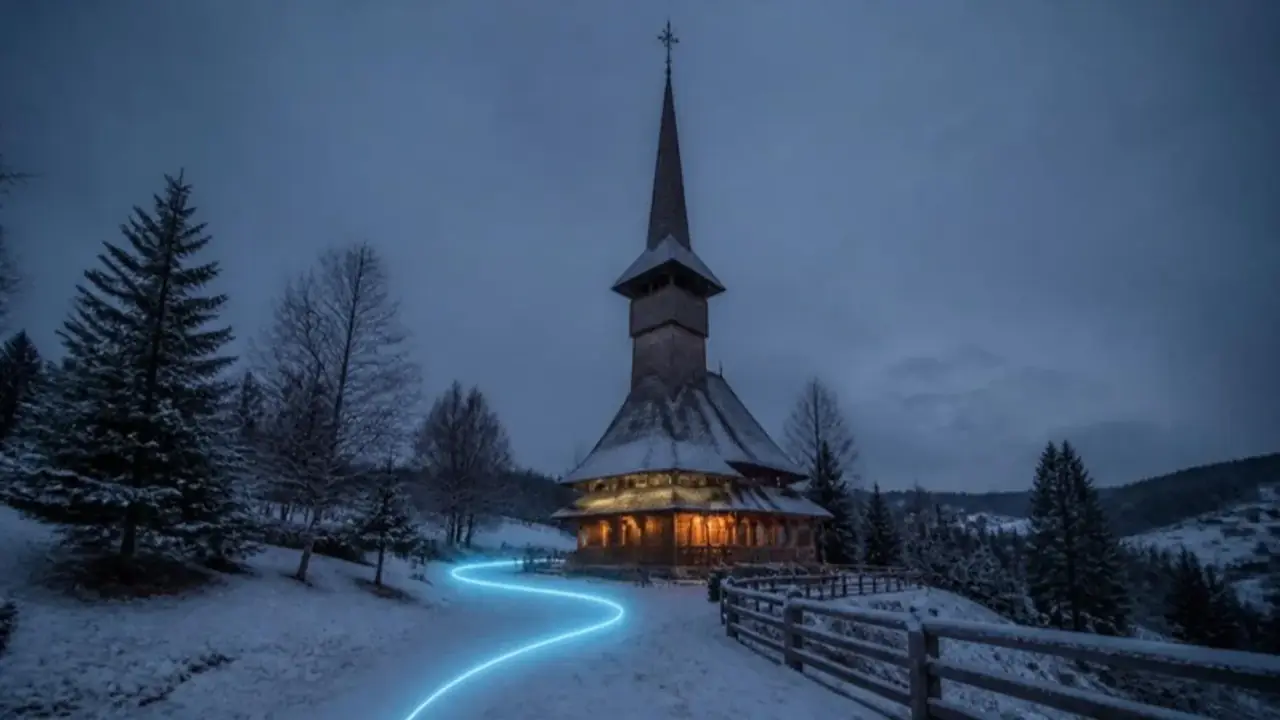
Article 139 of the Labour Code lists 17 non-working public holidays, since Law 52/2023 added 6 and 7 January from 2024.
The state switched to the Gregorian calendar in 1919, the church only in 1924. It still calculates Easter on the old calendar.
In 2027 Western Easter is on 28 March and Orthodox Easter on 2 May, with Good Friday on 30 April and 1 May on a Saturday.
The land register extract for authentication is valid for 10 working days (Law 7/1996). A holiday in the middle shortens the real window.
Since 25 February 2026, under Emergency Ordinance 7/2026, a certificate of no local tax debts is required from the buyer as well as the seller.
Faith, holidays and business: the short answer
Romania is a mostly Orthodox country. In the 2021 census, about 85% of those who stated a religion said they were Orthodox, a little under 14 million people. The Romanian Labour Code lists 17 public holidays on which nobody works, most of them Christian feasts. Two of them, Orthodox Easter and Pentecost (Rusalii), move every year, and not always in step with the Easter you may know from Western Europe.
Why should a home buyer care? Because a Romanian purchase relies on several documents whose validity is counted in working days, and on public offices that close on holidays. If you book a notary signing the week before Easter without checking the calendar, you may find that the land register extract has expired, the certificate from the town hall has not arrived, and everyone has gone home to the countryside.
In plain terms: in Romania, the church calendar still sets the deal calendar. Check it before you pick a date.
Timeline: from the church to the notary's desk
| When | What happened | Source |
|---|---|---|
| 1885 | The Ecumenical Patriarchate in Constantinople recognises the independence (autocephaly) of the Romanian Orthodox Church | World Council of Churches |
| 1919 | The state switches to the Gregorian calendar: 31 March 1919 is followed by 14 April | Historia |
| 1924 | The church adopts the revised calendar: 1 October becomes 14 October. Easter stays on the old reckoning | Historia |
| 1925 | The head of the Romanian church is raised to the rank of Patriarch | World Council of Churches |
| 1990 | Law 10/1990 makes 1 December Romania's National Day | Legislative portal |
| 2012 | Law 147/2012 adds 30 November, Saint Andrew's Day, to the list of holidays | Europa Liberă |
| 2024 | Under Law 52/2023, 6 and 7 January are added and the total rises to 17 | MMC Law |
| 26.10.2025 | Bucharest's National Cathedral is consecrated by the Ecumenical Patriarch and the Romanian Patriarch | Archdiocese of Bucharest |
| 25.2.2026 | Emergency Ordinance 7/2026: the buyer, not only the seller, needs a local tax clearance certificate | Notary office Stoica |
The story: five years, two calendars
In spring 1919, just after the Great Union, Romania discovered it was living in several times at once. Transylvania and Bukovina, formerly under Austro-Hungarian rule, already used the Gregorian calendar. The old kingdom used the Julian calendar, which ran 13 days behind. The state settled it by decree: 31 March 1919 was followed directly by 14 April.
The church refused. For five years Romania ran on two clocks: the state's and the church's. Only in 1924 did the Holy Synod adopt the revised calendar, and on 1 October people wrote 14 October. According to Historia, Roman Ciorogariu, the bishop of Oradea, explained it to his flock in that year's Christmas letter as moving forward a clock that runs slow.
But the compromise left one thread loose. Fixed feasts, such as Christmas on 25 December, moved to the new calendar. Easter, however, the Orthodox churches kept calculating on the old one. That is why Orthodox Easter still usually falls on a different date from Western Easter. In 2027, for example, Western Easter is on 28 March and Orthodox Easter on 2 May. In 2028 both fall on the same day, 16 April.
Why do I tell this story? Because every year I see buyers from Israel plan a signing trip around "Easter in Europe", only to find that in Bucharest Easter is just beginning.
The 17 holidays: the list to pin next to your diary
Article 139 of the Romanian Labour Code lists the public holidays on which nobody works:
| Date | Holiday | What it means for a deal |
|---|---|---|
| 1 and 2 January | New Year | The late-December holiday week runs into it |
| 6 January | Epiphany (Boboteaza) | A holiday by law since 2024 |
| 7 January | Saint John the Baptist (Sfântul Ion) | Also the name day of many people called Ion or Ioana |
| 24 January | Union of the Principalities (1859) | National holiday |
| Friday before Easter | Good Friday | Start of a long weekend |
| Easter Sunday and Monday | Orthodox Easter | Moves every year |
| 1 May | Labour Day | Sometimes right next to Easter |
| 1 June | Children's Day | |
| Pentecost Sunday and Monday | Rusalii | Seven weeks after Easter |
| 15 August | Dormition of the Virgin (Adormirea Maicii Domnului) | In the middle of the holiday season |
| 30 November | Saint Andrew, patron of Romania | Next to the National Day |
| 1 December | National Day | Marks the 1918 union |
| 25 and 26 December | Christmas | On the revised calendar, not on 7 January |
Two small details in the same article are worth knowing. First: by 15 January each year the government decides "bridge" days (punte) for public-sector staff, working days next to a holiday that are given off. So a public office may be closed on a day that is not on the list. Second: for members of recognised non-Christian faiths, including the Jewish community, the law grants two days off for each of the three annual holidays their faith designates.
The year ahead
| When | What falls |
|---|---|
| Mon 30.11.2026 and Tue 1.12.2026 | Saint Andrew and the National Day: a four-day weekend |
| Fri 25.12 and Sat 26.12.2026 | Christmas |
| Fri 1.1 and Sat 2.1.2027 | New Year |
| Wed 6.1 and Thu 7.1.2027 | Epiphany and Saint John |
| Fri 30.4 to Mon 3.5.2027 | Good Friday, 1 May on a Saturday, and Easter on 2 and 3 May |
| Tue 1.6.2027 | Children's Day |
| Sun 20.6 and Mon 21.6.2027 | Rusalii |
| Sun 15.8.2027 | Dormition |
| Tue 30.11 and Wed 1.12.2027 | Saint Andrew and the National Day |
The government has not yet set the 2027 bridge days. They will be published by 15 January 2027.
In Romania, the church calendar still sets the deal calendar.
Why it matters for the deal: three clocks that run in working days
The extract for authentication
Before a signing, the notary orders a land register extract for authentication (extras de carte funciară pentru autentificare). Under Law 7/1996, this extract is valid for 10 working days from the date the request is filed, and during that time the registrar records nothing else on the property except the transaction it was issued for. That is an important protection for the buyer. But 10 working days around Easter or the end of December are much longer than two calendar weeks. What the extract is and what to look for, in our article on the land register extract.
The local tax certificate
There is no signing without a certificate showing no local tax debts (certificat de atestare fiscală). Under Emergency Ordinance 7/2026, published and in force on 25 February 2026, the buyer needs one too, and according to Bucharest notaries a deed signed without it is void. The certificate comes from the local authority's tax department, or through an electronic check where the authority supports it. The law does not spell out how this applies to a foreign buyer with no Romanian address. Ask the notary early, and certainly not the week before a holiday.
The money, across two calendars
A transfer from Israel crosses two holiday calendars: the Jewish holidays in Israel and the Orthodox holidays in Romania. In some years they fall in the same week. I recommend planning for the money to reach the account a few working days before the signing, and checking with both banks which days they are closed. On the transfer itself, see our article on transferring money to Romania.
Business in Romania: what I learned at the table
I write this section from my own experience, not from a book. Romania is diverse, and people differ.
- Polite address. Romanian has a formal "you", dumneavoastră. At a first meeting you use it, together with domnule (sir) and doamnă (madam). The switch to first names happens when the other side offers it.
- A meeting, then an email. Many agreements are reached in conversation, over coffee. Whatever is not then written in an email and in the contract does not exist. That is true of every deal, and doubly so when the contract is in Romanian.
- Calm negotiation. The usual Israeli pressure, "give me an answer by tomorrow", works less well. What works: precise questions, organised documents, and time to check.
- Holidays are family time. At Easter and Christmas many Bucharest residents travel to the countryside to family. Do not expect quick answers on those days, and do not schedule the critical step of the deal then.
- A small greeting goes a long way. In the week after Easter you will hear Hristos a înviat ("Christ is risen"), and the usual reply is Adevărat a înviat ("Truly He is risen"). Many people also celebrate their name day. "La mulți ani", many years, works for both.
And in Bucharest itself, the church is part of the skyline. The National Cathedral, next to the Palace of Parliament, was consecrated in October 2025, and you will see it from many points in the city. On the neighbourhoods around it, see our guide to Bucharest's neighbourhoods.
What this means for you as a buyer
- Before you set a signing date, check the table above and the bridge days the government publishes by 15 January.
- Do not sign on the day before a long weekend. Leave a buffer of several working days in case one document is late.
- Count working days, not days. The extract for authentication is valid for 10 working days, and one holiday in the middle shortens the real window.
- A tax certificate from both sides. Since February 2026 the buyer needs one too. Ask the notary how to obtain it in your case.
- Align two holiday calendars. Check the holidays in Israel and in Romania, and plan for the money to arrive before the signing.
- If you cannot fly, sign a power of attorney in advance. We explained how in our article on powers of attorney in Romania, and the whole remote timeline in our article on buying remotely.
- An independent lawyer. That is the person who checks that dates, documents and money line up. What the notary does and does not do, in our guide to the Romanian notary.
Frequently asked questions
How many public holidays does Romania have?
Under Article 139 of the Labour Code, 17 non-working public holidays, since Law 52/2023 added 6 and 7 January from 2024. On top of that, the government can set bridge days for public-sector staff, and members of recognised non-Christian faiths get days off for their own holidays.
Why does Easter in Romania fall on a different date from Western Europe?
Because in 1924 the Romanian church adopted the revised calendar for fixed feasts but still calculates Easter on the Julian calendar, like the other Orthodox churches. Sometimes the dates coincide, as in 2028, and sometimes they are five weeks apart, as in 2027.
Is Christmas in Romania on 25 December or 7 January?
On 25 and 26 December. Since 1924 the Romanian church has celebrated fixed feasts on the revised calendar. On 7 January Romania marks a different feast, Saint John the Baptist, which became an official public holiday in 2024.
Can I sign at a notary on a public holiday?
In practice, most notary offices are closed on holidays, and even if one is open, the public offices the notary needs documents from are not. The land register and local tax departments work on working days only. So plan the signing for an ordinary working day, well away from a long weekend.
When is it busiest or quietest to close a deal in Romania?
In my experience, the weeks around Orthodox Easter, mid-August, and late December until after 7 January are slow. Late November, with its two back-to-back holidays, also needs planning. Outside those windows it is easier to coordinate the notary, lawyers and banks.
The bottom line
The church kept its own calendar for five years, and to this day it decides when Romania stops. For a buyer this is not a matter of faith. It is a matter of the diary: 17 holidays, two moving feasts, and three documents counted in working days.
If you are planning a signing in Romania and want a timeline that does not get stuck on a holiday, book a half-hour call with me. We will go through the dates and the documents together.
Moti Azulay, Compass Group Romania
Sources: Labour Code, Article 139 (codulmuncii.ro) · MMC Law, Law 52/2023 · Law 10/1990 (legislatie.just.ro) · Europa Liberă, Saint Andrew's Day · Europa Liberă, religion in the 2021 census · National Institute of Statistics, 2021 census results · World Council of Churches: Romanian Orthodox Church · Historia, the calendar reform · Archdiocese of Bucharest, consecration of the National Cathedral · Law 7/1996, the extract for authentication (legeaz.net) · Notary office Stoica, Emergency Ordinance 7/2026 · 2027 holiday calendar (liberelegale.ro)
This article is general information only and is not legal, tax or financial advice. Rules and dates are correct as of 17 October 2026, and the 2027 bridge days have not yet been set. Before you fix a signing date, check with the notary and an independent lawyer.
The series: a history lesson
- From Rome and Dacia: why Romanian is a Latin language
- Three principalities and two unions: 1859 and 1918
- Nationalisation and restitution: why land claims still exist
- The rise and fall of Ceaușescu
- 1989 and the move to a market economy
- The EU and Schengen
- Faith, holidays and business (you are here)
- The Jews of Romania and the bond with Israel
- Bucharest, "Little Paris"
Now you know more.
This article is general information, not legal, tax or financial advice. Consult local professionals before any transaction.

