Bucharest's tallest concrete building, from 1935 to 1936, collapsed in the earthquake of 10 November 1940. It was not designed for quakes.
According to Știrile ProTV, of the 33 tall buildings that collapsed in Bucharest in 1977, 28 had been built before 1940.
The P13-63 code came into force in 1963. After the 1977 quake the code was revised repeatedly, and since 2014 P100-1/2013 applies.
A privately owned historic monument may be sold only after the state has had the chance to buy it. Without that, the sale is void (Article 4).
Until a protection zone is defined, the law sets a 100 m radius around a monument in towns. Works inside it need the Culture Ministry's approval.
Bucharest, "Little Paris": the short answer
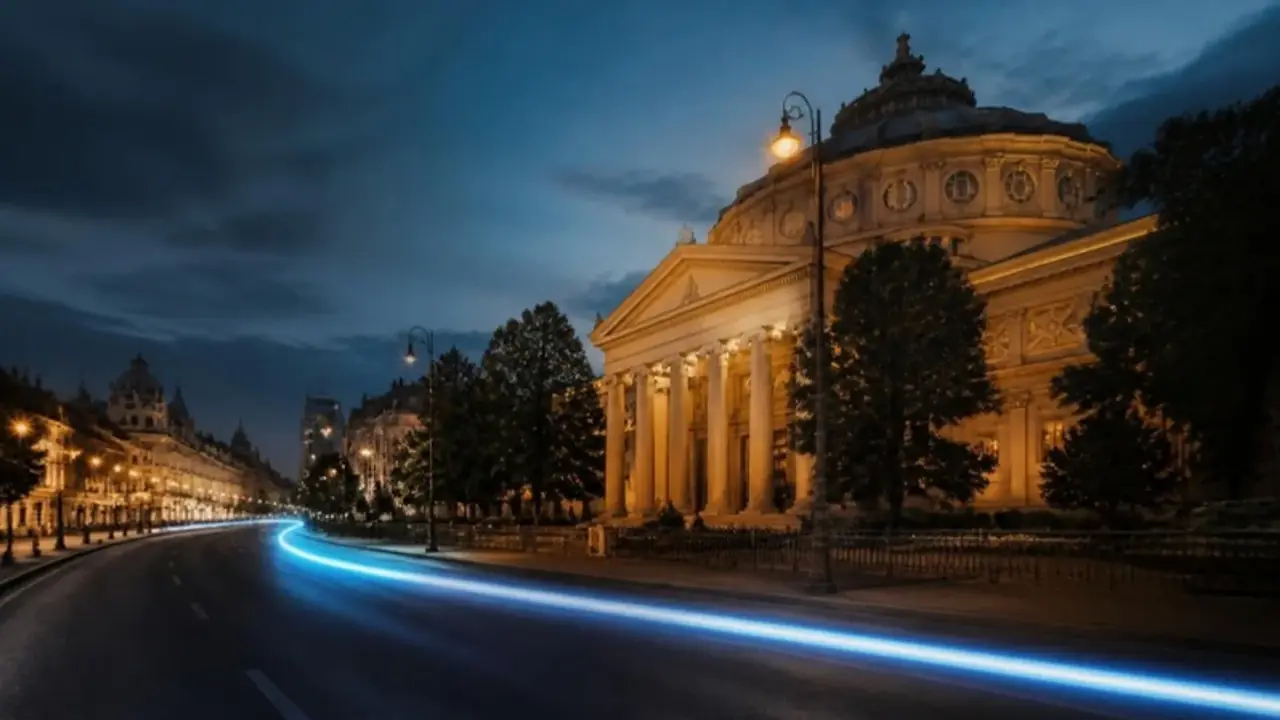
In the late 19th century and between the two world wars, Bucharest was rebuilt on French lines. According to the Romanian Cultural Institute, the Romanian Athenaeum, the Palace of Justice, the CEC Palace and the National Bank are emblems of that modernisation. In the 1930s came tall modern blocks in reinforced concrete along the central boulevards. Hence the nickname "Little Paris", Micul Paris.
For today's buyer, that beauty comes with two questions. The first is the structure: according to research from the national institute URBAN-INCERC, tall reinforced-concrete buildings put up before 1940 were built when seismic design requirements were not yet mandatory. The second is heritage: a building that is a historic monument, or stands in a protected area, needs the Culture Ministry's approval for any change, and when a monument is sold the state has a right of first refusal.
In plain terms: in Bucharest, the construction year is the first thing to check. It tells you which code the structure was built to, and whether the building carries heritage restrictions.
Timeline: from Calea Victoriei to today's code
| When | What happened | Source |
|---|---|---|
| 1692 | Podul Mogoșoaiei is cut, linking the princely court to Constantin Brâncoveanu's estate at Mogoșoaia | Museum of Bucharest |
| 1878 | After the War of Independence, the street is renamed Calea Victoriei, "Victory Road" | Museum of Bucharest |
| 1882 | Calea Victoriei becomes the first street in Bucharest with electric lighting | Museum of Bucharest |
| Late 1880s | The Romanian Athenaeum is built to designs by the French architect Albert Galleron, paid for by public subscription | Romanian Cultural Institute |
| 1933 | The Telephone Palace, an Art Deco building on Calea Victoriei, is completed. Today it is a historic monument | HotNews |
| 1935 to 1936 | The Carlton block is built, the tallest reinforced-concrete building in the city | URBAN-INCERC |
| 10.11.1940 | An earthquake from Vrancea. The Carlton block collapses | URBAN-INCERC |
| 1963 | The P13-63 seismic code comes into force | URBAN-INCERC |
| 4.3.1977 | The great earthquake: 1,578 dead, 90% of them in Bucharest | Georgescu and Pomonis |
| 1978 | A new version of the seismic code after the quake, followed by versions in 1981, 1991 to 1992 and 2006 | URBAN-INCERC |
| 2000 | The city council approves 98 "protected built zones" | Buletin de București |
| 2001 | Law 422/2001 on the protection of historic monuments | Law 422/2001, consolidated text |
| 1.1.2014 | The P100-1/2013 code comes into force | Revista Construcțiilor |
| 15.10.2026 | The Telephone Palace is put up for sale | HotNews |
The story: the Carlton block, 10 November 1940
In the mid-1930s, on the corner of Brătianu Boulevard and Regală Street, rose the building that was meant to stand for the new Bucharest. The Carlton block was designed by the architect G. M. Cantacuzino, one of the leading names of the new generation, and built in 1935 and 1936. At its centre stood a tower of 12 floors above the ground floor, with a cinema hall behind. According to research by Dr Emil-Sever Georgescu of URBAN-INCERC, it was the tallest reinforced-concrete building in Bucharest and in all of Romania. Only the Telephone Palace, with its steel frame, was taller.
In October 1940 an earlier earthquake had already damaged beams and walls. According to the same research, that damage became public only after the disaster. In the night of 9 to 10 November 1940 a strong earthquake struck from Vrancea, and the building collapsed into the boulevard.
The experts of the day found that the structure had not been calculated for earthquakes at all. They found concrete of varying quality, an asymmetric design and columns of unusual shapes. According to Georgescu, it was the first collapse in Europe of a modern tall reinforced-concrete building in an earthquake, and afterwards a fear of living in apartment blocks spread through the city for a while.
That is the lesson of "Little Paris": the city was built beautifully and fast, before it had rules for earthquakes. After 1940 seismic requirements were set for the first time, initially for public buildings, and only in 1963 did a full code arrive.
How Bucharest became "Little Paris"
The spine of the story is Calea Victoriei. According to the Museum of Bucharest, Podul Mogoșoaiei was cut in 1692, and from the 18th century the great boyar families settled along it. In 1878, after the army returned from the War of Independence, the street took its current name, and in 1882 it became the first in the city to be lit by electricity.
In the late 19th century the city gained its great public buildings. According to the Romanian Cultural Institute, the Romanian Athenaeum, the Palace of Justice, the CEC Palace and the National Bank are emblems of a modernisation under the direct influence of French architecture. The Athenaeum was designed by a French architect, and the money to build it was collected from the public.
In Bucharest, the construction year is the first thing to check.
In the 1930s came the second, modernist wave: tall reinforced-concrete blocks along the central boulevards, and the 1933 Telephone Palace on Calea Victoriei. These are the buildings that were hit in 1940, and again on 4 March 1977. According to Știrile ProTV, of the 33 tall buildings that collapsed in Bucharest then, 28 had been built before 1940. On the earthquakes themselves, and the "red dot" list, see our article on earthquake risk in Bucharest. In the 1980s much of the old city was demolished for the Civic Centre, a story told in the episode on Ceaușescu.
What the era tells you about the structure
| Built | What to expect | What to check |
|---|---|---|
| Up to 1940, low house or palace | Brick construction, often a monument or within a protected area | Engineering report, and heritage status |
| 1920 to 1940, tall concrete block | Built with no mandatory seismic design. Most of the 1940 and 1977 collapses were in this group | The seismic risk list, an engineering report, and whether it was strengthened |
| 1941 to 1963 | Provisional rules, mainly for public buildings | Engineering report |
| 1963 to 1977 | The P13-63 and P13-70 codes. Many performed well in 1977, but buildings with an open commercial ground floor were badly damaged | What is on the ground floor, and whether walls were removed there |
| 1978 to 2013 | The post-1977 versions of the code | The design year, and alterations made to the flat |
| From 2014 | The P100-1/2013 code | Who designed and who checked the structure, from the building permit |
This table is a rule of thumb, not an engineering opinion. What counts is the building itself. Under Law 212/2022, a building that has undergone a technical survey is placed in one of four risk classes, from RsI, the highest, to RsIV. An old building that has never been surveyed is not a safe building. It is a building nobody knows about yet.
Monuments and protected areas: what it means for you
Romania keeps an official list of historic monuments, and Law 422/2001 sets out what may be done with them. Three provisions matter to a buyer:
- The state's right of first refusal (Article 4). A privately owned monument may be sold only after the state has had the chance to buy it, through the Culture Ministry or its local office. The ministry has up to 25 days to reply. The price is negotiated with the seller. If the ministry declines, the right passes to the local authority, which has up to 30 working days. A sale without this procedure is absolutely void.
- Approval for every change (Article 23). Any work that alters the fabric or appearance of a monument, whether strengthening, an extension, a sign or a change of use, needs the Culture Ministry's approval. A building permit issued without it is void.
- The neighbours are included too (Articles 24 and 59). A building that is not a monument but lies in a monument's protection zone or in a protected built zone also needs the Culture Ministry's approval for works. Until a monument's protection zone has been defined, the law sets it as a 100-metre radius around it in towns.
Bucharest also has 98 "protected built zones" (zone construite protejate), approved by the city council in 2000. The legal standing of that decision has since been disputed in court, so do not rely on an old map. The rules that actually apply to a given building appear in the urban planning certificate (certificat de urbanism) issued by the town hall. How to request one and what to check in it, in our article on checking the permit and the plan.
An example from this week: on 15 October 2026 HotNews reported that the Telephone Palace, a historic monument on the official list, is up for sale. By law, any such sale goes through the state's right of first refusal.
What this means for you as a buyer
- Start with the construction year. Ask for it in writing, and check it against the land register extract and the building's documents.
- A tall building from before 1940: check the seismic risk list, ask for an engineering report, and ask whether it was strengthened and when that was signed off.
- A commercial ground floor: in buildings from the 1960s and 1970s, check what was done on the ground floor, and whether walls or columns were removed.
- Monument or protected area? Check the list of monuments and the urban planning certificate before you sign. For a flat in a monument, ask your lawyer how the right-of-first-refusal procedure works and who files it.
- Planning a renovation? If you intend to change the facade, windows or internal layout of a protected building, budget time for the Culture Ministry's approval.
- The right comparison. A flat in a historic building and a house built to today's code are two different products, with different strengths. A structured comparison is in our article on villa versus apartment, and the neighbourhoods themselves in our guide to Bucharest's neighbourhoods.
Frequently asked questions
Why is Bucharest called "Little Paris"?
Because of the French-inspired building of the late 19th century and the interwar years. According to the Romanian Cultural Institute, buildings such as the Romanian Athenaeum, the Palace of Justice, the CEC Palace and the National Bank were built under the direct influence of French architecture, alongside the boulevards and modern blocks of the 1930s.
Is a flat in an interwar block a risk?
Not every one, but this is the group that needs the most checking. Tall concrete blocks built before 1940 were designed with no mandatory seismic design, and according to Știrile ProTV, 28 of the 33 tall buildings that collapsed in Bucharest in 1977 were built before 1940. Check the risk class, get an engineering report, and find out whether the building was strengthened.
What is the state's right of first refusal on a monument?
Under Article 4 of Law 422/2001, a privately owned historic monument may be sold only after the state, and after it the local authority, have had the chance to buy it, at a price negotiated with the seller. A sale that skips this procedure is absolutely void.
How do I know whether a building is a monument or in a protected area?
Check the Culture Ministry's list of historic monuments, and ask the town hall for an urban planning certificate for the address. The certificate sets out the legal and planning regime that applies to the property, including heritage restrictions.
Can I renovate a flat in a protected building?
Yes, but not as you please. Works that alter the fabric or appearance of a monument, or of a building in a protection zone or protected built zone, need the Culture Ministry's approval before the building permit. Small interior works that do not touch the structure or the facade are usually simpler, but check each case with an architect.
The bottom line
"Little Paris" is why Bucharest is beautiful, and it is also why every building there is judged on its own. The Carlton block collapsed in 1940 because it was built before there were rules. Since then codes were written, lists were drawn up, and heritage laws were passed. If you know a building's era, you know which question to ask.
If you are considering a flat in a historic Bucharest building, or a new house outside the city, book a half-hour call with me. We will go through the construction year, the documents and the questions to ask.
Moti Azulay, Compass Group Romania
Sources: Museum of Bucharest, the Calea Victoriei exhibition · Romanian Cultural Institute, the Romanian Athenaeum · Romanian Cultural Institute, Bucharest: Memory Walled-In · Emil-Sever Georgescu, URBAN-INCERC, from the Carlton block to curtain walls · Georgescu and Pomonis, the 1977 earthquake, 14th World Conference on Earthquake Engineering · Știrile ProTV, the buildings that collapsed in 1977 · Revista Construcțiilor, P100-1/2013 · Bucuresti.ro, the red-dot guide and Law 212/2022 · Law 422/2001 on historic monuments, consolidated text · Buletin de București, the dispute over protected zones · HotNews, the Telephone Palace up for sale, 15.10.2026
This article is general information only and is not engineering or legal advice. The table by era is a rule of thumb. For a specific building, rely on an engineering report by a certified expert, the urban planning certificate and an independent lawyer. Rules are correct as of 17 October 2026.
The series: a history lesson
- From Rome and Dacia: why Romanian is a Latin language
- Three principalities and two unions: 1859 and 1918
- Nationalisation and restitution: why land claims still exist
- The rise and fall of Ceaușescu
- 1989 and the move to a market economy
- The EU and Schengen
- Faith, holidays and business
- The Jews of Romania and the bond with Israel
- Bucharest, "Little Paris" (you are here)
Now you know more.
This article is general information, not legal, tax or financial advice. Consult local professionals before any transaction.

