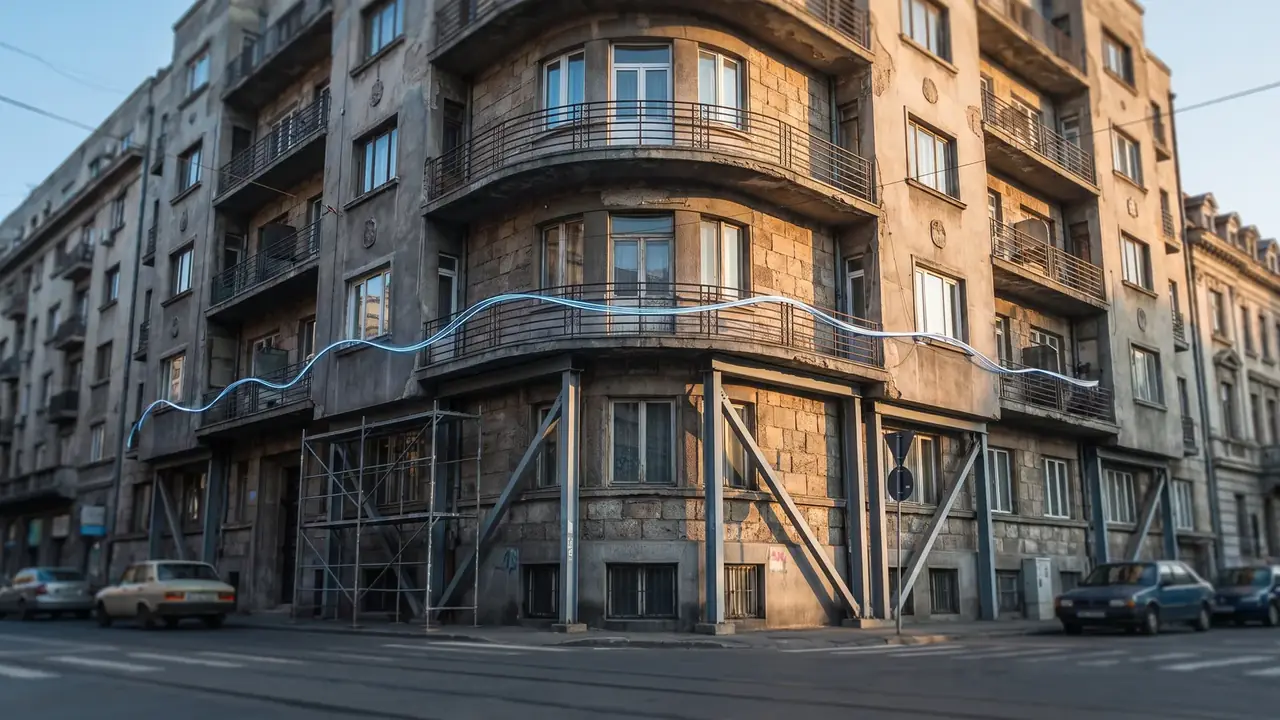
On 4 March 1977, a magnitude 7.4 Vrancea earthquake killed 1,424 people in Bucharest, mostly in older tall buildings.
The official AMCCRS list, updated in May 2026, counts more than 400 buildings in seismic risk class I, most built before 1940.
New buildings are designed under the P100 code; P100-1/2013 has applied to new design contracts since 2014.
Under Law 10/1995, hidden defects are covered for 10 years after acceptance, structural defects for the building's life.
Year built, the AMCCRS list, any assessment, the code used, who signed the structure, changes made, insurance.
Earthquake risk in Bucharest: the short answer
Bucharest is one of Europe's capitals most exposed to earthquakes, because of the deep Vrancea seismic source about 150 km to the north-east. The risk is concentrated in older buildings: the city's official list holds more than 400 buildings in seismic risk class I, the "red dot" category, most of them built before 1940. A home designed under Romania's current seismic code, P100, is in a different category altogether.
When a buyer from Israel hears "earthquake", it is not abstract. Israel also sits on a fault line, and many families remember the national drills. So when Bucharest comes up, the question is a serious one: "Is it safe to buy there?" My answer is that the risk is real, it is mapped, and it is concentrated in specific buildings. Which means it can be checked.
Why is Bucharest exposed to earthquakes?
The source is the Vrancea zone, in the bend of the Carpathians. Its earthquakes are intermediate-depth, typically between about 70 and 160 km down, so they are felt over a very wide area, and Bucharest, built on soft sediments, feels them strongly.
The defining event is the earthquake of 4 March 1977: magnitude about 7.4, at a depth of about 94 km. According to the historical record, about 1,578 people were killed in Romania, 1,424 of them in Bucharest, and more than 11,300 were injured. Most of the deaths in the capital were caused by the collapse of older tall buildings. Before that, on 10 November 1940, a magnitude 7.7 Vrancea earthquake brought down the Carlton block in central Bucharest.
The lesson the city learned is that the damage is decided by the building, not by the address.
What is the "red dot" list?
After a technical assessment, buildings found to be at the highest risk are placed in seismic risk class I (RsI) and marked with a round red sign at the entrance. The Municipal Administration for the Consolidation of Buildings with Seismic Risk (AMCCRS) publishes the official list, with the address, year of construction, number of floors and the class assigned.
| Class | What it means |
|---|---|
| RsI | High risk of collapse in a major earthquake: the "red dot" |
| RsII | Major structural damage expected, collapse unlikely |
| RsIII | Non-structural damage expected |
| RsIV | Expected response close to that of buildings designed under current codes |
According to the city's guide to the list, the version updated in May 2026 counts more than 400 buildings in class RsI, most of them in the central sectors 1, 2 and 3 and most built in 1940 or earlier.
Two things to remember. First, the list includes only buildings that were assessed: a building that is not on it was not necessarily found safe; it may simply never have been assessed. Second, a consolidation project in progress does not change the class until the work is finished and certified.
How does Romania's seismic code protect new buildings?
New buildings in Romania are designed under the P100 seismic design code. Its 2013 edition, P100-1/2013, has applied to new design contracts since 2014. It sets the design earthquake for each area, the structural requirements and the checks that a certified designer and verifier must sign.
The damage is decided by the building, not by the address.
On top of that, Law 10/1995 on quality in construction makes the designer, the contractor and the other parties liable for hidden defects for 10 years after acceptance, and for defects of the load-bearing structure for the entire life of the building.
| Building type | Typical seismic position |
|---|---|
| Built before 1940, tall, central Bucharest | Highest share of RsI buildings on the official list |
| Built 1941–1977 | Mixed; many were assessed after 1977 |
| Built 1978–2013 | Designed under post-1977 codes, generally better |
| Designed under P100-1/2013 | Current standard, with certified design and verification |
| Low-rise house, current code | Low height and current design: a different risk profile |
A two-storey villa built today under the current code is not the same risk as a 1930s block in the centre. That does not mean zero risk. It means a risk that is designed, calculated and signed.
A buyer's checklist: seven questions before you sign
- Year of construction. Ask for it in writing; check it in the land register extract and the building's documents.
- Is the building on the AMCCRS list? Search the address on the official list.
- Was it ever assessed? If it is old and not on the list, ask whether a technical assessment (expertiză tehnică) exists.
- For new construction: which code? Ask the developer to confirm that the structure was designed under P100-1/2013 and verified by a certified checker.
- Who signed the structure? The names of the structural designer and the verifier appear on the building permit documents.
- Has the structure been changed? Walls removed in old apartments are a known risk. Ask for the permit for any change.
- Insurance. Make sure the home carries PAD insurance against earthquake, flood and landslide, and consider extra cover. We explain both in our guide to home insurance in Romania.
Mandatory PAD insurance: what it covers
Every home in Romania must carry PAD, the compulsory disaster insurance under Law 260/2008. It covers earthquake, flood and landslide. For a home built of concrete or brick (type A) the premium is 130 lei a year and the maximum cover is 100,000 lei, according to the PAID insurance pool. That is a base layer, not the value of a villa, which is why most owners add optional insurance.
And north of Bucharest?
The Vrancea source affects the whole Bucharest region, Ilfov included, so the questions above apply there too. What differs in the northern suburbs is the building stock: mostly low-rise houses and new construction, far from the old tall blocks of the centre. For a picture of the area, see our guide to Balotești and our article on safety in Bucharest.
Frequently asked questions
Is Bucharest at risk of a major earthquake?
Yes. Bucharest is exposed to intermediate-depth earthquakes from the Vrancea zone. The 1977 earthquake, about magnitude 7.4, killed 1,424 people in the city. The risk is concentrated in older buildings.
What is a "red dot" building in Bucharest?
A building assessed and placed in seismic risk class I (RsI), the highest category, marked with a red sign at the entrance. The official list is published by AMCCRS.
How do I check whether a building has seismic risk?
Search the address on the AMCCRS list, check the year of construction, and for older buildings ask whether a technical assessment exists. For new buildings, ask for confirmation that the design follows the P100-1/2013 code.
Are new buildings in Romania earthquake-resistant?
New buildings must be designed under the current P100 seismic code and checked by certified specialists. Under Law 10/1995, liability for defects of the load-bearing structure lasts for the life of the building.
Is earthquake insurance mandatory in Romania?
Yes. PAD insurance, which covers earthquake, flood and landslide, is compulsory for every home. For a type A home the premium is 130 lei a year and the cover is up to 100,000 lei.
The bottom line
The earthquake risk in Bucharest is real, but it is not spread evenly. It is concentrated in older, taller buildings, and it is mapped on an official list.
The right question is not "Is Bucharest safe?" but "Is this building safe?" If you want to go through the seismic questions for a specific property, ours or any other, book a 30-minute call with me. We will go through the documents together.
Moti Azulay, Compass Group Romania
Sources and data: AMCCRS, list of buildings with seismic risk · Bucuresti.ro, guide to the red-dot list · Law 10/1995 on quality in construction · PAID, compulsory home insurance (Law 260/2008) · Georgescu and Pomonis, "The Romanian earthquake of March 4, 1977 revisited", 14th World Conference on Earthquake Engineering.
This article is for general information only and is not engineering or legal advice. For a specific building, rely on a technical assessment by a certified expert.
Now you know more.
This article is general information, not legal, tax or financial advice. Consult local professionals before any transaction.