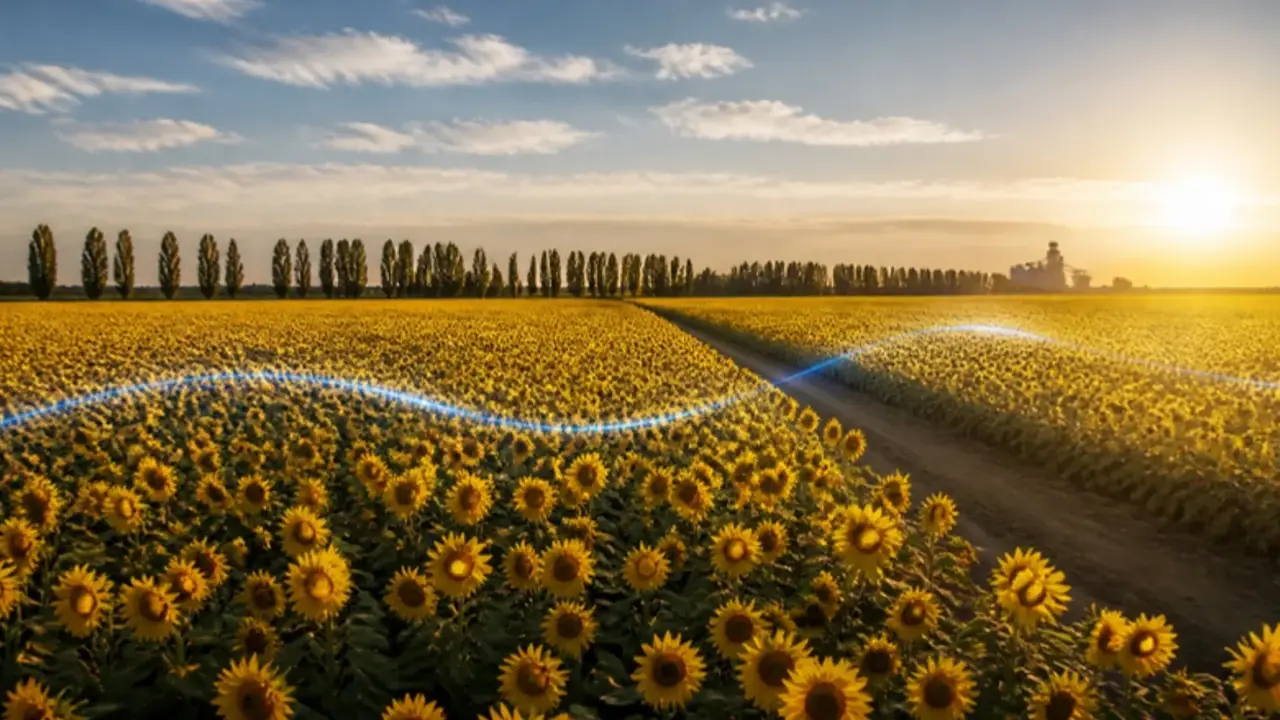
According to Eurostat, in 2025 Romania grew about 1.81 million tonnes of sunflower, about 21% of the whole EU harvest. It is third for maize and fourth for wheat.
According to Eurostat, in 2023 Romania had 2.9 million farms, about a third of all farms in the EU. 90.2% of them are smaller than 5 hectares.
With 8% of the EU's agricultural area, Romania produces 3.7% of its agricultural output (Eurostat, 2023). That is the room for productivity growth in one number.
According to INS, in 2024 the trade deficit in agri-food products was €4.9 billion. Romania exports grain and imports meat, cheese and processed food.
According to INS, in 2024 the maize harvest fell by 31.5% and cereal production by 14%. The Commission approved about €400 million of aid for farmers.
Romania's agriculture: the short answer
Romania really is one of the European Union's grain powers. According to Eurostat, in 2025 it was first in the EU for sunflower production, third for maize and fourth for wheat. It has about 8.4 million hectares of arable land, the fifth largest area in the EU. In the 2024/25 marketing year it was the EU's largest exporter of wheat, barley and maize to destinations outside the bloc.
There is also room to grow. Romania is home to about a third of all farms in the EU, and 90% of them are smaller than 5 hectares. With 8% of the EU's agricultural area, it produces 3.7% of the EU's agricultural output. It sells the world mainly wheat and maize, and buys meat, cheese and processed food. According to INS, in 2024 the trade deficit in agri-food products stood at €4.9 billion.
In plain words: Romania already grows and sells a lot, mostly as raw material. The next stage is to process the produce at home: meat, cheese and packaged food.
How much Romania grows: the 2025 numbers
According to Eurostat data, these are the 2025 figures, a good year after a hard drought year:
| Crop | Romanian production in 2025 | EU rank | Ahead of it |
|---|---|---|---|
| Soft wheat | About 12.97 million tonnes | Fourth | France, Germany, Poland |
| Grain maize | About 7.75 million tonnes | Third | France, Poland |
| Sunflower | About 1.81 million tonnes | First | None |
In sunflowers, Romania grew about 21% of the whole EU harvest (8.5 million tonnes). It also leads on area: according to Eurostat, in 2025 it had about 1.97 million hectares of maize and about 1.21 million hectares of sunflower, the largest in the EU for both crops.
Note the gap between area and harvest. In maize Romania is first by area but third by production. In other words, each hectare produces less. This is the central issue of Romanian agriculture, and we will come back to it.
2024: what one drought does to a grain power
2024 showed how dependent Romanian farming is on the weather. According to INS (provisional data of 31 March 2025), cereal production fell by 14%, from 20.8 million tonnes to 17.9 million tonnes. Maize fell by 31.5%, from 8.7 to 6.0 million tonnes. Sunflower fell by 26%, from 2.0 to 1.5 million tonnes. Production of vegetables, grapes and fruit also fell.
According to Eurostat's first estimate, agricultural labour productivity in Romania fell by 16.8% in 2024, the sharpest fall in the EU. In October 2024 the European Commission approved a €400 million (2 billion lei) state aid scheme for Romanian farmers hit by the drought. The aid is for those who lost more than 30% of their harvest, and amounts to up to €200 per hectare for a total loss.
In 2025 the harvest recovered. But 2026 was not quiet either: according to Economica, in its July 2026 report the European Commission lowered its forecast for Romania's maize and sunflower, because of drought and heat in July. The forecast for maize stood at about 7.8 million tonnes, and for sunflower at about 2.2 million tonnes.
What this means: most of Romania's land is not irrigated, so the harvest swings sharply from year to year. First place in sunflowers is renewed in every good year, and irrigation is one of the levers to stabilise it.
2.9 million farms: two agricultures in one country
This is where the big difference between Romania and France or Germany lies. According to Eurostat, in 2023 there were 8.8 million farms in the EU. 2.9 million of them, 32.6%, were in Romania. Most of these farms are tiny:
- 90.2% of farms in Romania are smaller than 5 hectares (Eurostat, 2023).
- 4.39 hectares is the average farm size in Romania, according to the INS farm structure survey for 2023. The EU average, according to Eurostat: 17.8 hectares.
- About 25,000 farms are companies with legal personality. Their average area: 190.51 hectares.
In other words, there are two agricultures here. On one side, millions of rural households growing for themselves and for the local market. On the other, a few tens of thousands of medium and large companies growing most of the grain that goes out by sea.
Productivity: where the next growth lies
The data show how much room there is to grow between the number of people and the amount of land on the one hand, and the value they produce on the other:
The added value lies in processing, and that is where Romania's opportunity lies.
| Indicator | Romania | EU average | Source |
|---|---|---|---|
| Share of EU farms | 32.6% | Not applicable | Eurostat, 2023 |
| Share of EU agricultural area | 8.0% | Not applicable | Eurostat, 2023 |
| Share of EU agricultural output | 3.7% | Not applicable | Eurostat, 2023 |
| Farm workers as a share of all employment | About 10.9% | About 3.2% | World Bank (ILO estimate), 2025 |
| Agriculture as a share of GDP | About 3.0% | About 1.6% | World Bank, 2025 |
Reading the table is analysis, not a measured fact: when about a tenth of the workforce produces about 3% of GDP, productivity per worker is much lower than in the rest of the economy. That fits the picture of small farms, little machinery and irrigation, and little processing of produce inside the country.
What Romania sells, and what it buys
In the 2024/25 marketing year (July 2024 to June 2025), according to European Commission data published by the Dutch agriculture ministry, Romania was the EU's largest exporter to destinations outside the EU in three crops: about 5.48 million tonnes of soft wheat, about 2.07 million tonnes of barley and about 1.23 million tonnes of maize. To be precise: this is a ranking of exports to markets outside the EU, not of all exports.
On the other side of the balance:
- 2024: according to INS, the trade deficit in agri-food products was €4.9 billion, 14.7% of the entire goods trade deficit. 31 basic products alone created a deficit of more than €4 billion. In pork alone the deficit exceeded €1 billion, and in cow's milk cheese €400 million.
- 2025: according to HotNews, based on INS data, Romania imported more than €11 billion of food, and the food deficit was close to €4 billion.
- The BCR analysis: the bank's research department, based on Eurostat data, found in 2025 that Romania is a net exporter of agricultural raw materials, but its deficit in processed food is the fifth worst in the EU.
In plain words: the wheat leaves through the port of Constanța, and bread, meat and packaged cheese arrive by truck. The added value lies in processing, and that is where Romania's opportunity lies.
The port of Constanța: the grain gateway
Most Romanian grain that goes out by sea passes through Constanța. According to data from the Constanța Maritime Ports Administration, published by Ziarul Financiar in July 2026, the volume of cereals handled by the port has fallen over the past three years:
| Year | Cereals at the port of Constanța | All cargo at the port |
|---|---|---|
| 2023 | 36 million tonnes | 92.6 million tonnes |
| 2024 | 26.9 million tonnes | 77.5 million tonnes |
| 2025 | 18.3 million tonnes | 67 million tonnes |
These figures also include Ukrainian grain that passed through the port, not only Romanian grain. The 2023 peak is linked to the war in Ukraine, when part of its grain was routed through Romania. Since then Ukraine has gone back to exporting more from its own ports. The fall in 2025 also came with low harvests the year before and low prices.
Who the big players are
- Agricost. Romania's largest farm, owned by the Al Dahra group from Abu Dhabi. According to Economica, the company farms about 57,000 hectares on Insula Mare a Brăilei, state land under lease. Turnover in 2025: 729.3 million lei.
- Other large farms. On the same list, based on the areas declared to the payments agency APIA: Intercereal with about 23,000 hectares, and JD Agro Cocora, owned by Danish investors, with about 17,500 hectares.
- The grain traders. According to Ziarul Financiar, in 2025 Cargill moved into first place in Romania's grain market, with turnover of almost 4 billion lei, and Ameropa was second with 3.5 billion lei.
The picture here is clear: the large grain trade is run mainly by international corporations, and the large estates are farmed by companies with foreign and local owners.
Then and now: from the collective farm to the family farm
In 1949 the communist regime decided to collectivise agriculture, and the process was completed in 1962 (Lup, Miron and Alim, 2018). According to ARC2020, by the end about 93% of Romania's farmland was in collective structures. In the 1980s, to repay the foreign debt, the regime exported food and other goods at the expense of consumption at home, as the Christian Science Monitor described in December 1989. We set out the story of rationing and the debt in our article on Ceaușescu's rise and fall.
After 1989 came Law 18/1991, which returned land to its former owners. At first, according to Lup and colleagues, up to 10 hectares were returned per family. This restitution, which divided the land among many families, may explain much of today's structure: millions of small plots. We set out the story of restitution and what it left in the land registers in our article on nationalisation and restitution.
| The 1980s | Today | |
|---|---|---|
| Land ownership | About 93% in collective structures and state farms | Private: millions of small plots alongside large companies |
| Who decides what to grow | A central plan | The market, prices and EU farm policy rules |
| Where the produce goes | Exports to pay the debt, rationing at home | Free exports, mainly raw grain |
| Support | The state | About €14.9 billion from the EU programme for 2023 to 2027 |
Money from Brussels: the Common Agricultural Policy
In December 2022 the European Commission approved Romania's strategic plan for the Common Agricultural Policy (CAP) for 2023 to 2027, with an EU budget of €14.9 billion. According to the Commission, farms of less than 50 hectares receive an additional payment, and about €1.1 billion is earmarked for investment in farms and processing plants. We set out the wider picture of EU funds in Romania in our article on EU funds and infrastructure.
Frequently asked questions
In what sense is Romania "Europe's breadbasket"?
In 2025 it was first in the EU for sunflowers, third for maize and fourth for wheat (Eurostat). In wheat, France still produces more than two and a half times as much, but in sunflowers and in maize area Romania leads the EU.
If Romania exports so much, why does it have a food deficit?
Because it mainly exports raw grain and imports processed food, meat and dairy products. According to INS, in 2024 the trade deficit in agri-food products was €4.9 billion.
Why are there so many small farms?
One possible explanation is the restitution after 1989: Law 18/1991 initially returned up to 10 hectares to owners, and the land was divided among many families. According to Eurostat, in 2023 90.2% of farms were smaller than 5 hectares.
How much did the 2024 drought cost?
According to INS, the maize harvest fell by 31.5% and cereal production by 14%. The European Commission approved an aid scheme of about €400 million for Romanian farmers who were affected.
Does this matter to people living in Bucharest?
Indirectly. The markets are full of local produce in season, but much of the meat and packaged food in the supermarket is imported. If you want to see the local side, see our guide to Bucharest's food markets.
The bottom line
Romania is an agricultural power of the EU. In grain and sunflowers it is a leading player, and in good years it is among the largest exporters. The next chapter is already marked out in the data: connect the millions of small farms to the market, irrigate, and process at home more of the produce that today leaves as raw material. Romanian agriculture is a story of abundance in the field, and the food industry is its next stage.
The road here is interesting too. The communist regime concentrated the land and exported food at the expense of the population. Today's structure was born from dismantling that structure, and from the money and markets that opened up with EU accession.
Moti Azulay, Compass Group Romania
Sources: Eurostat, crop production (apro_cpsh1) · Eurostat, farms and farmland in the EU · INS, crop production in 2024, 31.3.2025 (Agrointel copy) · Dutch agriculture ministry, INS farm structure survey 2023 · Dutch agriculture ministry, grain exports 2024/25 · World Bank, employment in agriculture · World Bank, agriculture as a share of GDP · World Bank, arable land · Economedia, agricultural labour productivity 2024 · Newsweek România, INS bulletin, 4.11.2025 · HotNews, the 2025 trade deficit · Curs de Guvernare, BCR analysis · Ziarul Financiar, port operators 2026 · Ziarul Financiar, grain traders 2025 · Economica, the largest farms 2025 · Economica, the 2026 harvest forecast · European Commission, approval of Romania's CAP plan · European Commission, daily news 24.10.2024 · Lup, Miron, Alim, agrarian reforms and policy in Romania 1918 to 2018 · ARC2020, cooperatives in Romania · Christian Science Monitor, 26.12.1989
This article is for general information only and is not investment advice. Some of the harvest data for 2024 and 2025 is provisional and may be revised, and different sources (INS, Eurostat, the Commission) sometimes give slightly different numbers. Correct as of 23 October 2026.
Forget the dictatorship economy
- Forget the dictatorship economy: the new Romania
- Who earns what in Romania today
- Agriculture: Europe's breadbasket (you are here)
- Finance: banks, the stock exchange and money
- Tech: from UiPath to Bitdefender
- Food and wine
- Culture: festivals, film and music
- Abundance: malls, consumption and brands
- Western brands: consulting, accounting and hotels
- What drives growth: EU funds versus investment
- From dictatorship to market economy: what remained and what was built
Now you know more.
This article is general information, not legal, tax or financial advice. Consult local professionals before any transaction.

