
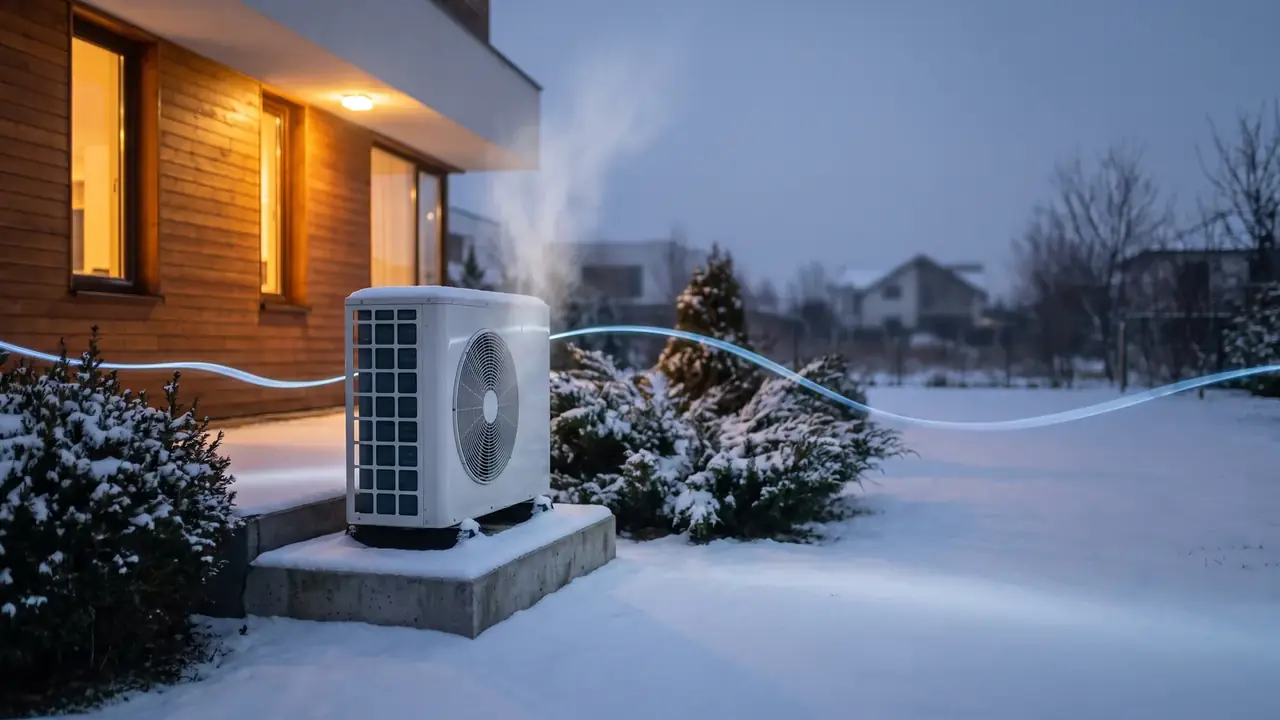
Electric underfloor heating turns each kWh of electricity into one kWh of heat. Fine for a bathroom, less so for a whole house.
A heat pump works best with lukewarm water, which is exactly what underfloor heating needs. In our illustration: about 1,600 kWh of electricity for 7,200 kWh of heat.
Manufacturers commonly cite 0.15 m²K/W as the maximum thermal resistance of a floor covering on underfloor heating. Tiles and stone are best.
Underfloor heating in Romania: the short answer
Underfloor heating warms a room from the floor up, through pipes with warm water or electric cables laid under the floor finish. In a new, well-insulated villa it is one of the most comfortable ways to heat: no radiators on the walls, even warmth, and warm floors during a Bucharest winter.
There are two families. Water-based (hydronic) systems circulate water from a heat source, usually a heat pump or a gas boiler, through pipes in the screed. Electric systems use heating cables, mats or films. Water-based systems cost more to install and less to run. Electric systems are cheaper to install but turn each kWh of electricity into only one kWh of heat.
In plain words: underfloor heating and a heat pump are a natural pair, because the floor needs only lukewarm water. Electric underfloor heating makes sense in a bathroom, not usually as the heating for a whole villa.
Water or electric: side by side
| Water-based (hydronic) | Electric | |
|---|---|---|
| How it heats | Warm water from a heat pump or boiler through pipes in the screed | Cables, mats or films under the finish |
| Installation | More work: pipes, manifold, screed, connection to the heat source | Simpler and thinner, especially in renovations |
| Running cost | Depends on the heat source; with a heat pump, well below direct electric | Every kWh of heat costs a full kWh of electricity |
| Warm-up | Slow, because the screed has thermal mass | Faster, especially thin systems under tiles |
| Typical use | Whole house | Bathrooms, small areas, extra comfort |
| Repairs | Pipes rarely fail if laid correctly; the manifold and heat source need service | Few moving parts; a damaged cable means lifting the floor |
Why a heat pump likes underfloor heating
A heat pump's efficiency depends on how hot it has to make the water. The cooler the water it supplies, the more heat it produces for each kWh of electricity. Underfloor heating spreads heat across the whole floor area, so it can work with lukewarm water, while radiators need hotter water to give the same heat from a smaller surface.
That is why the same heat pump can perform very differently in two houses. In our comparison of heat pumps and gas, we used a seasonal efficiency (SCOP) of 3.5 for an ordinary case and 4.5 for the best case, and the best case is typical with underfloor heating.
An illustration in kWh. Take the assumption from that article: a new, insulated 180 m² villa that needs about 7,200 kWh of heat a year.
| System | Electricity needed for 7,200 kWh of heat |
|---|---|
| Direct electric underfloor heating | about 7,200 kWh |
| Heat pump, SCOP 3.5 | about 2,060 kWh |
| Heat pump, SCOP 4.5 | about 1,600 kWh |
Multiply by your electricity tariff to get the bill. The calculation covers space heating only and is for illustration. If the house has solar panels, part of that electricity comes from the roof, though winter output is low exactly when demand is highest. More in our guide to solar panels for a villa.
Floor finishes: what works on a heated floor
Every floor finish slows heat on its way into the room. The measure is thermal resistance, R, calculated as the thickness of the material divided by its thermal conductivity. Manufacturers commonly give 0.15 m²K/W as the maximum for the floor covering. The lower the value, the better.
| Finish | On underfloor heating |
|---|---|
| Ceramic tiles, porcelain, natural stone | The best conductors; ideal |
| Engineered wood (multilayer parquet) | Works well if thin and dense, and approved by the manufacturer for underfloor heating; watch the maximum surface temperature |
| Solid wood | Possible, but more sensitive to drying and movement; ask the manufacturer |
| Laminate | Most products are suitable; check the manufacturer's approval and the underlay |
| Vinyl | Often limited to a lower floor surface temperature; Uponor, for example, cites 27°C |
| Carpet and thick rugs | Insulate the floor; keep underlay and carpet thin |
Two rules apply to every finish. First, follow the manufacturer's maximum floor temperature. Second, a screed over underfloor heating must be dry before the floor is laid. Laying wood or vinyl on a damp screed is one of the classic first-year problems. If it happens, it is a matter for the warranty, covered in our guide to new home warranty and defects.
Underfloor heating and a heat pump are a natural pair, because the floor needs only lukewarm water.
Zoning: one thermostat per room, or one for the house?
A water-based system is fed from a manifold, usually one per floor, with a loop for each room. Each loop can have its own actuator and thermostat. That gives you zones: a cooler bedroom, a warmer bathroom, a living room that follows your schedule.
What to know about zones:
- More zones, more control, but also more components and a slightly more complex setup.
- Underfloor heating reacts slowly. It is best run on steady settings, with small night setbacks, rather than switched on and off. A smart thermostat helps, but it cannot make the screed heat up in five minutes.
- Balancing matters. Each loop needs the right flow, or some rooms will always be colder than others. Ask for the commissioning record.
- Bathrooms often get a small electric mat in addition, or a towel radiator, for comfort outside the heating season.
Running it day to day
- First heat-up: a new screed is heated gradually, according to the system manufacturer's procedure. Ask the developer whether it was done and recorded.
- Steady temperature: set it and leave it. Large swings waste energy and slow comfort.
- Furniture: large items without legs, thick rugs and built-in furniture over heated floor reduce output and can overheat finishes. Plan them where the loops are not, if possible.
- Cooling: some reversible heat pumps can send cool water through the same pipes in summer. It needs controls that keep the floor above the dew point, otherwise condensation can form. Ask whether your system is designed for it before using it that way.
Maintenance over the years
| Item | Water-based | Electric |
|---|---|---|
| Heat source | Annual service of the heat pump or boiler | None |
| System pressure and leaks | Check the pressure gauge; look at the manifold for drips | Not applicable |
| Manifold and actuators | Check that every loop opens and closes | Check thermostats and floor sensors |
| Water quality | Follow the installer's advice on flushing and inhibitors | Not applicable |
| Documents | Keep the loop plan, so nobody drills into a pipe | Keep the cable plan for the same reason |
We include these in the yearly plan in our villa upkeep costs guide.
Checklist: 8 questions to ask the developer
- Is the system water-based or electric, and in which rooms?
- What is the heat source, and what flow temperature was it designed for?
- Is there one manifold per floor, and a thermostat per room?
- Was the system pressure-tested before the screed was poured? Ask for the record.
- Was the first heat-up of the screed done and recorded before the floor was laid?
- Which floor finishes are approved for this system, and what is the maximum floor temperature?
- Where is the loop plan, and is it part of the building's technical book (cartea tehnică)?
- Can the system cool in summer, and if so, how is condensation prevented?
For the record, the villas of Compass on the Lake come with underfloor heating. The questions above apply to them as to any other project.
Frequently asked questions
Is underfloor heating worth it in Romania?
In a new, well-insulated house, it is one of the most comfortable options, and with a heat pump it is also efficient to run. In a poorly insulated house, any system is expensive, and insulation matters more than the choice of emitters.
Is electric underfloor heating expensive to run?
It turns each kWh of electricity into one kWh of heat. A heat pump with a seasonal efficiency of 3.5 to 4.5 needs roughly 22% to 29% of that electricity for the same heat. Electric systems make the most sense in small areas such as bathrooms.
Can I put parquet on underfloor heating?
Yes, if the product is approved for underfloor heating and the total thermal resistance of the finish stays low; manufacturers commonly cite 0.15 m²K/W as the maximum. Thin, dense engineered wood performs better than thick solid boards. The screed must be dry before laying.
Does underfloor heating need maintenance?
Not much. A water-based system needs an annual service of the heat source, a look at the pressure and the manifold, and the installer's water treatment. An electric system needs almost nothing, but keep the cable plan.
Can underfloor heating also cool the house?
Some systems with a reversible heat pump can. It requires controls that keep the floor above the dew point to avoid condensation, and it gives gentle cooling rather than the effect of air conditioning.
The bottom line
Underfloor heating is a comfort system first. Its running cost depends on the heat source and on the insulation of the house, more than on the pipes. With a heat pump, in a tight house, it works at its best.
If you are comparing villas in Romania, with us or anywhere else, book a 30-minute call with me. We will go through the heating design together, from the heat source to the floor finish. And if you are planning the interior, see our guide to furnishing a villa.
Moti Azulay, Compass Group Romania
Sources: Uponor: best floor coverings for underfloor heating · Infrarot-Fussboden FAQ: thermal resistance of floor coverings, R = d/λ, maximum 0.15 m²K/W · Compass Group: Heating a villa, heat pump vs gas (assumptions and SCOP values)
This article is for general information only and is not engineering or financial advice. The figures are illustrations, correct as of 22 October 2026. For a specific house, rely on a qualified heating engineer and the manufacturers' instructions.
Now you know more.
This article is general information, not legal, tax or financial advice. Consult local professionals before any transaction.

