
The US EPA advises keeping indoor relative humidity below 60%, ideally between 30% and 50%. A cheap hygrometer is enough to know.
Under Article 2531 of Romania's Civil Code, a hidden defect in a building must appear within 3 years of handover for a claim against the seller.
Under Law 169/2026, designers and contractors are liable for hidden defects that appear within 10 years of acceptance (Articles 424 and 451).
Damp in a new home: the short answer
A new house holds a lot of water. Concrete, screeds, plaster and mortar are made with water, and much of it leaves the building during the first months of use, often during the first heating season. If that moisture has nowhere to go, it condenses on the coldest surfaces: windows, corners, the junction between wall and ceiling. That is where mould starts.
Some of this is normal and passes with good ventilation and steady heating. Some of it is a defect: a leak, missing insulation at a thermal bridge, damp rising from the foundation, or flooring laid on a screed that was not dry. Under Romanian law, a hidden defect in a building must appear within 3 years of handover for a claim against the seller (Civil Code, Article 2531), and designers and contractors are liable for hidden defects for 10 years from acceptance (Law 169/2026).
In plain words: condensation that goes away when you air the house is a first-year habit to manage. Mould that comes back in the same spot, at normal indoor humidity, is a question for the builder, in writing.
Why a new house is damp in its first year
Three things happen at once in a new home:
- The building dries out. Water from the concrete, screed and plaster evaporates into the rooms over months. Thick screeds over underfloor heating dry slowly.
- The house is tight. Modern windows and insulation, required for a nearly zero-energy building, mean that less outside air leaks in. That saves energy, but moisture stays inside unless ventilation removes it.
- Daily life adds water. Cooking, showers, drying laundry and breathing add moisture every day.
The US Environmental Protection Agency advises keeping indoor relative humidity below 60%, ideally between 30% and 50%, and drying any water-damaged material within 24 to 48 hours to prevent mould. A simple hygrometer in the bedroom and the living room tells you more than any argument.
Ventilation: the tool that solves most of it
Natural ventilation means opening windows. In the first winter, short, wide airing several times a day works better than a window left slightly open for hours, which cools the walls.
Extract fans in bathrooms and the kitchen remove moisture where it is produced. They help only if they run long enough after a shower.
Mechanical ventilation with heat recovery (often called MVHR, or recuperator in Romania) brings in fresh air and extracts stale air continuously, passing both through a heat exchanger so that most of the heat stays in the house. In a tight, well-insulated home it is the most reliable way to keep humidity in check without opening windows in winter. It needs filter changes and an annual check.
| Ventilation | How it works | Strength | Watch out for |
|---|---|---|---|
| Opening windows | Air exchange by hand | Free, simple | Depends on habits; heat loss in winter |
| Extract fans | Removes moist air at the source | Cheap, targeted | Too short a run time; no fresh air supply |
| Mechanical ventilation with heat recovery | Continuous supply and extract through a heat exchanger | Steady air quality, keeps heat | Filters, balancing, noise if poorly installed |
Good ventilation helps with more than damp: in a tight house it also clears cooking smells, carbon dioxide from breathing, and soil gases such as radon. For energy-efficient design in general, see our guide to an energy-efficient home.
Thermal bridges: why mould appears in the same corner
A thermal bridge is a spot where heat escapes faster than through the rest of the wall: a concrete ring beam or column without insulation, a balcony slab that continues outside, the junction of wall and roof, the frame of a window that was fitted badly. The inside surface at that spot is colder. When warm, moist air touches it, water condenses, and mould follows.
Condensation that goes away when you air the house is a first-year habit. Mould that comes back in the same spot is a question for the builder.
Signs that point to a thermal bridge rather than to lifestyle:
- Mould in the same place every winter, typically corners of exterior walls, the line between wall and ceiling, or around windows.
- It appears even when indoor humidity stays below 60%.
- A thermal camera, used in cold weather by a specialist, shows a cold line or spot exactly there.
A thermal bridge is a design or execution matter. It is not solved by airing more; it is solved by insulating the detail. We covered walls, insulation and windows in our guide to villa construction quality.
Normal or defect? A practical table
| What you see | Usually | What to do |
|---|---|---|
| Condensation on window glass on cold mornings, first winter | Normal if it clears after airing and humidity is high | Measure humidity, ventilate, keep heating steady |
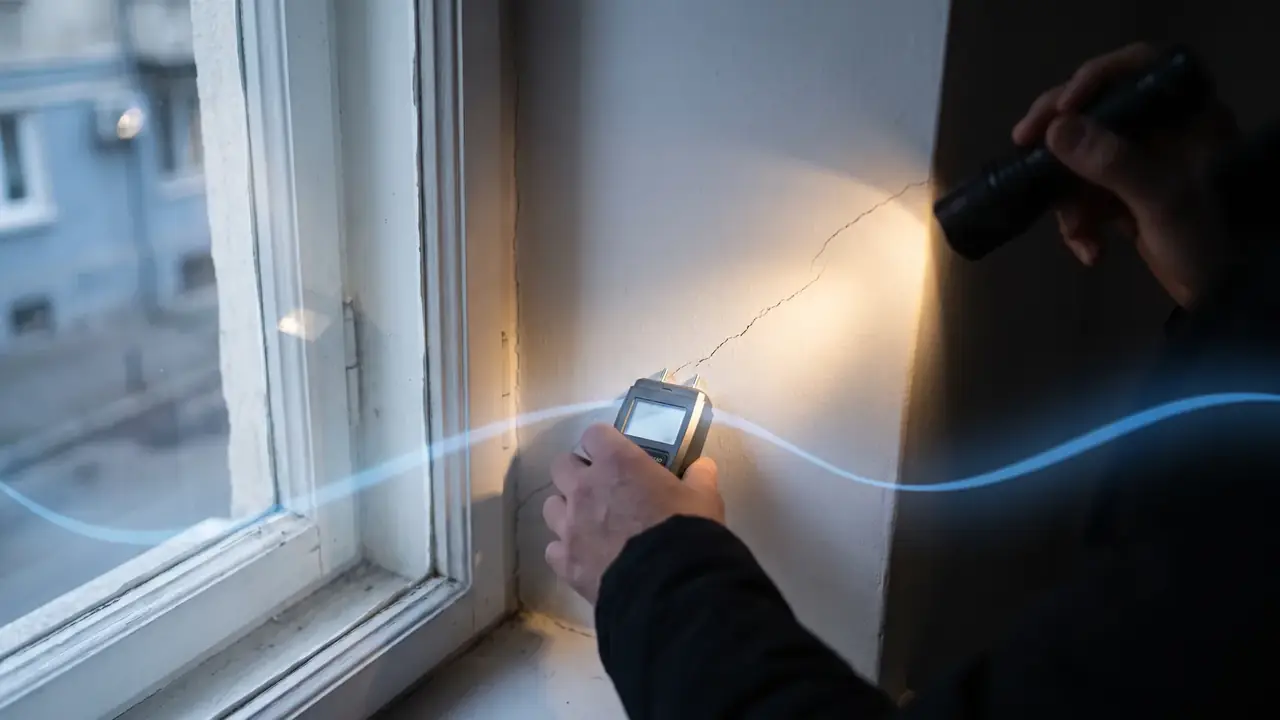
| Fine cracks in fresh plaster | Often drying shrinkage | Photograph and date; report if they widen |
| Mould in bathroom sealant or grout | Usually ventilation and cleaning | Run the extract fan longer; clean |
| Mould behind a wardrobe on an exterior wall | Often furniture blocking air on a cold wall | Leave a gap of a few centimetres; if it persists, suspect a thermal bridge |
| Mould returning in the same corner at normal humidity | Possible thermal bridge | Written notice; ask for a thermal survey |
| A damp patch that grows after rain or a thaw | Leak (roof, window, terrace, facade) | Written notice at once |
| Damp at the bottom of walls, peeling paint near the floor | Possible failure of foundation waterproofing | Written notice; ask for an expert |
| Wooden floor cupping or a musty smell under the flooring | Possible floor laid on a screed that was not dry | Written notice; ask for the screed moisture records |
The legal test is in Article 1707 of the Civil Code: a defect is hidden if a careful buyer could not have found it on handover day without professional help. Whether a specific case is a defect is decided on the facts, often by an expert.
What the law says about warranty and liability
Romania has two clocks, explained in detail in our guide to new home warranty and defects:
- Against the seller: for a building, a hidden defect must appear within 3 years of handover or final acceptance (Civil Code, Article 2531). You must notify the seller within a reasonable time after discovering it (Article 1709).
- Against those who designed and built: under Law 169/2026, designers are liable for hidden defects that appear within 10 years of acceptance (Article 424), and contractors for the same period, plus structural defects for the life of the building (Article 451).
Law 169/2026 also sets a minimum warranty period in the contract between the developer and the contractor: 1 year for buildings in consequence class CC1, which includes most single-family houses of ground floor plus one storey (Article 531). During that period the contractor must remedy hidden defects, and it ends with the final acceptance. That clause protects the developer, not you directly, but it explains why the first year is when builders expect to come back.
The same article says that operation and maintenance are the responsibility of the owner or user. In practice, a builder will first ask how the house was heated and ventilated. A humidity log answers that question.
Checklist: what to do in the first year
- At handover: ask for the ventilation instructions, the building's technical book (cartea tehnică) and the maintenance guidance.
- Buy two hygrometers. Note humidity and temperature weekly in the first winter.
- Heat steadily. Large swings in temperature encourage condensation.
- Ventilate briefly and often, or keep the heat-recovery unit running on the recommended setting.
- Leave furniture a few centimetres off exterior walls.
- Photograph anything unusual, with date and humidity reading.
- Report in writing to the developer, and keep proof of sending.
- Before the end of the first year, walk through the house again and send one consolidated written list.
Frequently asked questions
Is it normal for a new house to be damp?
Some extra moisture is normal in the first year, because the materials dry out into the rooms. It should go down with steady heating and good ventilation. If indoor humidity stays high despite that, or mould keeps returning in the same place, ask for an inspection.
What humidity should a new home have?
The US EPA recommends keeping indoor relative humidity below 60%, ideally between 30% and 50%. In the first winter, measure it in several rooms to see where the problem is.
Is mould in a new house a construction defect?
Not always. Mould caused by daily moisture and little ventilation is a use issue. Mould at a thermal bridge, from a leak, or from damp rising from the foundation can be a defect. Under Article 1707 of the Civil Code, a hidden defect is one a careful buyer could not have found at handover without a specialist.
How long do I have to report damp in a new home?
For a claim against the seller, a hidden defect in a building must appear within 3 years of handover (Civil Code, Article 2531), and you must notify within a reasonable time after you discover it. Against designers and contractors, Law 169/2026 sets 10 years from acceptance for hidden defects.
Do I need mechanical ventilation in a new house?
It is not the only option, but in a tight, well-insulated house it is the most dependable way to control humidity in winter. If the house has it, follow the filter and maintenance schedule. If it does not, a ventilation routine and extract fans become more important.
The bottom line
A damp first winter in a new house is common. Mould that keeps coming back is not something to live with. The difference is visible in the details: where it appears, at what humidity, and whether it goes away when the house is aired.
If you are buying or have just received a new home in Romania, with us or anywhere else, book a 30-minute call with me. We will go through what to record in the first year and how to put a complaint in writing. On heating and its effect on comfort, see our comparison of heat pumps and gas.
Moti Azulay, Compass Group Romania
Sources: Civil Code, consolidated (legislatie.just.ro), Articles 1707, 1709, 2531 · Law 169/2026, Code of planning and construction, Monitorul Oficial no. 661 of 10.08.2026, Articles 424, 451, 531 and Annex 6 · US EPA: A brief guide to mold, moisture and your home · Law 372/2005 on the energy performance of buildings, consolidated text, Article 17
This article is for general information only and is not legal, medical or engineering advice. The rules are correct as of 22 October 2026. For a specific case, rely on a qualified expert and an independent lawyer.
Now you know more.
This article is general information, not legal, tax or financial advice. Consult local professionals before any transaction.

