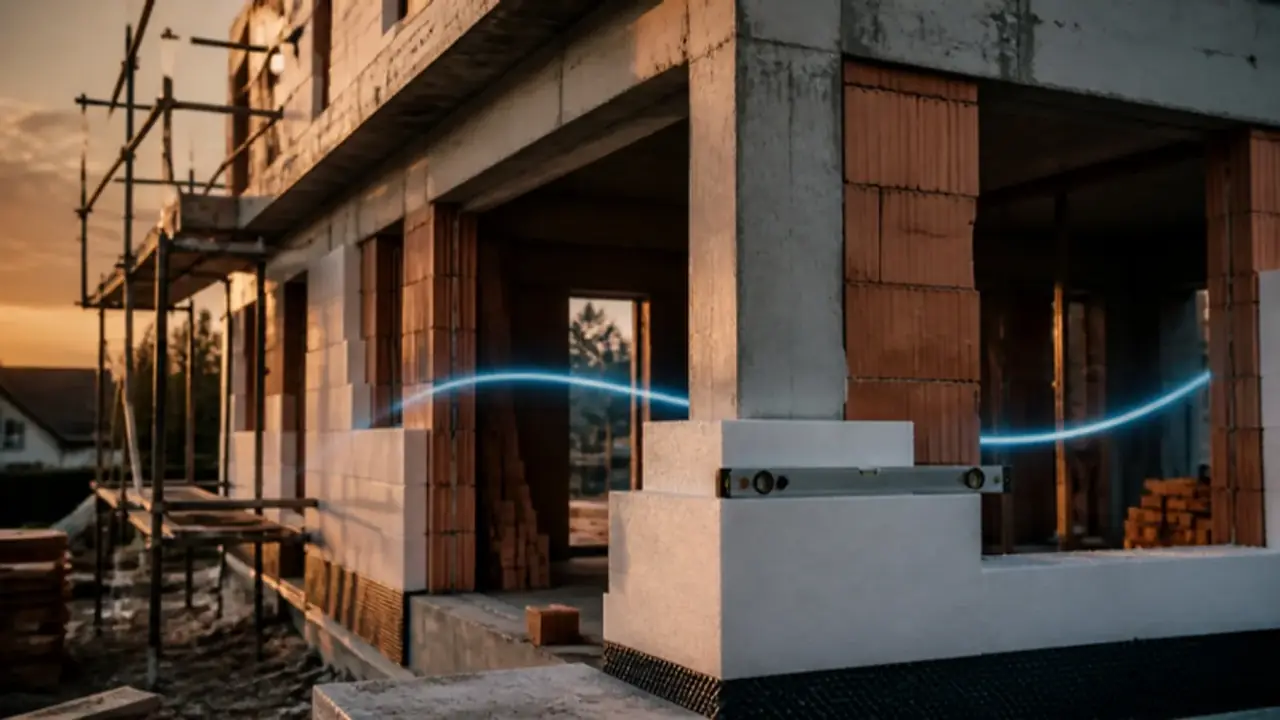
Concrete frame with masonry infill, confined masonry, or light steel or timber frame. Each can be good; design, details and supervision decide.
Law 169/2026 gives ground or ground + one floor family houses as CC1, where a check by an attested project verifier is not mandatory (Art. 440(3)). Ask whether it was done anyway.
New buildings on permits issued from 31 December 2020 must be nearly zero-energy, with at least 30% renewable energy (Law 372/2005, Art. 17).
Villa construction quality in Romania: the short answer
Most new villas around Bucharest are built in one of three ways: a reinforced concrete frame with masonry infill, confined masonry (load-bearing brick walls tied by small concrete columns and ring beams), or a light steel or timber frame. Each can make a good house. Quality is decided by the design, the details and the site supervision, not by the brochure.
Since 25 August 2026, quality on site is governed by the Planning and Construction Code, Law 169/2026, which repealed most of Law 10/1995 on quality in construction (Art. 576(3)). Seismic design follows the P100-1/2013 code, and every new home must be a nearly zero-energy building (nZEB) under Law 372/2005.
In plain words: you cannot see quality in a render, but you can see it in documents. A serious developer can show you each one, and a missing document tells you something too.
For the seismic picture of the region, see our article on earthquake risk in Bucharest. For defects after handover, see our guide to new-home warranties.
The three structural systems you will meet
| Concrete frame + masonry infill | Confined masonry | Light steel or timber frame | |
|---|---|---|---|
| How it works | Concrete columns and beams carry the loads; brick or block fills the gaps | Brick walls carry the loads, tied by tie-columns (stâlpișori) and ring beams (centuri) | Light frame braced by boards, filled with insulation |
| Seismic behaviour | Good with a regular frame and correctly detailed infill | Good for low-rise houses with enough walls in both directions | Low weight, lower seismic forces; depends on bracing and connections |
| Thermal mass | High: warms and cools slowly | High | Low: can overheat in summer without shading |
| Acoustics | Good; slabs need impact-sound layers | Good | Needs extra layers between rooms and floors |
| Typical use | Larger villas, big glazing, flat roofs | Ground or ground + one floor houses | Fast or prefabricated builds |
| What to ask | Concrete class, how infill is joined to the frame | Brick type and strength, position of tie-columns | Technical approval (agrement tehnic), vapour and fire layers |
None of these is "the right one". A well-detailed brick house can outperform a badly built frame. The real questions are who designed it, who checked it and who supervised the work.
What the P100 seismic code means for a house in Ilfov
The edition in force is P100-1/2013. Its design earthquake corresponds to a mean return period of 225 years, a 20% chance of being exceeded in 50 years. A revised draft, P100-1/2025, was notified to the European Commission in December 2024 (TRIS 2024/0706/RO) and would raise this to 475 years; we found no order approving it as of 22 October 2026.
Ilfov, Balotești included, is exposed to the same Vrancea earthquakes as Bucharest. The design ground acceleration for the site is written in the structural calculation. Ask to see it, and ask which code edition was used.
Law 169/2026 brings one change that matters. Buildings are now grouped in consequence classes, CC1 to CC4 (Art. 370). Annex 6 gives family houses of ground floor, or ground plus one floor, as an example of CC1, the lowest class. For CC1, a check by an attested project verifier is not mandatory: responsibility rests with the designers who signed (Art. 440(3), 441). From CC2, a detailed check is required (Art. 442). Ask in writing which class was assigned, and whether the structure was verified anyway.
Walls, insulation and thermal bridges
The Code lists energy saving and thermal insulation, and protection against noise, among the fundamental requirements every building must meet for its whole life (Art. 386(3)). In practice:
- U-values, not thickness. What counts is the U-value of each element (walls, roof, ground floor) in the energy calculation. Ask for them.
- Thermal bridges. Heat escapes where insulation is broken: balcony slabs, ring beams, lintels, window reveals, the base of the wall. Ask for the junction details.
- Moisture. Insulation must be protected from vapour, especially in light-frame walls.
- Mass and shading keep a house cool in a Bucharest summer.
Windows, airtightness and ventilation
Uw is the heat loss of the whole window, frame and glass together, in W/m²K: the lower, the better. A good glass value (Ug) alone does not make a good window. Ask for the manufacturer's declaration of performance, which accompanies CE-marked products and states Uw. ISC checks such declarations as part of state quality control (Art. 466(3)(a)). Then check the fitting: without sealing tapes around the frame, a good window leaks air and water.
You cannot see quality in a render, but you can see it in documents.
We found no general legal obligation to test the airtightness of a private house. You can still ask for a blower-door test before handover by an independent firm, and a thermal-camera scan in winter. An airtight house also needs planned ventilation, or humidity builds up.
nZEB and the energy performance certificate
Under Law 372/2005, new buildings received on a permit issued from 31 December 2020 must be nearly zero-energy buildings (Art. 17(1)), with at least 30% of primary energy from renewable sources (Art. 17(3)). An nZEB compliance report by a grade I energy auditor is required before the permit (Art. 17(4)); Law 169/2026 lists it among the permit documents (Art. 265(2)(e)).
The energy performance certificate (certificat de performanță energetică) is valid for 10 years (Art. 21(2)). A copy must reach the buyer before the contract, or the sale can be annulled (Art. 22(1), (4)). If you buy before completion, you get a certificate without a registration code; the final one is presented at reception, and the reception report is void without it (Art. 23). On heating, see heat pump or gas.
Who checks the quality on site under Law 169/2026
| Who | Role | Article |
|---|---|---|
| Designers | Sign the project and answer for it | 440, 441 |
| Attested project verifier | Checks the project, mandatory from CC2 | 440, 442 |
| Site manager (diriginte de șantier) | Checks the works for the developer, including key stages; can stop works and notifies ISC within 24 hours | 454, 456 |
| Contractor's technical manager (responsabil tehnic cu execuția) | Quality on the contractor's side | 457 |
| ISC | State quality control; receives the notice of start of works | 278, 466 |
| Reception committee | Reception at completion with the town hall's representative; final reception after the warranty | 280, 527, 528 |
The site manager is hired by the developer or the owner, must be independent of the other parties, and cannot design, build or verify the same project (Art. 454(2)-(3)). He works for the developer, not for you, which is why some buyers send their own engineer.
Works are not legally finished until reception at completion (Art. 280(8)). The buyer then receives the technical book of the building (cartea tehnică), which is uploaded to the National Register of Constructions and passed on at every sale (Art. 528-530). Until new government regulations are adopted, the earlier ones on reception (HG 273/1994), verification (HG 925/1995) and state quality control (HG 492/2018) stay in force (Art. 577).
Checklist: 15 things to ask for
- The building permit and approved plans. See why to see the permit before paying.
- The geotechnical study of the plot.
- The structural system and consequence class, in writing.
- Who designed the structure, and whether an attested verifier checked it.
- The design acceleration and code edition in the structural calculation.
- The nZEB compliance report.
- The provisional energy certificate, and the registered one at reception.
- U-values for walls, roof and ground floor, and the thermal-bridge details.
- The windows' declaration of performance, with Uw.
- The site manager's name and his ISC authorisation.
- The notice of start of works to the town hall and ISC.
- Key-stage reports, and photos of rebar and insulation before they are covered.
- An optional blower-door test and thermal scan by your own specialist.
- The reception report, with any list of remedies and deadlines.
- The technical book, the maintenance manual and the warranty period in your contract (the legal minimum for CC1 is 1 year, Art. 531(6)).
Go through the list with your own independent lawyer and, ideally, an independent engineer. For a site visit, use our villa tour checklist.
Where we stand
We are a developer, so we have an interest. Compass on the Lake is 29 villas in Balotești (24 semi-detached, 2 detached, 3 on the lakefront), from €299,900 including 21% VAT, notary and lawyer. The binding specification is the one attached to the sale agreement. Ask us for every document on this list, as you would any developer. Our company lawyer represents the company only; we recommend every buyer appoints an independent lawyer.
Frequently asked questions
Which is better in Romania: a concrete frame or a brick house?
Neither by default. A concrete frame suits larger villas and big openings; confined masonry suits ground or ground plus one floor houses. What matters is a correct P100-1 design, checked details and real site supervision.
Does a new house have to be checked by a project verifier?
From CC2, yes. For CC1, which Law 169/2026 uses for ground or ground plus one floor family houses, the check is not mandatory and the designers carry the responsibility. Ask whether the structure was verified anyway.
What is nZEB in Romania?
A nearly zero-energy building. New buildings received on permits issued from 31 December 2020 must meet it, with at least 30% of primary energy from renewables, and an nZEB compliance report is required for the permit.
Who supervises construction for the buyer?
No one by default. The site manager supervises for the developer and must be independent of the contractor, but he is not your representative. For your own eyes on site, hire an independent engineer.
What documents do I get at handover?
The reception report, the energy performance certificate, and the technical book with its maintenance manual. The technical book passes to every future owner.
The bottom line
A good villa in Romania is not defined by concrete or brick. It is defined by a correct design, documented checks and a site that someone qualified watched. All of that leaves a paper trail.
If you are looking at an off-plan villa, ours or any other, book a half-hour call with me. We will go through the documents on this list together.
Moti Azulay, Compass Group Romania
Sources: Law 169/2026, Planning and Construction Code, Monitorul Oficial 661 of 10.08.2026, Art. 265, 278, 280, 370, 386, 440-442, 454-457, 466, 527-531, 576-577 and Annex 6 · Law 372/2005 on the energy performance of buildings, consolidated text in force from 25.07.2024, Art. 17, 21-23 · European Commission TRIS notification 2024/0706/RO, draft P100-1/2025 · State Construction Inspectorate (ISC)
This article is for general information only and is not legal, tax, financial or engineering advice. Rules are current as of 22 October 2026. For a specific project, rely on a certified engineer and an independent lawyer.
Now you know more.
This article is general information, not legal, tax or financial advice. Consult local professionals before any transaction.

