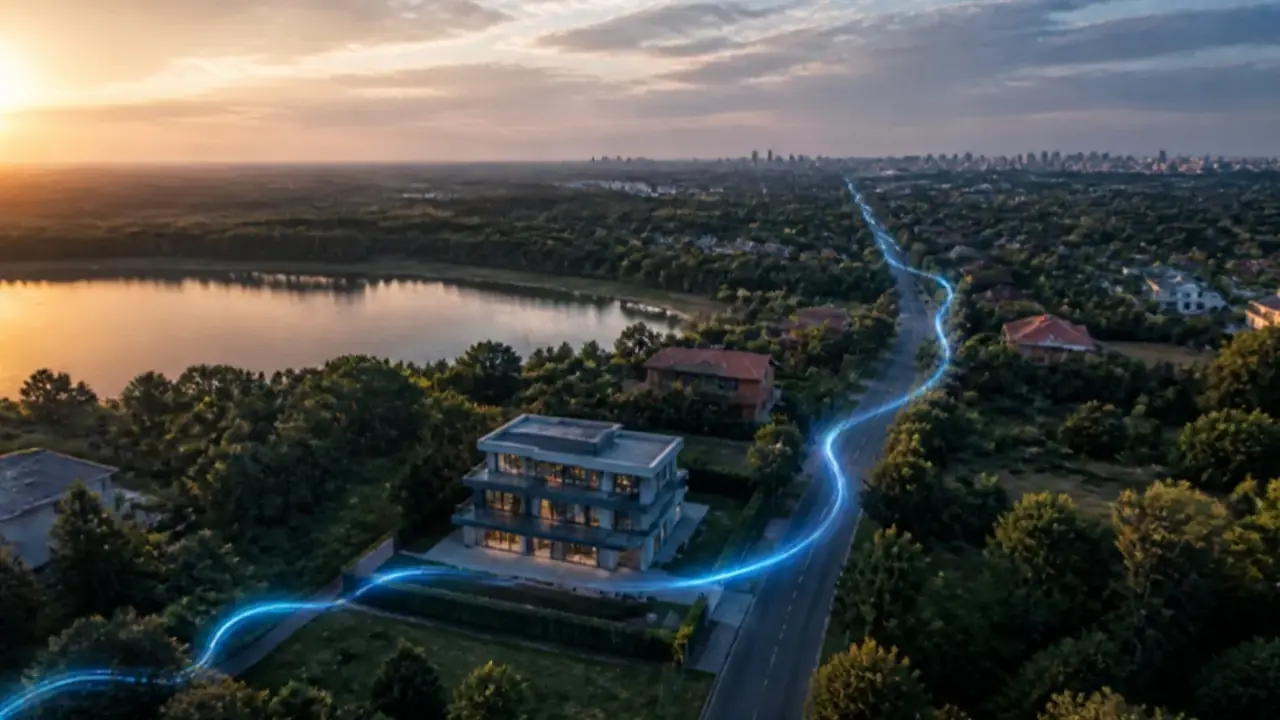
Ștefăneștii de Jos grew from 5,775 to 10,588 residents between the 2011 and 2021 censuses. Tunari grew by 80%.
From Mogoșoaia's town hall to Străulești station on M4 is about 4 km by road. From Voluntari to Pipera, about 8 km.
Only Snagov overlaps Natura 2000 sites and national protected areas, including Lake Snagov, per European Environment Agency data.
Ilfov communes compared: the short answer
North of Bucharest, eight local authorities attract most of the families looking for a house: Balotești, Corbeanca, Otopeni, Snagov, Tunari, Voluntari, Mogoșoaia and Ștefăneștii de Jos. We compared them on metrics that can be checked in official or open sources: census population and growth, homes completed, road distance to the city centre, the nearest metro station, regional bus lines, the length of the sewer network, the number of schools, the official airport noise map and protected nature areas.
The picture that comes out is not a ranking. Voluntari and Otopeni are towns with the most services and the shortest drives. Tunari and Ștefăneștii de Jos grew fastest between the two censuses, with small sewer networks. Snagov is the only one of the eight inside Natura 2000 areas. Balotești and Corbeanca sit in between, on the DN1 bus corridor.
In plain words: each commune trades distance, services and quiet differently, and the right one depends on where you work, how your children get to school and how much growth around you you are ready for.
Where a figure could not be verified, the cell is left blank.
Table 1: people and growth
| Commune | Residents, 2011 census | Residents, 2021 census | Change | Homes completed, 2025 |
|---|---|---|---|---|
| Balotești | 8,314 | 11,210 | +35% | 158 |
| Corbeanca | 7,072 | 11,412 | +61% | 65 |
| Otopeni (town) | 13,861 | 21,750 | +57% | 308 |
| Snagov | 7,272 | 8,331 | +15% | 137 |
| Tunari | 5,336 | 9,617 | +80% | 751 |
| Voluntari (town) | 42,944 | 47,366 | +10% | 862 |
| Mogoșoaia | 7,625 | 9,820 | +29% | 24 |
| Ștefăneștii de Jos | 5,775 | 10,588 | +83% | 346 |
Sources: INS censuses of 2011 and 2021 (as published on each locality's page and in our local guides); homes completed from INS TEMPO table LOC104B. Percentages are our calculation, rounded.
For comparison, Ilfov as a whole grew by about 40% over the same decade. Two communes almost doubled.
Table 2: getting to the city
| Commune | Road distance to Piața Victoriei | Drive without traffic | Nearest metro station (road distance) | Regional bus lines checked on STB |
|---|---|---|---|---|
| Balotești | 23.2 km | 27 min | Străulești, M4 (20.0 km) | 11 lines on DN1 to Piața Presei |
| Corbeanca | 20.2 km | 25 min | Străulești, M4 (17.0 km) | 441 and 441B |
| Otopeni | 16.5 km | 20 min | Străulești, M4 (10.4 km) | the same 11 DN1 lines, plus the airport train |
| Snagov | 35.7 km | 32 min | Străulești, M4 (27.8 km) | 447 and 447B |
| Tunari | 13.2 km | 21 min | Pipera, M2 (9.3 km) | |
| Voluntari | 9.8 km | 17 min | Pipera, M2 (7.6 km) | |
| Mogoșoaia | 12.5 km | 19 min | Străulești, M4 (4.1 km) | |
| Ștefăneștii de Jos | 16.7 km | 22 min | Pipera, M2 (12.4 km) |
Method: road distance and free-flow drive time from each town hall, calculated with the OSRM routing engine on OpenStreetMap data on 22 October 2026. Real peak-hour times are much longer. Bus lines as listed on STB's route pages on 22 October 2026; blank where we did not verify the full list. The M6 metro line to the airport is under construction and not yet open.
How the DN1 corridor works without a car, line by line, is in our guide to public transport in Ilfov.
Table 3: infrastructure and constraints
| Commune | Sewer network, 2025 | School units, 2025 | On the 2021 airport noise map (55 dB and above) | Natura 2000 or national protected area |
|---|---|---|---|---|
| Balotești | 64.4 km | 2 | No | No |
| Corbeanca | 49.3 km | 4 | Yes, village of Tămași | No |
| Otopeni | 62.9 km | 9 | Yes | No |
| Snagov | 40.9 km | 4 | No | Yes: Scroviștea (ROSAC0224, ROSPA0140), ROSPA0044, Lake Snagov, Snagov Forest |
| Tunari | 10.7 km | 2 | Yes, Tunari and village of Dimieni | No |
| Voluntari | 118 km | 35 | Yes, Băneasa airport: 25 residents | No |
| Mogoșoaia | 40.2 km | 4 | No | No |
| Ștefăneștii de Jos | 8.5 km | 2 | No | No |
Sources: sewer network length from INS TEMPO table GOS110A; school units from INS TEMPO table SCL101C; noise from the strategic noise maps of Bucharest Airports (2021 data) as analysed by News București; protected areas from the European Environment Agency's Natura 2000 and nationally designated areas datasets, intersected with each commune's boundary on 22 October 2026.
How to read each metric
- Census population. Residents counted at the census, not people registered at an address. Growth shows pressure on roads, schools and services.
- Homes completed. One year only. Small communes swing a lot when one project is finished.
- Distance and drive time. A free-flow time is the best case. Test the route at the hour you will drive it.
- Bus lines. Lines exist; frequency and the walk to the stop decide whether they are useful.
- Sewer network length. The length of public sewer pipes, not the share of homes connected. INS does not publish coverage by commune. A short network in a fast-growing commune means many homes rely on septic tanks or private systems, so ask about the specific street. Our guide to villa utilities in Ilfov explains what to check.
- School units. INS counts school units, including kindergartens. A school with several buildings can count once. It says nothing about places available or quality.
- Noise map. The official map is based on 2021, when the airport had far fewer passengers. Not being on the map does not mean silence. Read our article on aircraft noise in Otopeni and Balotești.
- Protected areas. Inside a Natura 2000 site, building needs extra environmental approvals. See Natura 2000 and building rules around the lakes.
What the numbers say, commune by commune
Voluntari is the most built-up: the largest population, the longest sewer network and the most school units of the eight, with Pipera metro station about 8 km away by road. It includes residential Pipera, next to the city.
Each commune trades distance, services and quiet differently.
Otopeni has the airport within its limits, nine school units and a short drive to the city, and it appears on the airport noise map. The future M6 line will end at the airport.
Tunari and Ștefăneștii de Jos grew fastest, by about 80% each, with sewer networks of around 10 km. For both, the nearest metro station is Pipera. Tunari appears on the noise map, on the eastern side of the runways.
Balotești and Corbeanca are on the DN1 corridor, with regional buses to north Bucharest. Balotești is not on the noise map; Corbeanca's village of Tămași is, on the western side.
Mogoșoaia is the closest of the eight to a metro station, Străulești on M4, and had the fewest homes completed in 2025.
Snagov is the furthest from the city and the only one inside protected nature areas, around the lake and the forests.
A checklist before you choose
- Drive the route to work and school at peak hour, twice.
- Ask the town hall about the sewer, water and gas on your street, not the commune average.
- Ask about school places for your children's ages, not only the number of schools.
- Check the noise map and listen at the address in the evening.
- Check the zoning around you, especially in communes that grew by 60–80%.
- If the plot is near a lake or forest, ask whether it is inside a protected area.
Frequently asked questions
Which commune north of Bucharest grew fastest?
Between the 2011 and 2021 censuses, Ștefăneștii de Jos grew from 5,775 to 10,588 residents and Tunari from 5,336 to 9,617, both by about 80%. Corbeanca and Otopeni grew by about 60%.
Which communes are closest to the metro?
Mogoșoaia is about 4 km by road from Străulești station on M4. Voluntari and Tunari are about 8–9 km from Pipera on M2. These are road distances from the town hall.
Which communes are on the airport noise map?
On the strategic noise maps based on 2021 data, residents exposed to 55 dB and above live in Otopeni, Tunari and its village Dimieni, and Tămași in Corbeanca, among others. Voluntari has 25 residents in that band from Băneasa airport. Balotești is not listed.
Is building restricted in Snagov?
Part of Snagov lies inside Natura 2000 sites and national protected areas, including Lake Snagov. Plots inside those boundaries need extra environmental approvals. Outside them, normal local rules apply.
Does a longer sewer network mean every home is connected?
No. INS publishes the length of the public sewer network, not the share of homes connected. Ask the town hall or the utility company about the specific street.
The bottom line
The eight communes north of Bucharest are not better or worse than each other. They offer different trade-offs: services and short drives in Voluntari and Otopeni, fast growth and thin networks in Tunari and Ștefăneștii de Jos, the DN1 corridor in Balotești and Corbeanca, the metro next door in Mogoșoaia, and lakes and forests in Snagov. Use the table as a starting point, then check the street.
We build in Balotești, so read this with that in mind. If you want to go through the map commune by commune before a visit, book a 30-minute call with me.
Moti Azulay, Compass Group Romania
Sources: INS TEMPO database: LOC104B, GOS110A, SCL101C · INS, 2021 population and housing census · STB route pages · OSRM routing on OpenStreetMap data · Metrorex · Bucharest Airports, strategic noise maps · News București, analysis of the 2021 noise maps · European Environment Agency, Natura 2000 sites · EEA, nationally designated areas (CDDA)
This article is for general information only and is not legal, tax or financial advice. Figures are as published by the sources above, checked on 22 October 2026. Local conditions differ from street to street; check them on site.
Now you know more.
This article is general information, not legal, tax or financial advice. Consult local professionals before any transaction.

