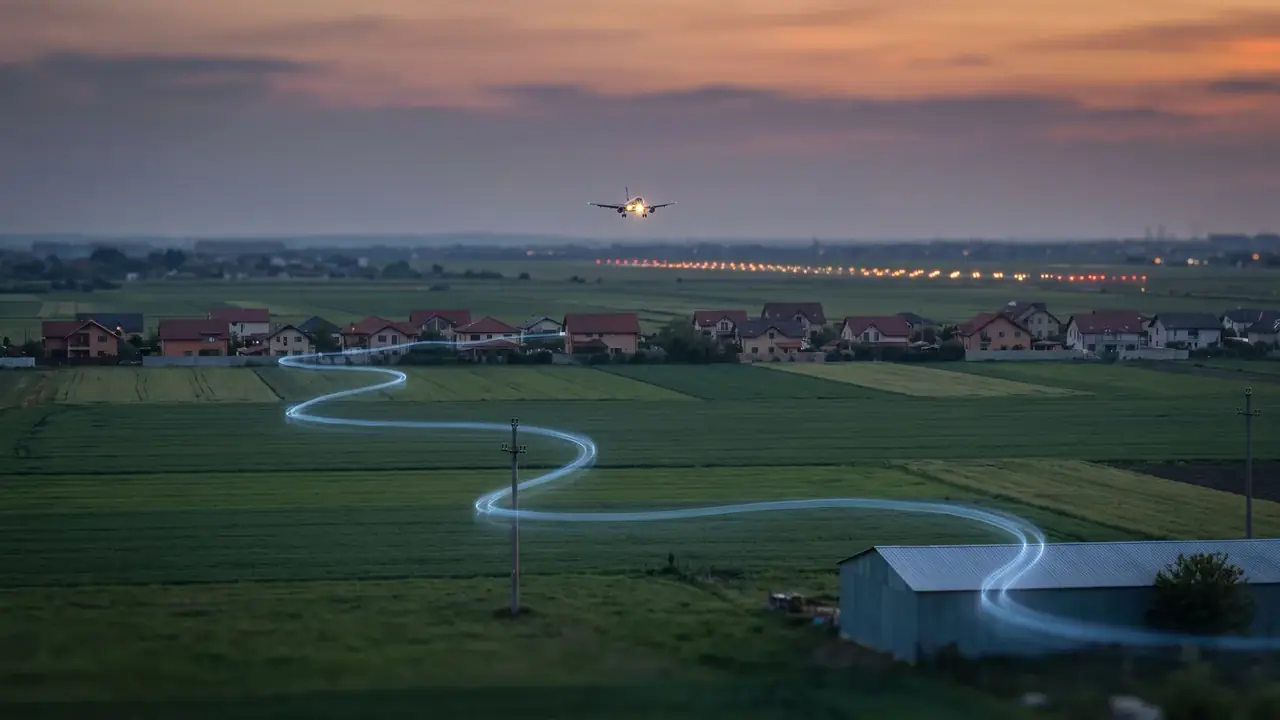
The two Otopeni runways, 3,500 metres each, point east and west. Balotești lies north of the airport, beside the axis, not on its extension.
On the 2021 noise maps, in the 55-60 decibel band: Buftea 6,695 residents, Dimieni 1,037, Otopeni 1,019. Balotești is not on the list.
The maps are based on 2021, with about 6.9 million passengers. In 2025 more than 17 million passed through. The geometry is right, the intensity probably higher.
The World Health Organization recommends under 45 decibels over the day and 40 at night. The official maps only count from 55 decibels.
Location relative to the axis, CNAB maps, a flight app, visits in east and west winds, listening at night, and checking the windows.
Aircraft noise in Balotești and Otopeni: the short answer
Henri Coandă International Airport in Otopeni has two parallel runways pointing east-west, so most of the noise falls on the towns along the extension of that axis: west towards Buftea and east towards Tunari. On the official noise maps, based on 2021 data, Balotești, which lies north of the airport, does not appear among the towns exposed to noise of 55 decibels and above. But the maps are old, traffic has grown since, and aircraft turning after take-off can be heard off the axis too. So every home is checked separately.
I am asked about this on almost every visit, and rightly so. Anyone who lives in Yehud or Shoham, near Israel's main airport, knows that the difference between "near the airport" and "under the flight path" is the difference between convenience and keeping the windows shut all summer. So I have gathered here what can be known from official sources, and where those sources end.
How the airport is laid out: two runways, one axis
Bucharest's airport has two runways, 08R/26L and 08L/26R, each 3,500 metres long (Aeroporturi București). The numbers in the runway names are their compass heading: 08 is about 80 degrees, meaning east, and 26 is about 260 degrees, meaning west.
The practical meaning is simple: aircraft land and take off along an east-west axis. The direction in use is set mainly by the wind, because aircraft take off and land into the wind. On one day the landing approach passes over the west, and on another over the east.
Balotești lies north of the airport, on the DN1, meaning beside this axis, not on its extension. That does not mean there are no aircraft in the sky there. It means they do not pass there at the low height of the final landing approach.
What the official noise maps say
Under the Romanian law on environmental noise assessment (Law 121/2019), which implements the European directive, major airports must prepare strategic noise maps and an action plan. Bucharest Airports National Company (CNAB) publishes the maps. The latest maps were prepared in 2022 on 2021 data, and published in 2023.
According to an analysis of the maps published by News București, these are the towns with residents in the 55-60 decibel band (average day-evening-night indicator, Lden):
| Town | Residents in the 55-60 decibel band |
|---|---|
| Buftea | 6,695 |
| Dimieni | 1,037 |
| Otopeni | 1,019 |
| Tămași | 233 |
| Tunari | 203 |
| Runcu | 19 |
| Buciumeni | 8 |
Balotești is not on the list. On the official noise maps, Otopeni's noise falls east and west, not north. In total, according to the same analysis, 11,193 residents were exposed in 2021 to day-evening-night noise of 55 decibels and above, compared with 15,536 on the 2016 maps. But at night the trend is reversed: the number exposed to night noise rose from 17,428 to 23,984.
The big asterisk: a 2021 map in a 2025 world
This is where we need to stop. The maps are a mathematical model based on traffic data, not a microphone measurement in the field. And the year they are based on was a COVID year.
| Year | Passengers at Henri Coandă International Airport |
|---|---|
| 2021 (map year) | 6,914,610 |
| 2025 | 17,005,524 |
Sources: Wall-Street.ro for 2021 and Profit.ro for the 2025 record. In other words, traffic in 2025 was two and a half times that of the map year. Anyone quoting these maps to you as proof that there is no noise is quoting a map of a half-empty airport.
What does not change is the geometry. The runways have not moved, so the basic split between east-west and north-south remains correct. What does change is the intensity and frequency, especially in the night bands.
Where the noise is actually felt
Residents of Tămași, a village in the commune of Corbeanca, launched a petition to the Civil Aviation Authority in 2024 asking for the landing path over their village to be moved. This matches the map: Tămași lies on the western side of the axis, not far from Buftea.
On the official noise maps, Otopeni's noise falls east and west, not north.
On the eastern side, Tunari and Dimieni appear on the map for the same reason. And in Otopeni itself, noise depends very much on the street: some neighbourhoods are right where the runway ends. We wrote about life in Otopeni in a separate guide.
In the north, in Balotești and Snagov, the story is different. Aircraft taking off turn right or left depending on their destination, and on some days you will hear them passing high up. That is the noise of an aircraft in the sky, not of a landing approach over the roof. Still, if you are sensitive to noise, it is something you will want to hear for yourself rather than read about.
What the World Health Organization says about aircraft noise
The World Health Organization, in its 2018 guidelines for Europe, recommends reducing aircraft noise below 45 decibels on the day-evening-night indicator and below 40 decibels at night (summary of the guidelines). Above these levels, a link has been found with sleep disturbance and persistent annoyance.
Note the gap: the official maps start counting from 55 decibels over the day, well above the recommended threshold. In other words, the fact that a town does not appear on the map does not mean it has no aircraft noise at all. It means its noise is below the reporting threshold.
How to check a specific home: six steps
- Locate the home on the map relative to the runway axis. Draw an imaginary line east and west from the runways. The further the home is from the line, the better.
- Open the CNAB noise maps and check the bands around the address.
- Open a flight-tracking app on several different days, and see where aircraft actually pass over the address and at what height.
- Visit twice: once with a westerly wind and once with an easterly wind, because the wind direction determines which side of the airport is busy.
- Listen in the evening and at night, when the street is quiet and a small noise is more noticeable.
- Check the windows. Double or triple glazing and good sealing change the experience inside the home. For what else to check on a visit, see our villa tour checklist.
Who being close to the airport suits, and who less so
It suits: people who fly a lot, for work or to family in Israel, and want to be at the airport within minutes. Also people looking for a home to let in the future to aviation staff and employees of companies operating near the airport.
It suits less: people who sleep with the window open, work from home on long calls and are sensitive to every noise, or are looking for the complete quiet of a village. If that is you, stay away from the runway axis, and in any case check for yourself.
On the planned expansion of the airport, and what it may change in traffic, we wrote in our article on the Otopeni expansion.
And what about us
I will mention this once: Compass on the Lake is in Balotești, north of the airport, about a 10-minute drive from it. Precisely because of that, I recommend that everyone who comes on a visit does the checks above with us too, and does not rely on my word. For Balotești itself, see our guide to Balotești.
Frequently asked questions
Do aircraft fly over Balotești?
Balotești lies north of the airport, beside the runway axis rather than on its extension, so low landing approaches do not pass over it. Aircraft turning after take-off may pass at height. On the official noise maps, based on 2021 data, Balotești does not appear among the towns exposed to 55 decibels and above.
Which towns near Otopeni are most exposed to aircraft noise?
According to the 2021 noise maps, mainly towns along the extension of the runway axis: Buftea and Buciumeni in the west, Tămași (Corbeanca), Dimieni and Tunari, and parts of Otopeni itself.
Are the CNAB noise maps up to date?
They were prepared in 2022 on 2021 data, a year in which about 6.9 million passengers passed through the airport. In 2025 more than 17 million did. So they are good for understanding the geometry of the noise, but probably understate today's intensity and frequency.
How do you know which side of the airport the aircraft will be on today?
By the wind. Aircraft take off and land into the wind, so the wind direction determines whether the landing approach passes over the east or the west. It is worth visiting the property in both conditions.
What is a healthy level of aircraft noise?
The World Health Organization recommends less than 45 decibels on the day-evening-night indicator and less than 40 decibels at night. The official noise maps only start counting from 55 decibels.
The bottom line
The geometry is clear: the Otopeni runways point east-west, and the loud noise falls along the extension of the axis. Balotești, north of the airport, does not appear on the official maps. But the maps are based on a year with less than half of today's traffic, so the real test is with your own ears, at your own address.
If you are considering a home near the airport, in Balotești or anywhere else in north Bucharest, book a 30-minute call with me. We will open the map together, mark the runway axis, and build a visit plan that checks what matters to you.
Moti Azulay, Compass Group Romania
Sources and data: Aeroporturi București (CNAB), strategic noise maps · News București, analysis of the noise maps (28.01.2024) · Order 132/2014, the airport noise action plan · Law 121/2019 on environmental noise · Wall-Street.ro, passenger traffic 2021 · Profit.ro, the 2025 record · Petition by Tămași residents · WHO noise guidelines, 2018 (AEF summary).
This article is for general information only and is not legal, tax or financial advice. The noise data is based on official maps prepared on 2021 data and on an analysis published in the press. It is not a measurement at any specific address, and flight paths may change.
Now you know more.
This article is general information, not legal, tax or financial advice. Consult local professionals before any transaction.