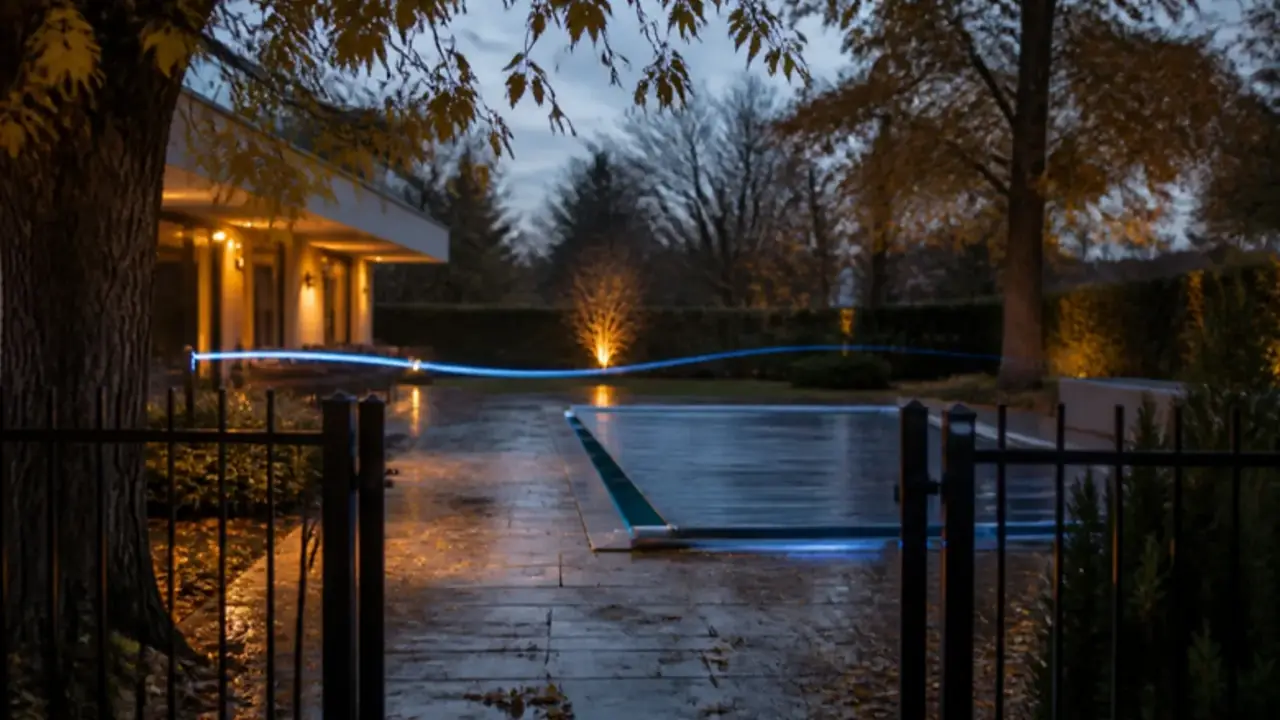
ANRSC-approved price excluding VAT, valid on 1 October 2026. Sewerage and treatment are 8.85 lei/m³. A 45 m³ first fill costs about 770 lei before VAT.
Eurostat's average household price in the first half of 2026, all taxes included. A 0.75 kW pump running 8 hours a day costs about 9 lei a day.
The WHO says the highest drowning rates are among children aged 0 to 4, and lists fencing swimming pools among the ways to prevent it.
A private pool in Romania: the short answer
Around Bucharest, an unheated outdoor pool is a summer pool. In practice it is used from late spring to early autumn, and for the rest of the year it has to be protected from frost. Between those two moments, a pool needs the same few things every week: the filter running every day, the water tested and balanced, the skimmer and the bottom cleaned.
The running costs you can calculate are water and electricity. In Ilfov, a typical first fill of about 45 m³ costs roughly 770 lei before VAT at the Apă-Canal Ilfov tariff, if sewerage is charged on the same volume. A filter pump of 0.75 kW running eight hours a day uses about 6 kWh, roughly 9 lei a day at the 2026 average household price. Chemicals, a cover, repairs and any service company come on top, and those depend on quotes.
In plain words: a pool is cheap to fill, steady to run and expensive to neglect. And the single most important thing about it has nothing to do with money: children must never be able to reach it alone.
Whether your pool needs a permit is a separate question. We covered it in our article on villa additions and the new Planning and Construction Code. This article starts after the pool exists.
The year of a pool near Bucharest
Ilfov lies on the Romanian Plain, with hot summers and cold winters. Our guide to Bucharest's weather by season has the details. For a pool, the year has four phases:
| Period | What happens | Main tasks |
|---|---|---|
| Spring (April to May) | Opening | Remove the cover, clean, refill to level, restart the filter, shock-treat and balance the water |
| Summer (June to August) | Full use | Daily filtration, water tests two or three times a week, weekly cleaning |
| Early autumn (September) | End of the season | Fewer swims, more leaves; skim daily, then prepare to close |
| Late autumn to winter | Closed | Winterise before the first frost, check the cover after snow and storms |
The dates move with the weather. A heated pool has a longer season, and a larger electricity bill.
Weekly upkeep: what a pool actually needs
- Filtration every day. The pump pushes the water through the filter. In summer, run it long enough to circulate the whole volume of the pool daily. The pool builder's manual gives the hours for your system.
- Test the water. Disinfectant level and pH, with test strips or a simple kit. In hot weeks and after heavy use, test more often.
- Balance and disinfect. Adjust the pH first, then the disinfectant. Follow the product labels exactly.
- Clean. Empty the skimmer baskets, brush the walls, vacuum the bottom, by hand or with a robot.
- Backwash or clean the filter when the pressure gauge shows it is clogged.
- Top up. Summer heat and splashing lower the level. The water must stay above the skimmer opening, or the pump can run dry.
If you live abroad part of the year, decide who does this. A pool left alone for two hot weeks can turn green.
Water: the first fill and the top-ups
Water is paid to the local operator. Around Bucharest, it depends on where the villa is: in many Ilfov communes the operator is Apă-Canal Ilfov, in Voluntari it is Euro Apavol, and other areas have their own operators. Check the name on your bill.
According to the ANRSC table of approved prices for 1 October 2026:
| Operator | Drinking water, lei/m³ excl. VAT | Sewerage and treatment, lei/m³ excl. VAT |
|---|---|---|
| Apă-Canal Ilfov | 8.25 | 8.85 |
| Euro Apavol, Voluntari | 8.87 | 7.64 |
An example, not a quote. A pool of 8 × 4 m with an average depth of 1.4 m holds about 45 m³. At the Apă-Canal Ilfov prices, that is about 370 lei for the water and, if sewerage is billed on the same metered volume, about 400 lei more, before VAT. Ask your operator how pool filling is billed. Some owners fill from a well in the garden; the rules on garden wells are in our article on gardens and irrigation in a dry summer.
Plan for dry summers. In July 2022, for example, Apă-Canal Ilfov limited the water supply for hours at a time in several communes because of excessive consumption, and the national water authority recommended not filling pools during that period, as Economica.net reported. Do the first fill in spring, not in a July heatwave, and keep the water through the winter instead of emptying it.
A pool is cheap to fill, steady to run and expensive to neglect.
Electricity: the pump runs every day
The household electricity price cap ended on 1 July 2025. According to Eurostat, the average price for Romanian households (consumption of 2,500 to 5,000 kWh a year, all taxes included) was 1.46 lei per kWh in the first half of 2026.
| Example | Assumption | Estimate |
|---|---|---|
| Filter pump, one day | 0.75 kW × 8 hours = 6 kWh | about 9 lei |
| Filter pump, one season | 6 kWh × 120 days = 720 kWh | about 1,050 lei |
These are illustrations. Your pump's power is on its label, the hours depend on the pool, and your price is the one in your supplier contract. A variable-speed pump can use much less than a single-speed one. Heating the water is a separate and larger consumption.
Winterising: before the first frost
An outdoor pool that is not prepared can be damaged by ice: pipes, the filter, the pump and the edges. The exact steps depend on the pool, so follow the builder's manual. The usual sequence is:
- Clean the pool thoroughly and balance the water one last time.
- Lower the water below the skimmers and the inlets, but do not empty the pool unless the builder says so. An empty shell can be damaged by groundwater or by frost.
- Drain the pump, the filter and the pipes, and blow out the lines.
- Add a winterising product if the builder recommends one.
- Put on a winter cover and secure it.
- Store chemicals dry, locked and away from frost.
- Check the cover after snow and strong wind during the winter.
Safety: children first
The World Health Organization counts around 300,000 drowning deaths a year worldwide. The highest rates are among children aged 0 to 4, and drowning is the fourth leading cause of death for children aged 1 to 4. Among its prevention measures, WHO lists barriers that control access to water, including fencing swimming pools.
We did not find a Romanian law that requires a fence around a private family pool. That does not make one optional. Our practical rules:
- A barrier between the house and the pool. A fence with a self-closing, self-latching gate that a small child cannot open. A cover is a second layer, not a replacement.
- An adult watching, without a phone. At a party, name one adult as the "water watcher" for each half hour.
- Nothing that invites a child in. No toys left floating, no chairs next to the fence.
- Teach swimming early, and keep a lifebuoy or a pole by the water.
- Learn first aid. Know the emergency number, 112, and know the way to the gate from the street.
- Chemicals locked away. Never mix products, and keep them in their original containers.
- Electrical safety. Pumps, lights and heaters must be installed by a qualified electrician, with residual current protection.
If you live in a gated community, its rules may add requirements, for example on fences, noise or hours. Our article on gated community fees and management explains how those rules work.
Who looks after it: you or a service
| Option | Suits | Watch out for |
|---|---|---|
| You do everything | You live in the villa all summer and like routine | Two weeks' holiday in August still needs a plan |
| A neighbour or caretaker checks | You are away for short periods | Clear written instructions and a test kit on site |
| A pool service company | You live abroad part of the year | Ask what a visit includes, how often they come, and who pays for chemicals |
Ask for written quotes: prices for chemicals, covers and service visits vary widely.
Frequently asked questions
How long is the swimming season for an outdoor pool near Bucharest?
For an unheated pool, roughly from late spring to early autumn, depending on the year. A heated pool lasts longer, at a higher electricity cost.
How much does it cost to fill a pool in Ilfov?
It depends on the volume and the operator. As an example, about 45 m³ at the Apă-Canal Ilfov prices of 1 October 2026 costs about 370 lei for the water, plus about 400 lei for sewerage if billed on the same volume, before VAT.
How much electricity does a pool pump use?
A 0.75 kW pump running eight hours uses about 6 kWh a day. At the average 2026 household price of 1.46 lei per kWh, that is about 9 lei a day. Your contract price and your pump decide the real figure.
Should I empty the pool for the winter?
Usually not. The common practice is to lower the level below the skimmers, drain the equipment and cover the pool. Follow your pool builder's instructions.
Is a fence around a private pool mandatory in Romania?
We did not find a Romanian law that requires one for a private family pool. The WHO lists pool fencing as a way to prevent child drowning, and we strongly recommend it.
The bottom line
A private pool is one of the great pleasures of a villa near Bucharest, for about four months a year. The other eight, it needs protecting from frost. The water and the electricity are predictable; neglect is not. And the fence matters more than the filter.
If you are planning a family villa north of Bucharest and want to talk through what owning one really involves, from the garden to the pool, book a 30-minute call with me. You can also read our overview of annual villa upkeep costs.
Moti Azulay, Compass Group Romania
Sources: ANRSC: approved water and sewerage prices for regional operators, 1 October 2026 · Eurostat: electricity prices for household consumers, nrg_pc_204 · World Health Organization: drowning fact sheet · Economica.net, July 2022: ANAR and Apă-Canal Ilfov on water use
This article is for general information only and is not legal, tax or financial advice. Cost figures are examples based on published tariffs and stated assumptions, not quotes. Information current as of 22 October 2026. Follow your pool builder's instructions and the labels of every product.
Now you know more.
This article is general information, not legal, tax or financial advice. Consult local professionals before any transaction.

