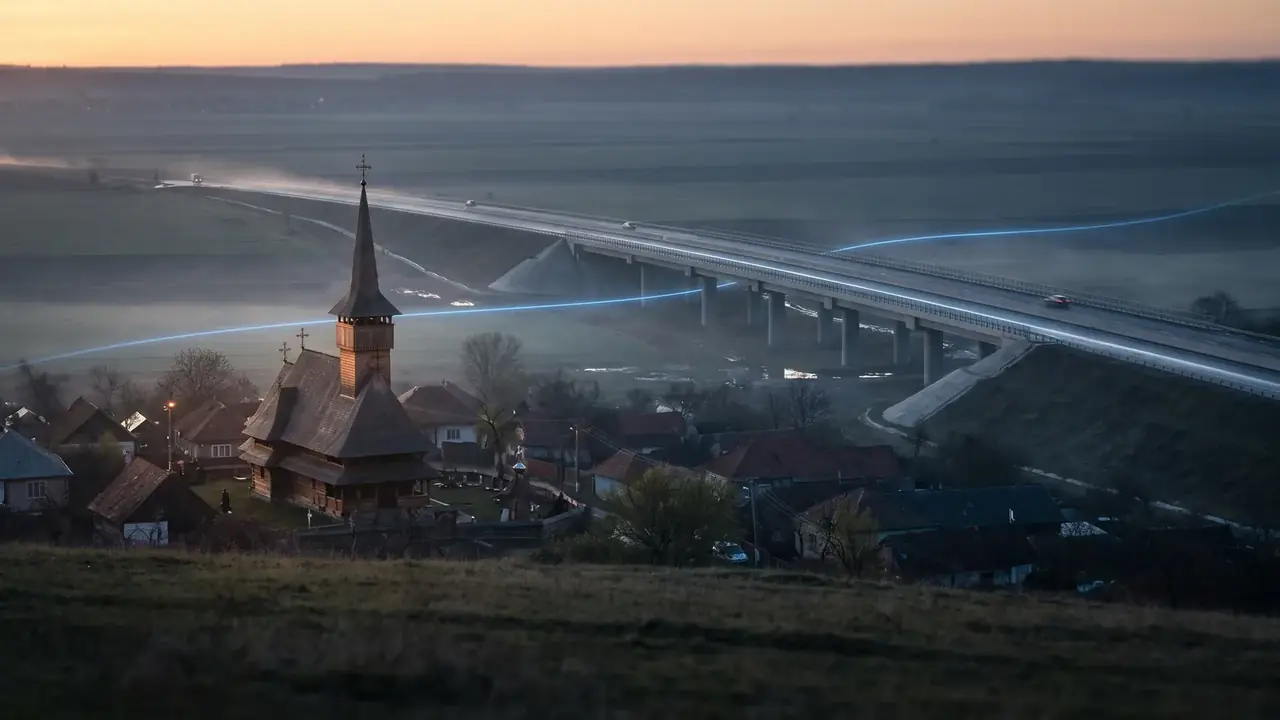
The Council of the EU set 2030 for Romania to close its excessive deficit procedure: from 9.3% of GDP to below 3%.
If the deficit path holds, the OECD expects rates to fall towards 4% as early as 2027. Slippage would reverse it.
According to INSSE, building permits are about 30% below their 2021 peak. Supply for 2028–2029 is being set now.
The M6 line in north Bucharest has a declared delivery around 2028–2030. Declared is not delivered: check the works.
Convergence, acceleration or stall. In each, a quality property in a good location with a clean legal structure holds up better.
"So where will Bucharest be in 2030?"
Investors ask me this in almost every meeting. They expect a number: a price per m², a percentage, something to hang a decision on.
I don't give a number. Nobody knows what a square metre in Bucharest will cost in 2030, and anyone who promises you a figure is selling you a story.
But when you look at Romania 2030, there is something you can do responsibly: point to processes that are already under way, whose timelines are known and public, and see where they meet. That is not a guess. It is reading a schedule.
Why 2030
A one-year forecast is mostly a continuation of what is happening now. A five-year view is something else: an analysis of forces.
And 2030 is not a date I picked at random. It is the deadline the Council of the EU set for Romania to close its excessive deficit procedure. Two more processes converge around it, as we'll see.
This article does not repeat the "why Bucharest, why now" question, which we answered in a separate article. It looks ahead, to the end of the decade.
The first process in Romania 2030: the deficit and interest rates
This decade in Romania is one of structured deficit reduction: from 9.3% of GDP to below 3%, on the path agreed with the EU.
If the path holds, the OECD expects interest rates to fall towards 4% as early as 2027. Lower rates mean cheaper mortgages and more accessible credit. If the path slips, the direction reverses.
This is the single most important variable to watch until the end of the decade. We explain the link between the deficit, interest rates and the euro area in our article on Romania and the euro.
The second process: end-of-decade housing supply is being decided now
Construction takes years. The homes delivered in 2028–2029 are the ones getting permits today.
And that pipeline is thin. According to the National Institute of Statistics (INSSE), building permits are about 30% below their 2021 peak.
At the same time, Law 207/2025 (the "Nordis law") requires buyers' advances to go into a dedicated project account, with caps per construction stage. That protects buyers, but it also slows launches and filters out highly leveraged developers. What the law changes in practice for buyers is covered in our Nordis law checklist.
Nobody knows what a square metre in Bucharest will cost in 2030, and anyone who promises you a figure is selling you a story.
Limited supply in the quality segment is already a fact, not a forecast.
The third process: infrastructure in north Bucharest
Two major projects mature in exactly this window:
- M6 metro line to the airport: declared delivery around 2028–2030.
- A0 ring motorway: opening in stages.
Both run along Bucharest's northern axis: Băneasa, Otopeni, Balotești. This area, seen today as a "convenient suburb", is gradually becoming a connected part of the metropolis. In our project in Balotești we already see it in buyers' questions: how long to the airport, how long to the centre, when the line opens.
To be fair: infrastructure timelines in Romania tend to stretch. Declared delivery is not delivery. Check the actual state of the works, not just the date in a press release.
For current prices and the neighbourhood map of Bucharest, including the northern axis, see our article on Bucharest prices.
Two uncertain factors worth knowing
Above the three processes sit two factors nobody can time:
- Return migration. About 3.15 million Romanians live in other EU countries. Every share of them that returns is new demand for urban housing.
- The euro. The official target is 2029, but it has slipped before. If it happens, it changes the price of money.
Neither is guaranteed. Both push in the same direction.
Three scenarios for Romania 2030
| Scenario | What happens | What it means for you |
|---|---|---|
| Convergence (central) | Deficit targets met, rates fall, infrastructure delivered, supply stays limited | A growing gap between quality properties in good locations and weak ones |
| Acceleration | On top of that: real progress towards the euro, institutional players, return migration | Competition for quality properties intensifies, and entering later may cost more |
| Stall | Fiscal slippage, political instability, delayed EU funds | Rates stay high for longer and few deals close. Leveraged, weak properties are hit first |
Notice what the three scenarios have in common: not the price, but the selection. In each one, a quality property in a good location with a clean legal structure holds up better than an average property in a weak location.
What to check in a property today
Hence my checklist. These are six things that decide where you stand in every scenario, and all of them can be checked now, not in 2030:
- A location on an infrastructure axis already under construction, not one that has only been announced.
- A right registered in the land register, not a promise.
- A developer that meets the Nordis law requirements, with a dedicated project account.
- A project a local bank is willing to finance, a good sign of outside scrutiny.
- Someone who stays after handover, for management and maintenance.
- Tax planning in advance, in Romania and in your home country.
Frequently asked questions
How much will property in Romania rise by 2030?
Nobody knows, and I won't commit to any figure. What is known are the timelines of three processes: deficit reduction by 2030, limited housing supply, and infrastructure in north Bucharest planned for 2028–2030.
What does the excessive deficit procedure mean for property buyers?
It is a path Romania has committed to with the EU, to bring the deficit from 9.3% to below 3% by 2030. If it holds, the OECD expects rates of about 4% in 2027, meaning cheaper mortgages. Slippage would keep rates high.
When will the M6 metro line to the airport open?
Declared delivery is around 2028–2030. Infrastructure timelines in Romania sometimes stretch, so it is worth following the actual progress of the works on the Metrorex website.
Why is housing supply in Romania limited?
According to INSSE, building permits are about 30% below the 2021 peak. Construction takes years, and the Nordis law adds financial requirements for developers. So the supply that reaches the market at the end of the decade is being decided now.
What happens to my property in the bad scenario?
In a stall scenario, rates stay high and the market is slow. Leveraged properties in weak locations are hit first. The best protection is location, a clean legal structure and financing you can carry at today's rates.
How can I follow the three processes without being an economist?
Three sources are enough: the European Commission's economic forecasts for Romania, published in spring and autumn, INSSE building permit data, and Metrorex progress updates on the M6 line. If all three stay on track, the central scenario stays on the table.
The bottom line
Romania 2030 is not a number. It is three schedules already running, and one question: does the property you are looking at hold up in every scenario?
The three things that decide it, location, structure and partners, are decided today. If you'd like to go through a property you are considering, with us or elsewhere, book a half-hour call with me.
Moti Azulay, Compass Group Romania
Sources and data: European Commission, economic forecast for Romania · OECD, Economic Survey of Romania · National Institute of Statistics of Romania (INSSE) · Metrorex, Bucharest metro · Eurostat · Council of the EU · Law 207/2025, Romanian legislation portal
This article is a scenario analysis, not a numerical forecast, and is for general information only. It contains no promise of price changes and is not investment, legal or tax advice. Official targets and infrastructure timelines may change.
Now you know more.
This article is general information, not legal, tax or financial advice. Consult local professionals before any transaction.