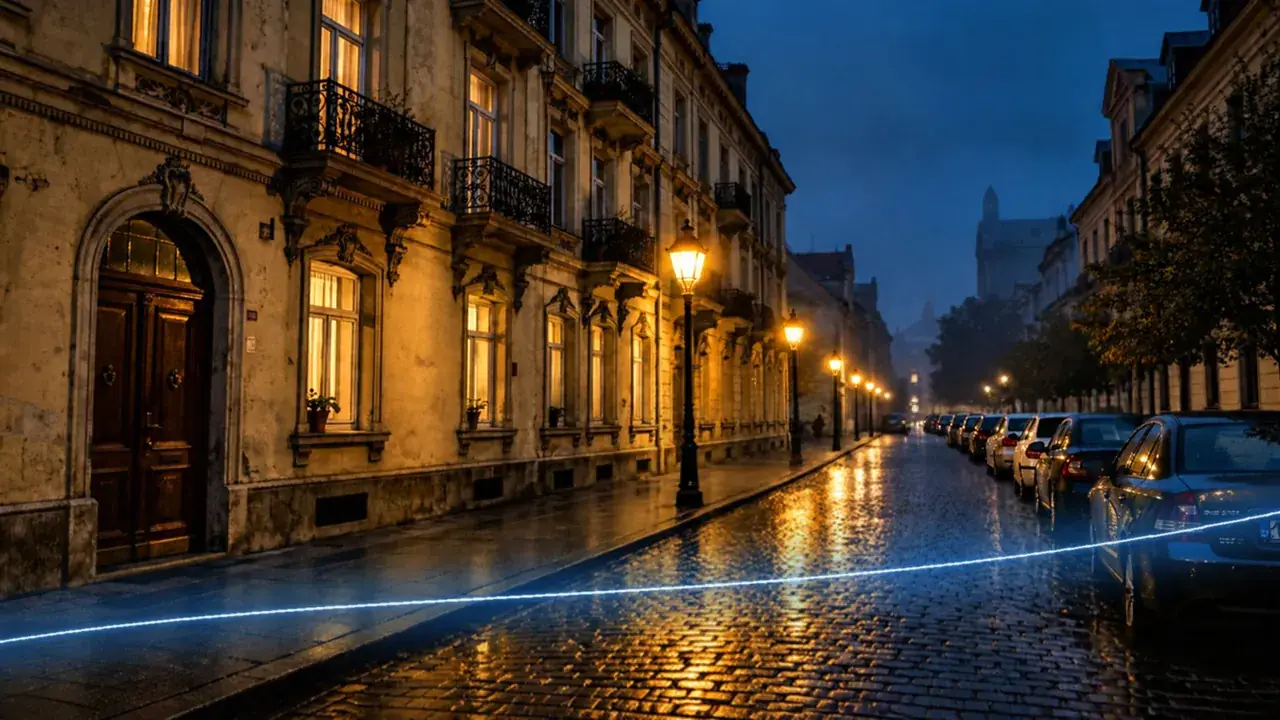
The AMCCRS list updated in May 2026 contains more than 400 buildings in seismic risk class I, most in Sectors 1, 2 and 3 and most from before 1940.
Most older blocks have no private parking. A residents' parking space costs between 397 and 796 lei a year in 2026, and sometimes there is a waiting list.
A notary won't sign the sale of an apartment without the owners' association's certificate on the seller's debts, valid for 30 days (Law 196/2018).
An apartment in central Bucharest: the short answer
An apartment in central Bucharest can be an excellent choice, but only after you check the building, not just the address. Most apartments in the centre are in old buildings: some from before 1940, most from the communist era. So there are seven checks worth doing before you sign: the seismic status on the official list, the design year, parking, noise, the owners' association and repairs fund, the building's rules on short-term rentals, and the heating system. If a building passes all seven, you are buying a good apartment in a great city.
The question we hear most in sales calls, after price, is "why outside the city? I'm only looking in the centre". That's a legitimate preference. But for many people it's a default, not a decision: they haven't yet seen what a 1970s block in Sector 2 is like in winter, with no parking and district heating that has broken down.
In plain words: the centre isn't the problem. A building you haven't checked is the problem.
Who really needs the centre
Let's start by giving the centre its due. For some buyers an apartment in the centre is the right answer, and there's no point trying to talk them out of it:
- People living alone or as a couple who don't want a car. The metro, public transport and walking are a real advantage.
- People coming to Bucharest for culture-filled weekends. The opera, the theatres, the restaurants and cafés are all within walking distance.
- People whose budget is aimed at a small apartment. A studio or one-bedroom in an older block costs less than a house.
- People who love the city's architecture. Belle Époque, Art Deco and interwar modernism: these streets are genuinely beautiful.
If you're in one of these groups, this article is for you: it will help you choose a good building. And if you're a family looking for a house, a garden and parking, read to the end before you decide.
Check 1: seismic status and design year
This is the first check, and everything else comes after it. Bucharest is exposed to intermediate-depth earthquakes from the Vrancea zone. The earthquake of 4 March 1977, of about magnitude 7.4, killed 1,424 people in the city, most of them in the collapse of old high-rise buildings.
The Municipal Administration for the Consolidation of Buildings at Seismic Risk (AMCCRS) publishes an official list. According to the Bucharest City Hall guide, the version updated in May 2026 contains more than 400 buildings in risk class I, the "red dot", most of them in the central sectors 1, 2 and 3, and most built in 1940 or earlier.
Three periods worth remembering:
| Design year | What it usually means |
|---|---|
| Before 1940 | Tall reinforced-concrete blocks built before seismic design was mandatory. The highest share of "red dot" buildings |
| 1941–1977 | Mixed. The P13-63 standard came into force in 1963, and many buildings were assessed after 1977 |
| After 1977 | Designed to the standards updated after the earthquake, usually in better condition |
| Under P100-1/2013 | The current standard, with certified design and inspection |
Two things are easy to miss. A building that isn't on the list isn't necessarily safe: it may simply never have been assessed. And a building in the middle of a strengthening project doesn't change class until the work is finished and approved. Ask for the design year in writing, look the address up on the list, and ask whether there is a technical assessment (expertiză tehnică). The full details are in our article on earthquake risk in Bucharest, and how to recognise a building's period from its facade is in our guide to Bucharest's architectural styles.
Checks 2 and 3: parking and noise
Check 2: parking, something you apply for. Most apartment buildings in Bucharest have no private parking. The spaces in front of the building are public land, and the sector city hall rents them to residents as residents' parking. In 2026 such a space costs 397–796 lei a year, depending on the area, under General Council Decision 514/2025. In the older neighbourhoods there are waiting lists.
In other words, in the centre a parking space isn't something that comes with the apartment. If you have a car, or will have a family with a car, ask the seller whether they have a residents' parking contract, and check the sector's waiting list. In a new building, check whether the parking space is registered in the land-book extract as a separate unit and what it costs. The full explanation is in our article on cars and parking in Bucharest.
Check 3: noise, by day and by night. In Romania quiet hours are set by national law. Under Law 61/1991, it is forbidden to disturb residents between 22:00–08:00 and between 13:00–14:00, and in 2026 Law 92/2026 raised the fines. But no law will silence a boulevard with trams, or a street of bars in the Old Town on a Friday night.
How to check in practice:
- Visit the apartment twice: on a weekday at rush hour, and on a weekend evening.
- Ask which way the bedrooms face: the street or the courtyard.
- Check the windows: new double glazing makes a big difference.
- Ask the neighbours, if you can. They know what happens at three in the morning.
We covered the rules and fines in our article on quiet hours in Romania.
Check 4: the owners' association and the repairs fund
When you buy an apartment in a block, you also join the building. Under Law 196/2018, a building with at least three units is managed through an owners' association (asociație de proprietari). Every month it publishes the list of maintenance charges, and every owner also pays into a mandatory repairs fund. The fund may only be used for strengthening the building, thermal insulation and repairs to common property.
The centre isn't the problem. A building you haven't checked is the problem.
In an old building, the association's books tell you what the building will cost you in the coming years. Three documents to ask for before making an offer:
- The association's certificate on the seller's debts. The notary won't sign without it. It is valid for 30 days.
- The minutes of the last general meeting. They say whether strengthening, a lift replacement, a roof or plumbing is planned.
- The annual budget and the repairs fund balance. An empty fund in an old building means the big bill is still ahead of you.
The details are in our article on the owners' association in Romania.
Checks 5 and 6: short-term rentals and heating
Check 5: short-term rentals in the building. Many people look in the centre for an apartment that will stand empty part of the year, and rent it out for short stays. Here it's important to know that the rules in Romania changed in 2026. According to a Playtech summary from September 2026, the tourism classification rules in force since July 2026 may require, depending on the case, a written opinion from the association's executive committee and the written consent of the directly affected neighbours, to the sides, above and below.
So the question is not just "am I allowed?" but also "will the neighbours in this building agree?". Before buying an apartment with such a plan:
- Ask to see the association's statutes and the general meeting's decisions on the subject.
- Ask whether there are already apartments in the building rented to tourists, and how the neighbours reacted.
- Check with an independent lawyer which requirements apply to that specific apartment.
The taxation of such rentals has its own rules too, and it's worth clarifying them with an accountant before buying, not after.
Check 6: heating, and who supplies it. Many older blocks in Bucharest are connected to the city's district heating (termoficare), operated by the municipal company Termoenergetica, formerly RADET. The network is old, and it has breakdowns. One example: on 4 January 2026, according to Capital, a boiler at the CET Sud power plant went out of service because of a cracked pipe, and all of Sectors 2 and 3, and parts of Sectors 4 and 5, were left without heating or hot water, with repairs expected only on 7 January.
So ask three questions:
- Is the apartment connected to district heating, or does it have its own gas boiler (centrală de apartament)? A private boiler gives independence from the network.
- If the building is connected, what happened last winter? The neighbours and the association's administrator know.
- How is the heating cost split? By meters or heat cost allocators, or by floor area. It appears on the association's monthly list.
Check 7: the real price per m², and the costs around it
The centre is expensive. According to Imobiliare.ro data for the first half of 2026, new apartments in Sector 1 were offered at about €4,478 per m², and in Sector 2 at about €4,072. For comparison, the median asking price for all apartments in Bucharest stood at €2,312 per m² in September 2026. These are asking prices in listings, not transaction prices.
And the asking price comes with more items: notary fees, a 0.15% land-registry fee, your own lawyer, and sometimes an agent's commission. In an old building you can add renovation, windows, systems and whatever payments the association asks for. For prices by sector, see our article apartment prices in Bucharest and where to look.
The seven checks at a glance
| Check | Where to find the answer | Red flag |
|---|---|---|
| Seismic status | AMCCRS list, technical assessment | "Red dot", or an old building that has never been assessed |
| Design year | Land-book extract, building documents | A tall concrete block from before 1940 without strengthening |
| Parking | Sector city hall, residents' parking contract | No space, and a long waiting list |
| Noise | A visit in the evening and at the weekend | Bedrooms facing a main road or bars |
| Owners' association | Debt certificate, minutes, budget | An empty repairs fund before major works |
| Short-term rentals | Statutes, general meeting decisions, lawyer | Neighbours who object |
| Heating | Maintenance list, neighbours | Full dependence on a network that broke down in winter |
And who should look north
Now the other side, with full disclosure: we are the developers of Compass on the Lake, 29 villas in Balotești, north of Bucharest. The villas aren't for everyone, so let's say who they are for.
If the seven checks above showed you that you need parking, quiet, room for children and a garden, and you don't want to share decisions about a roof and a lift with dozens of neighbours, it's worth looking at the north too. A new villa, designed to the current seismic standard, with two parking spaces registered together with the plot, answers many of the checks in advance.
Our price is from €299,900, including 21% VAT, the land-registry fee, notary and the company lawyer's fees. Renderings are for illustration only. The binding price is the price in the company's price list.
And the real price of the north is travel time. According to Google Maps, without traffic, the project is 31 minutes from central Bucharest, 27 from Pipera, and 10–15 minutes from the airport. At rush hour it's more. Someone who needs to be in the centre every day, on foot, will be happier in a city apartment. The broader comparison is in our article villa or apartment in Bucharest, and if budget is the question, in our article on how much money you really need for a villa.
Frequently asked questions
Is it safe to buy an old apartment in central Bucharest?
It depends on the building, not the neighbourhood. Most "red dot" buildings on the official list are in Sectors 1, 2 and 3 and were built before 1940. Check the address on the AMCCRS list, the design year, and whether there is a technical assessment or completed strengthening.
How do I know if a building in Bucharest is a "red dot"?
Look the address up on the list AMCCRS publishes, with the year of construction and the risk class. Class I buildings are also marked with a round red sign at the entrance. A building that isn't on the list hasn't necessarily been assessed.
Is there parking for apartments in central Bucharest?
Most older blocks have no private parking. You rent a residents' parking space from the sector city hall, in 2026 between 397 and 796 lei a year depending on the area, and sometimes you wait on a waiting list.
Can I rent out an apartment in the centre to tourists?
You can, but under the rules in force since July 2026 you may need a written opinion from the association's executive committee and the written consent of the directly affected neighbours. Check the statutes and the general meeting's decisions, and ask an independent lawyer before you buy.
What is the problem with district heating in Bucharest?
The municipal network is old, and there are breakdowns in winter. In January 2026, according to Capital, a fault at the CET Sud plant left Sectors 2 and 3 and parts of 4 and 5 without heating and hot water for several days. An apartment with its own gas boiler doesn't depend on the network.
What should I check with the owners' association before buying?
Three documents: the certificate on the seller's debts, without which the notary won't sign, the minutes of the last general meeting, and the budget with the repairs fund balance. They tell you what the building will ask of you in the coming years.
The bottom line
Central Bucharest is a wonderful place to live, and for some buyers it's the right choice. But an apartment in the centre is first of all a building: structure, neighbours, books, heating and parking. These seven checks take a few weeks, and they save years of surprises.
If you'd like to go through a specific apartment in the centre together, or compare it with a house in the north, you can book a meeting with the developers, on Zoom or in person.
Moti Azulay, Compass Group Romania
Sources: AMCCRS, list of buildings at seismic risk · Bucharest City Hall: guide to the red-dot list (in Romanian) · Law 196/2018 on owners' associations (in Romanian) · Law 61/1991 on public order (in Romanian) · Știrile ProTV: residents' parking fees in 2026 (in Romanian) · Playtech: the new short-term rental rules, 13.9.2026 (in Romanian) · Capital: the CET Sud breakdown, 4.1.2026 (in Romanian) · Imobiliare.ro index, Bucharest (in Romanian) · Georgescu and Pomonis: the 1977 earthquake
This article is for general information only and is not legal, tax or financial advice, nor a structural engineering opinion. The information is correct as of 18 November 2026. Before buying an apartment in an old building, consult an independent structural engineer and an independent lawyer.
Now you know more.
This article is general information, not legal, tax or financial advice. Consult local professionals before any transaction.

