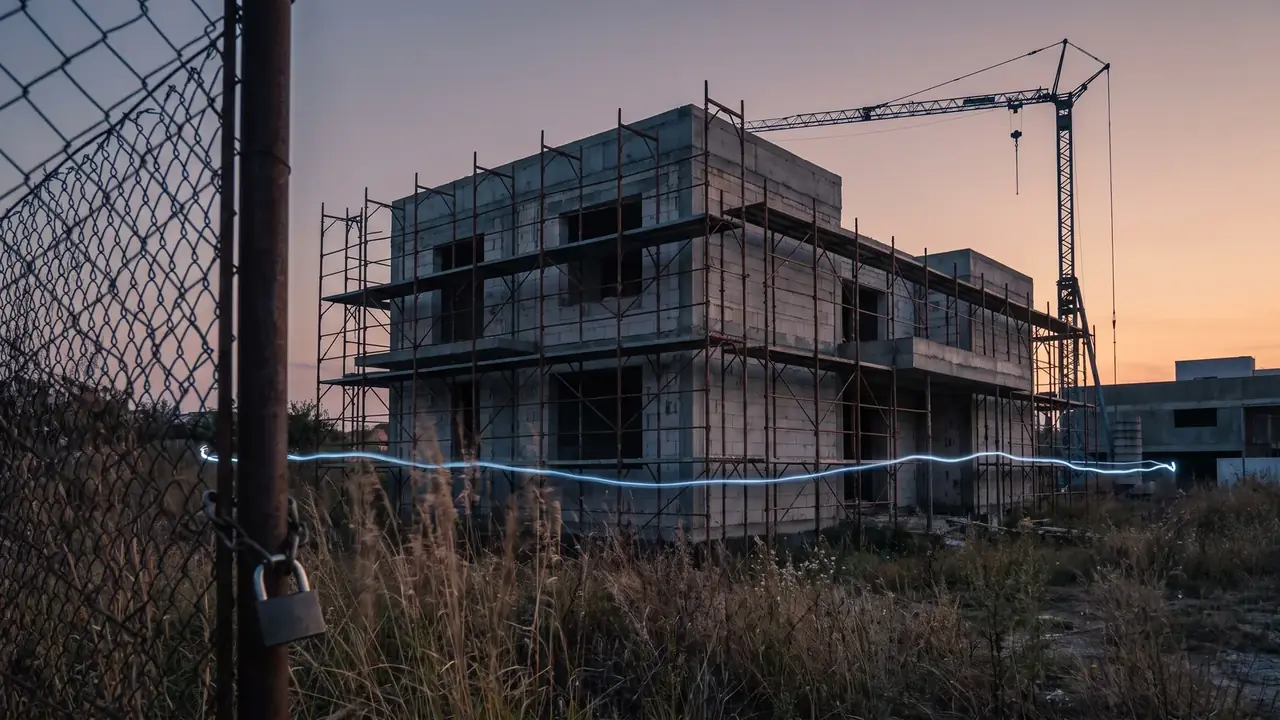
Law 207/2025 limits advances and requires a dedicated account, but does not set a handover date or compensation for delay.
Article 1522 of the Civil Code: a written notice, sent by a means that proves delivery, with a deadline for performance. Damages are counted from it.
Article 1538: the penalty set in the contract is claimed without proving loss. A court reduces it only if it is manifestly excessive.
If the developer refuses to sign the final contract, Article 1669 allows a claim, within 6 months of the date it should have been signed.
An exact date, compensation for every day, a right to cancel, time-limited force majeure, and reciprocity on interest.
Late handover in Romania: the short answer
Romania has no fixed statutory compensation for late handover, as Israel's Sale (Apartments) Law provides. Your rights rest on the contract and on the Civil Code: a formal notice with a deadline, payment of the penalty agreed in the contract without having to prove loss, withholding payments that fall due only after a stage that has not been completed, cancelling the contract and getting the money back, or a court judgment that takes the place of the final contract, within 6 months of the date it should have been signed.
I am a developer, so I am writing this article from the uncomfortable side of the table. Delays happen, even with good developers. The question is what your contract says before it happens, and what you do the day after.
Why it is simpler in Israel
In Israel, the Sale (Apartments) Law (in Hebrew) sets in section 5A fixed compensation for a delay of more than a month: the rent of a similar apartment, rising gradually to 1.5 times as the delay lengthens. You do not need to prove loss. The law has already done the calculation.
Romania has no such mechanism. Attorney Ilan Leibovitch, who has been reviewing transactions in Romania for years, put it simply in an interview with ynet in November 2025 (in Hebrew): Romania has no sale law and no guarantees like those in Israel. In Romania, compensation for delay is worth exactly what your contract says, and no more.
What Law 207/2025 gives you, and what it does not
Law 207/2025, known as the "Nordis law", has been in force since December 2025. It changed the picture for off-plan purchases, but mainly on the money side:
- Reservation fees of up to 5% of the price, for a period of up to 60 days, and a full refund within 30 days if the transaction is not signed through the developer's fault.
- Staged advances: up to 25% until the structure is complete, and up to a further 20% until the systems are complete.
- A dedicated project bank account, and a fine of 1% of turnover for using the money for another purpose (avocatnet.ro).
- A preliminary contract before a notary only, registered in the land register.
What the law does not set: a minimum handover date, compensation for delay or a construction timetable. We wrote about its protections in detail in our article on what the Nordis law changes. Here it is important to understand one thing: the law reduces the amount at risk during a delay, but does not compensate for it.
The Civil Code toolbox
These are the tools available to you under the Romanian Civil Code. The numbers are article numbers.
| The tool | Legal basis | What it gives | Point to watch |
|---|---|---|---|
| Formal notice (punere în întârziere) | Article 1522 | A written deadline for performance | Sent through a bailiff or any means that proves delivery |
| Agreed penalty clause (clauza penală) | Articles 1538, 1541 | The amount set in the contract, without proving loss | A court reduces it only if it is manifestly excessive |
| Withholding payment | Article 1556 | You may refrain from paying, to the corresponding extent, when the other party has not performed | Not for a minor breach |
| Cancelling the contract (rezoluțiune) | Articles 1549, 1550, 1552 | Refund of the money and damages | Cancellation by notice must be registered in the land register |
| Judgment in place of the contract | Articles 1279, 1669 | Transfer of ownership without the developer's cooperation | Claim within 6 months |
| Confirmatory earnest money (arvună) | Article 1544 | Cancel and claim double | Only if what you paid was defined as arvună |
Step 1: a formal notice, before anything else
Under Article 1522, a notice is sent in writing and must give the developer a deadline for performance. If you did not give a deadline, they may perform "within a reasonable time". This letter fixes the moment of breach, and damages are counted from there.
And a practical point: if you file a claim without prior notice, Article 1522 gives the developer a reasonable time to perform, and if they perform within that time, the legal costs may fall on you. A formal notice is far cheaper than a lawsuit, and it is the condition for most of what follows.
Step 2: the agreed penalty, if there is one
Article 1538 provides that you can claim the agreed penalty without proving any loss. This is your strongest tool, and it exists only if someone wrote it into the preliminary contract.
Under Article 1541, a court can reduce the penalty in only two situations: when part of the obligation has already been performed for your benefit, or when the penalty is manifestly excessive compared with the foreseeable loss. Even then, the reduced penalty must remain higher than the main obligation.
No penalty clause in the contract? You can still claim damages, but then you have to prove the loss: rent you paid in the meantime, interest differences, expenses. That is much harder and more expensive work.
In Romania, compensation for delay is worth exactly what your contract says, and no more.
Step 3: cancellation, or a judgment in place of the contract
When the delay becomes a real problem, there are two opposite routes.
The way out. Under Articles 1550 and 1552, you can cancel the contract by written notice when the contract allows it, or when the developer has not performed by the deadline set in the formal notice, and you can also ask a court for cancellation. Under Article 1552, a notice of cancellation must be registered in the land register to bind third parties. Cancellation returns the money only if the developer is able to return it, which is why the dedicated account under Law 207 matters here.
The way in. If the house is ready but the developer refuses to sign the final contract, Articles 1279 and 1669 allow you to ask a court for a judgment that takes the place of the contract, provided you have met your own obligations. The deadline is strict: 6 months from the day the contract should have been signed. Anyone who politely waits a year loses this tool.
"Force majeure": what the developer may claim
Article 1351 defines force majeure as an external, unforeseeable event that is absolutely impossible to overcome or prevent. A subcontractor's delay, a labour shortage or rising material costs usually do not meet this definition.
So before signing, read the force majeure clause in your contract. A clause defining "delay in obtaining approvals" or "weather conditions" as force majeure extends the developer's protection far beyond the law. Such a clause needs a time limit.
Five clauses to ask for in the preliminary contract, before any delay
- An exact handover date, a date and not a "quarter", and a defined grace period.
- Daily or monthly compensation for every day of delay after the grace period.
- A right to cancel after a certain delay, with a full refund by a fixed date.
- Force majeure defined and limited in time, not an open list.
- Reciprocity. If you pay interest for late payment, the developer pays for late handover too.
We wrote about everything else that must be in the contract in our guide to the preliminary contract in Romania.
And honestly: when it is not worth rushing to court
A two-month delay on a project that is progressing on site is not the same as a site standing empty. Before you send a formal notice, check three things: is there activity on site, are withdrawals from the dedicated account continuing, and is the developer communicating with you in writing.
Legal proceedings in Romania take time and cost money, and sometimes an agreed solution with written compensation is worth more than a judgment two years from now. The decision should be made with a Romanian lawyer, not out of anger.
Frequently asked questions
Does Romania have fixed statutory compensation for late handover?
No. Unlike Israel's Sale (Apartments) Law, Romania has no fixed compensation in law. Compensation is set in the contract, and without such a clause you have to prove the loss in court.
Does Law 207/2025 protect me from delays?
Only indirectly. The law limits advances and requires a dedicated account and a preliminary contract before a notary, so less of your money is at risk. It does not set a handover date or compensation for delay.
What is the first step when the developer is late?
A written formal notice, under Article 1522 of the Civil Code, sent by a means that proves delivery and giving a deadline for performance. It fixes the moment of breach and opens the way to compensation and cancellation.
The developer has finished building but will not sign the final contract. What do I do?
You can ask a court for a judgment that takes the place of the contract, under Article 1669, if you have met your own obligations. The claim is filed within 6 months of the date the contract should have been signed.
Can I stop paying a developer who is late?
Under Article 1556, a party may withhold its own performance to the corresponding extent when the other party has not performed. In an off-plan purchase this is relevant mainly when a payment is tied to a construction stage that has not been completed. Do it only after checking with a lawyer, so that you do not become the party in breach yourself.
The bottom line
In Romania, protection against delay does not come from the law. It comes from the contract. Anyone who signs without an exact date, without compensation and without a right to cancel will discover on the day of the delay that their only tool is a long lawsuit.
I will mention it once: in our project in Balotești handovers are planned from December 2027, and we encourage every buyer to check the handover and compensation clauses with their own lawyer. If you are about to sign, with us or with any other developer, book a 30-minute call with me and we will go through the handover clauses in your contract together. And if the contract is already signed, start with the Nordis law checklist to see where your money stands.
Moti Azulay, Compass Group Romania
Sources and data: Law 207/2025, Romanian legislation portal · Romanian Civil Code, legislation portal · Article 1279 of the Civil Code, legeaz.net · avocatnet.ro: key points of Law 207/2025 · lexeto.ro: legal analysis of the Nordis law · Sale (Apartments) Law, section 5A (in Hebrew) · ynet, 16.11.2025 (in Hebrew) · National Union of Public Notaries of Romania (UNNPR).
This article is for general information only and is not legal, tax or financial advice. The description of the Civil Code and Law 207/2025 is a general summary as of October 2026; the binding text is the one published in the Monitorul Oficial. In the event of a delay, consult an independent Romanian lawyer before taking any step.
Now you know more.
This article is general information, not legal, tax or financial advice. Consult local professionals before any transaction.