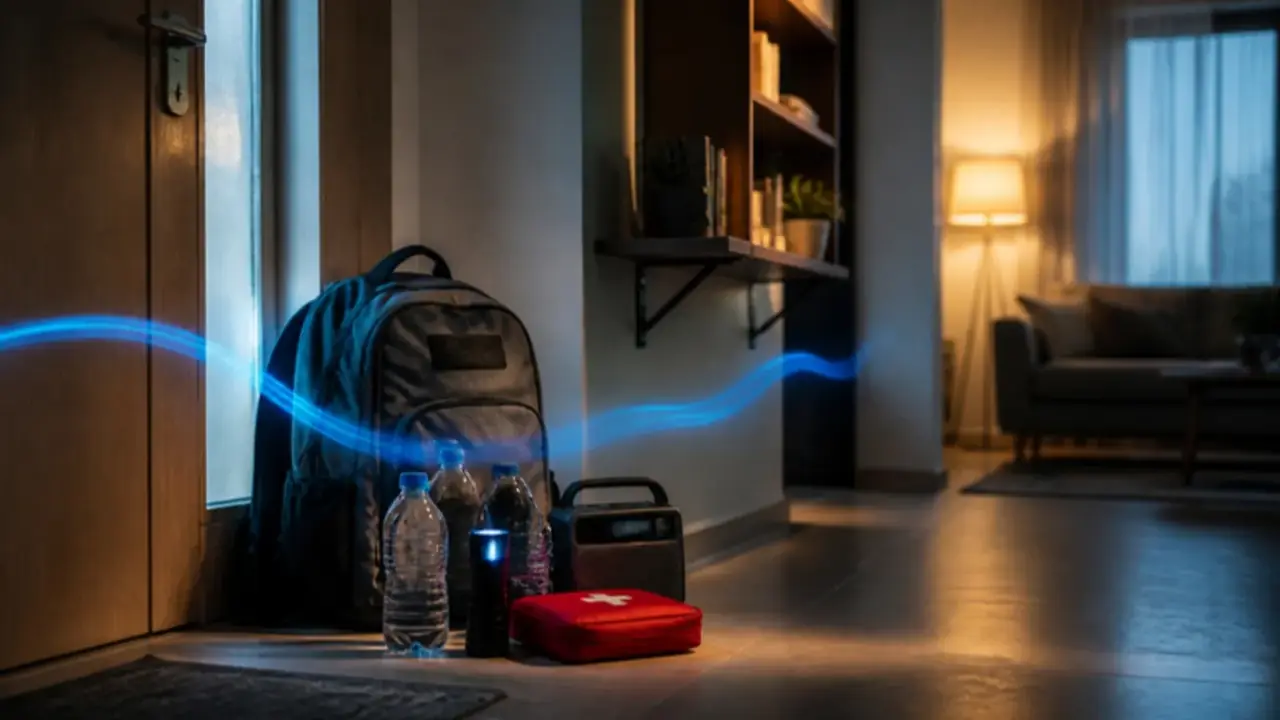
The IGSU describes the emergency reserve as items that help you for 3–5 days if you must leave home, starting with at least 4 litres of water.
After an earthquake, the IGSU asks people to use the phone only for justified emergency calls, so the lines are not blocked.
Authorities have said RO-ALERT is not used to warn before an earthquake, citing low predictability and the risk of panic. Messages may follow afterwards.
Earthquake preparedness in Romania: the short answer
Romania's General Inspectorate for Emergency Situations (IGSU) gives families the same short list in every campaign. Before an earthquake: fix furniture that could move to a wall, put heavy objects low, agree a family protection plan, know where the switches and the water and gas valves are, and keep an emergency reserve. During it: stay inside, keep away from windows, take cover and hold on. After it: help the injured, shut off gas and electricity if there is damage, leave calmly, and follow only official information.
Two practical facts matter for anyone moving to Bucharest. The emergency number is 112, and the IGSU asks people to use the phone after an earthquake only for justified emergency calls, so the lines stay free. And RO-ALERT, the national phone alert system, is not used to warn before an earthquake. Authorities have said it may send messages afterwards, if the earthquake has serious consequences.
In plain words: the building does most of the work, and the family plan does the rest. Fix what can fall, pack one bag, agree one meeting point, and practise the one-minute drill once a year.
Which buildings are most at risk, and how to check a building before you buy, is covered in our article on earthquake risk in Bucharest. This article is about the household.
Before: the family plan
The IGSU campaign "Nu tremur la cutremur" ("I don't tremble at an earthquake") says every family should have an emergency plan. Its preparation page lists what the plan should answer:
- What the home is built of, and whether it will sway more or less.
- Where the load-bearing walls and the partition walls are, and where plaster or ornaments could fall.
- Which furniture is stacked or tall, to be avoided and fixed to the structure.
- What could start a fire, such as a stove or a gas cooker.
- Where the switches, fuses and the main and local valves for electricity, water and gas are, and how to operate them.
To that, add three family decisions:
- The safe spot in each room. The IGSU suggests a place under a beam or under a solid piece of furniture, away from stacked furniture, windows, glass cabinets and lamps.
- A meeting point outside, in open space away from buildings and power lines, and a second one further away in case the first is not reachable.
- One contact person outside the city, whom everyone calls or texts, because local lines may be busy.
Write it on one page, give a copy to each family member and to the nanny or babysitter, and keep one in the emergency bag.
Before: securing the house
| What | What to do | Why |
|---|---|---|
| Tall bookcases and wardrobes | Fix to the wall or a solid structural element | IGSU: furniture can move during an earthquake |
| Heavy objects | Store on lower shelves | IGSU: place heavy objects that can injure you low in the room |
| Beds and children's beds | Away from windows, mirrors and heavy shelves above | Fewer things that can fall on a sleeping person |
| TV and screens | Wall bracket or anti-tip strap | They tip forward easily |
| Glass and pictures | Not above beds or sofas; secure hooks | Glass is a common cause of injury |
| Gas cooker and boiler | Know where the valve is; keep the periodic checks up to date (see fire safety in a villa) | A damaged gas line is a fire risk |
In a new villa, the structure itself has been designed under the current seismic code. The furniture has not: it is on you. If you are fitting out a new house, plan wall fixings with the carpenter, before the wardrobes go in.
Before: the emergency kit
The IGSU describes the emergency reserve or backpack as items that help you for 3–5 days if you need to leave home. Its minimum list:
The building does most of the work, and the family plan does the rest.
| Item in the IGSU list | Practical note |
|---|---|
| Water, at least 4 litres | More for a family; replace it regularly |
| Light, non-perishable food: biscuits, energy bars | Check expiry dates once a year |
| First-aid kit | Add the family's regular medication |
| Blanket | One per person in a car or a second bag |
| Battery radio | Official information comes on national radio and TV |
| Torch | One per adult |
| Spare batteries | For the radio and the torch |
| Whistle | To signal if you are trapped |
| Personal hygiene: soap, toothpaste and toothbrush, toilet paper | |
| A notebook with important phone numbers | On paper, in case the phone is dead |
Many families add copies of identity documents and the property papers in a waterproof folder, some cash, a power bank, and what small children or pets need. Keep the bag near the exit, and tell everyone where it is.
During: the first minute
According to the IGSU inspectorates, if you are inside a building:
- Stay calm and calm the people around you.
- Don't try to go out. Don't run down the stairs, don't go onto the balcony, don't use the lift. The IGSU warns that moving during the shaking can throw you off balance.
- Move away from windows, exterior walls and objects that can injure you.
- Turn off sources of fire if you can do it quickly.
- Take cover in a door frame, under a beam, next to a load-bearing wall or under a solid piece of furniture. The campaign slogan is "Jos! Protejează-te! Ține-te!": drop, cover, hold on.
- If there is no shelter, stay on the floor next to a solid wall and protect your head and neck with your hands and forearms.
- Open the door if you can, so it doesn't jam and you can get out afterwards.
Outside, move away from buildings, bridges, trees and power lines, and stay at least 10 metres from broken or fallen cables. In a car, stop somewhere safe without blocking the road, away from bridges and buildings, and stay inside.
After: the first hour
The IGSU guidance after an earthquake:
- Help the injured, but don't move seriously injured people unless they are in immediate danger.
- Check the installations: electricity, gas, water and sewerage. If there is damage, shut off the local or main supply and call the specialist service. Don't use open fire.
- Leave the building calmly if you need to, without taking unnecessary things, and check the way out. Protect your head from falling plaster, with a helmet or, failing that, a bag or a stool.
- Use the phone only for emergencies. Call 112 in justified cases, so as not to block the lines. A text message to your contact person uses less of the network.
- Follow official information on national radio and television. Ignore rumours, even from so-called specialists.
- Expect aftershocks. Don't go back into a damaged building until it has been checked.
RO-ALERT and 112: what to expect from your phone
| Tool | What it is | What to expect in an earthquake |
|---|---|---|
| 112 | The single emergency number | For real emergencies; keep the lines free |
| RO-ALERT | Alerts sent to all phones in an area | Not sent before an earthquake; may be sent afterwards with instructions if there are serious consequences |
| Android earthquake alerts | A Google phone feature | Optional; Google does not promise the alert arrives before the shaking |
| National radio and TV | Official announcements | The source the IGSU tells people to follow |
In late 2022, after a magnitude 5.4 earthquake in Vrancea, the Department for Emergency Situations explained that RO-ALERT would not send notifications before earthquakes, citing low predictability and the risk of panic. A legislative proposal on warning the population in earthquakes (B400/2025) was in public consultation at the Senate in late 2025; we did not find it adopted as of October 2026. Leave emergency alerts switched on in your phone settings: RO-ALERT is also used for floods, storms and other dangers.
Building categories, in brief
After a technical assessment, older buildings in Bucharest are placed in one of four seismic risk classes, from RsI (the "red dot", highest risk) to RsIV. The official list is published by the city's AMCCRS. New buildings are designed under the P100 seismic code. For a family, this means two things. First, know the class or the design code of the building you live in. Second, the household plan is the same in every building: in a low-rise new house it mostly protects you from falling objects. Details and a buyer's checklist are in our article on earthquake risk in Bucharest. Compulsory PAD insurance covers earthquake damage up to a set limit; see our guide to home insurance.
Your yearly checklist
- Family plan updated and one copy in the bag.
- Furniture and screens fixed; nothing heavy above beds.
- Everyone knows where the gas valve, the main water valve and the fuse box are.
- Water and food in the kit replaced, batteries tested.
- Meeting points and the contact person confirmed with the children.
- Emergency alerts on in every phone.
- A one-minute drill at home, ideally around 4 March, when Romania marks the 1977 earthquake and the IGSU runs its campaign.
Frequently asked questions
What does IGSU recommend doing during an earthquake?
Stay inside, keep calm, move away from windows and exterior walls, and take cover in a door frame, under a beam, next to a load-bearing wall or under solid furniture. Don't use the stairs or the lift and don't go onto the balcony.
What should be in an earthquake emergency kit in Romania?
The IGSU minimum list for 3–5 days: at least 4 litres of water, non-perishable food, a first-aid kit, a blanket, a battery radio, a torch, spare batteries, a whistle, hygiene items and a notebook with phone numbers.
Will RO-ALERT warn me before an earthquake?
No. Authorities have said RO-ALERT is not used to warn before an earthquake, because of low predictability and the risk of panic. Messages may be sent after an earthquake with serious consequences.
Should I call 112 after an earthquake?
Only for a real emergency. The IGSU asks people to use the phone after an earthquake only for justified emergency calls, so the lines are not blocked.
The bottom line
In Bucharest, earthquake preparedness is a household routine, not a fear. Choose a building whose seismic position you know, fix what can fall, keep one bag ready, and agree the plan with everyone who lives in the house.
If you are thinking about moving your family to Bucharest and want to talk through the building and the neighbourhood, book a 30-minute call with me.
Moti Azulay, Compass Group Romania
Sources: IGSU, "Nu tremur la cutremur": preparation and emergency reserve · IGSU, "Nu tremur la cutremur": behaviour after an earthquake · ISU Giurgiu (IGSU), April 2025: protection measures before, during and after an earthquake · ISU Vaslui (IGSU), essential rules in an earthquake · HotNews, November 2022: why RO-ALERT is not sent before earthquakes · Senate public consultation: a submitted opinion on proposal B400/2025
This article is for general information only and is not legal, tax or financial advice, nor a substitute for official instructions. Information current as of 22 October 2026. In an emergency, follow the instructions of the authorities and call 112.
Now you know more.
This article is general information, not legal, tax or financial advice. Consult local professionals before any transaction.

