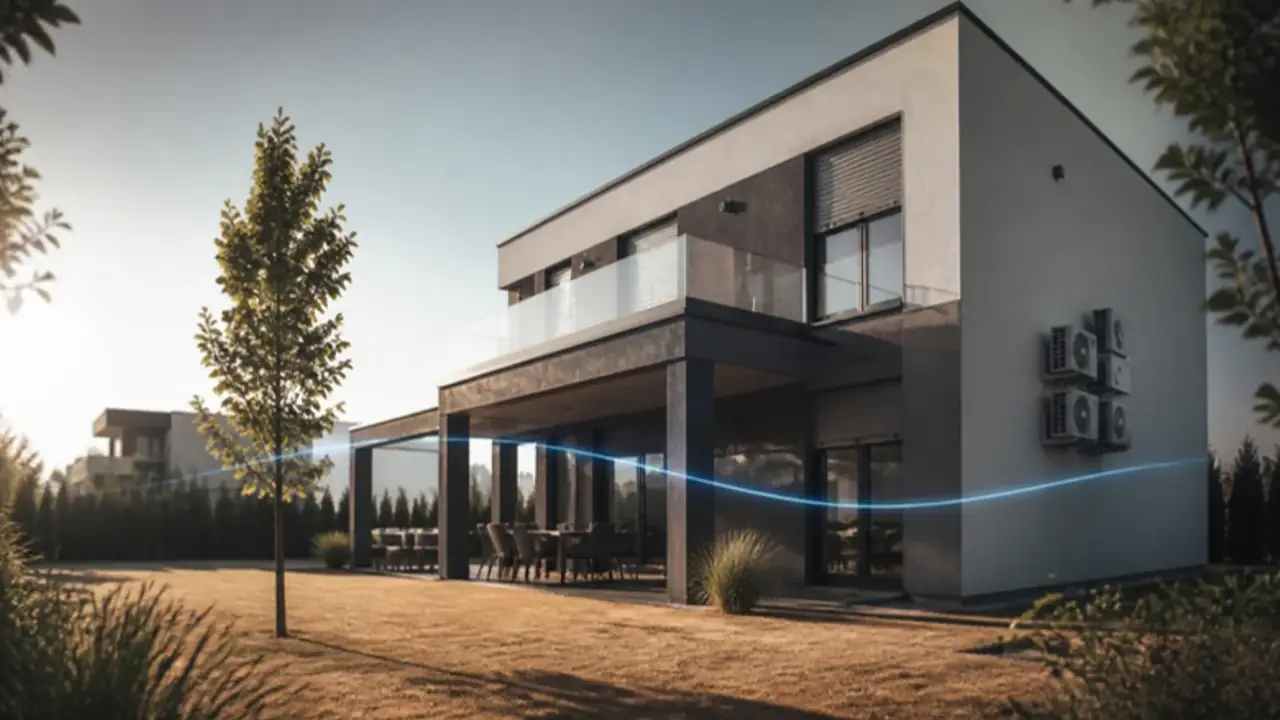
On 26 July 2025, ANM recorded daily heat records at 114 stations, including all three in Bucharest; Filaret reached 40–41.5°C.
According to ANM, summer 2024 was the hottest in Romania in the series that starts in 1901, with a national mean of 24.2°C.
An efficient 3.5 kW unit uses about 200 kWh a summer by the EU label method: roughly 220–290 lei at July 2026 tariffs.
Cooling a villa in a Bucharest heatwave: the short answer
Bucharest summers are hot and getting hotter. According to Romania's National Meteorological Administration (ANM), summer 2024 was the hottest in Romania since records began in 1901, and on 26 July 2025 the București-Filaret station reached between 40°C and 41.5°C. A villa near Bucharest needs a cooling plan, not just an air conditioner in the living room.
The order matters. First keep the sun out (shading), then keep the heat out (insulation, especially the roof), then flush the heat at night (ventilation), and only then cool what is left with machines: split air conditioners or a heat pump in cooling mode. A house that does the first three well needs smaller machines and runs them for fewer hours.
In plain words: shade first, insulate second, open the windows at night, and let the air conditioning do the last part of the job. That is cheaper than doing it the other way round.
Our guide to Bucharest weather through the year covers the seasons; this article covers the house in the hottest weeks.
How hot Bucharest summers get: what ANM recorded
A few figures from ANM, the official source:
| Measure | What ANM reported |
|---|---|
| Summer 2024 | The hottest summer in Romania in the 1901–2024 series, national mean 24.2°C (previous record 23.5°C in 2012) |
| August 2024 | National mean 24.5°C, 2.9°C above the 1991–2020 norm; up to 31 tropical days and up to 27 tropical nights at some stations |
| 26 July 2025 | Daily maximum records at 114 stations; records at all three Bucharest stations, 40–41.5°C at București-Filaret |
| 27 July 2025 | Record morning minimums at 50 stations |
Three ANM terms you will see in forecasts:
- Tropical day: a maximum of 30°C or more.
- Tropical night: a minimum of 20°C or more. These are the nights when a house cannot cool down on its own.
- Heatwave day (zi caniculară): a maximum of 35°C or more.
ANM also issues yellow, orange and red heat warnings, and its warnings often mention the temperature-humidity index (ITU) reaching the critical threshold of 80 units. When that is forecast, the house should already be closed and shaded by mid-morning.
Layer 1: keep the sun out
Most summer heat enters through glass. A large window facing south or west, without shading, can heat a room faster than any split unit cools it.
- External shading beats internal blinds. External roller shutters, louvres or awnings stop the sun before it reaches the glass. An internal curtain stops it after the heat is already inside.
- West is the hardest side. Low afternoon sun is difficult to block with a roof overhang. Vertical shading or shutters work better there.
- Overhangs and pergolas on the south. A roof overhang or pergola above a south-facing window blocks the high summer sun and lets the low winter sun in. If you plan to add a pergola, read our guide to villa additions and permits first.
Layer 2: keep the heat out
Insulation is usually discussed as a winter topic, but it works in summer too. The roof is the most important surface: it takes the most sun for the most hours.
- Roof first. An insulated roof, or a ventilated pitched roof with insulation at the ceiling, keeps the top floor usable on a 38°C afternoon. Flat and pitched roofs behave differently here, so ask how yours is built.
- Walls and glazing. External insulation and good double or triple glazing slow the heat down. Low-emissivity, solar-control glass helps on large glazed walls.
Layer 3: flush the heat at night
When the night is cooler than the house, open up. Windows on opposite sides of the house, or a low window and a high one, create a cross draught that removes the heat stored in the walls and floors.
This works on ordinary summer nights. It works much less on tropical nights, when the minimum stays at 20°C or more. In a heatwave the routine becomes: windows open from late evening to early morning, shutters down and windows closed by mid-morning, and air conditioning only for the hours and rooms that need it.
Shade first, insulate second, open the windows at night, and let the air conditioning do the last part of the job.
Near Bucharest, add mosquito screens and secure ground-floor shutters if windows stay open at night.
Layer 4: split air conditioners or a heat pump in cooling mode
| Split air conditioners (air-to-air) | Air-to-water heat pump in cooling mode | |
|---|---|---|
| How it cools | An indoor unit in each room, one or more outdoor units | Chilled water sent to fan coils, or to underfloor or ceiling systems |
| Speed | Fast: a room cools in minutes | Slower with underfloor; fan coils are faster |
| Also heats? | Yes, most modern units can heat | Yes, it is usually the main heating system |
| Comfort | Air movement and noise from indoor units | Quiet, even temperature with radiant systems |
| Watch out for | Placement of outdoor units, condensate drainage | Underfloor cooling must stay above the dew point to avoid condensation |
| When it fits | Existing house, cooling room by room | New villa designed with one system for heating and cooling |
An air-to-water heat pump that heats through underfloor heating can often cool through the same pipes. Underfloor cooling is gentle: it takes the edge off the heat but will not cool a room as quickly as a split unit, and the water temperature must stay above the dew point so the floor does not sweat. Many villas combine both.
Our comparison of heat pumps and gas for heating covers the winter side and the full energy-price picture.
What it costs to run: a calculation from published tariffs
Electricity is the fuel of every cooling system. The regulated price cap for households ended on 1 July 2025, and prices now depend on your supplier contract. In July 2026, the standard offers for Bucharest households on ANRE's price comparator ranged from 1.11 to 1.43 lei/kWh among the ten cheapest suppliers, according to HotNews. Check the current offers yourself on posf.ro before you calculate.
The EU energy label for air conditioners assumes 350 hours a year of cooling at full design capacity (Regulation 626/2011, Annex VII). Annual consumption is roughly the cooling capacity times those hours, divided by the seasonal efficiency (SEER). A unit rated A++ has a SEER of at least 6.10.
Our assumptions: split units of 3.5 kW cooling capacity, SEER 6.1. A "label" summer uses the 350 hours. A "heatwave" summer doubles them to 700 hours; that is our illustration, not an official figure. Exchange rate 5.3365 lei/€ (ECB, 21 October 2026).
| Scenario | Electricity per summer | At 1.11 lei/kWh | At 1.43 lei/kWh |
|---|---|---|---|
| 1 unit, label summer | about 200 kWh | about 220 lei (€42) | about 290 lei (€54) |
| 1 unit, heatwave summer | about 400 kWh | about 445 lei (€83) | about 575 lei (€108) |
| 5 units, label summer | about 1,000 kWh | about 1,110 lei (€208) | about 1,430 lei (€268) |
| 5 units, heatwave summer | about 2,000 kWh | about 2,220 lei (€416) | about 2,860 lei (€536) |
What the table shows:
- Cooling is not the scary bill. Even five units in a hot summer cost less than heating a poorly insulated villa in winter.
- Hours matter more than units. Shading and night ventilation cut the hours, and the hours drive the bill.
- Solar panels fit summer cooling well. Peak cooling coincides with peak solar production. Our guide to solar panels on a villa covers the prosumer rules.
Real consumption depends on the house, the settings and the hours someone is at home.
Checklist: before buying, and before the first summer
- Ask for the cooling specification in writing: which system, how many units, which rooms, capacity and energy class.
- Check the orientation of the main glazed walls. Ask what shading is included on the south and west.
- Check the roof insulation and ask for the energy performance certificate.
- See where the outdoor units go. They need airflow, access for service and a place where their noise does not reach a bedroom, yours or the neighbour's.
- Check condensate drainage from every indoor unit, so water does not run down a facade or into a wall.
- Use a certified installer. Air conditioners and heat pumps contain fluorinated refrigerants, and EU rules require certified personnel for installation and leak checks.
- Service before June. Clean filters and have the units checked in spring, not on the first 38°C day when every technician is booked.
- Plan the heatwave routine: night windows, morning shutters, 25–26°C on the thermostat.
Frequently asked questions
How hot does Bucharest get in summer?
Hot. ANM recorded the hottest Romanian summer since 1901 in 2024, and on 26 July 2025 the București-Filaret station measured between 40°C and 41.5°C. Days above 30°C are common in July and August, and in heatwaves the nights can stay above 20°C.
Is air conditioning necessary in a villa near Bucharest?
In practice, yes, at least in the bedrooms and the main living area. Shading, insulation and night ventilation reduce the need a lot, but they are not enough on tropical nights during a heatwave.
How much does it cost to run air conditioning in Romania?
With July 2026 tariffs of 1.11–1.43 lei/kWh, one efficient 3.5 kW unit uses about 200 kWh in a summer by the EU label method, roughly 220–290 lei. Five units in a hot summer can reach around 2,000 kWh, roughly 2,200–2,900 lei.
Can a heat pump also cool the house?
Yes. An air-to-water heat pump can send chilled water to fan coils or to underfloor or ceiling systems. Underfloor cooling is gentle and slower, and the water must stay above the dew point to avoid condensation on the floor.
The bottom line
A Bucharest heatwave is a design question before it is an electricity question. A house that is shaded, insulated and easy to ventilate at night stays comfortable with smaller machines and lower bills. Running costs from published tariffs are modest; what costs money is a house that fights the sun all day.
If you are choosing a villa near Bucharest, with us or anywhere else, book a 30-minute call with me. We will go through orientation, shading and the cooling system before you sign.
Moti Azulay, Compass Group Romania
Sources: ANM data on summer and August 2024, as reported by Digi24 (11 September 2024) · ANM on the records of 26–27 July 2025, as reported by G4Media · ANM, National Meteorological Administration · Commission Delegated Regulation (EU) No 626/2011, Annex II and Annex VII · ANRE price comparator (posf.ro) · HotNews, cheapest electricity offers in Bucharest, July 2026 · ECB euro reference rate for the leu
This article is for general information only and is not legal, tax or financial advice. The figures are correct as of 22 October 2026. Electricity offers change often; check the current offers on the ANRE comparator before you decide.
Now you know more.
This article is general information, not legal, tax or financial advice. Consult local professionals before any transaction.

