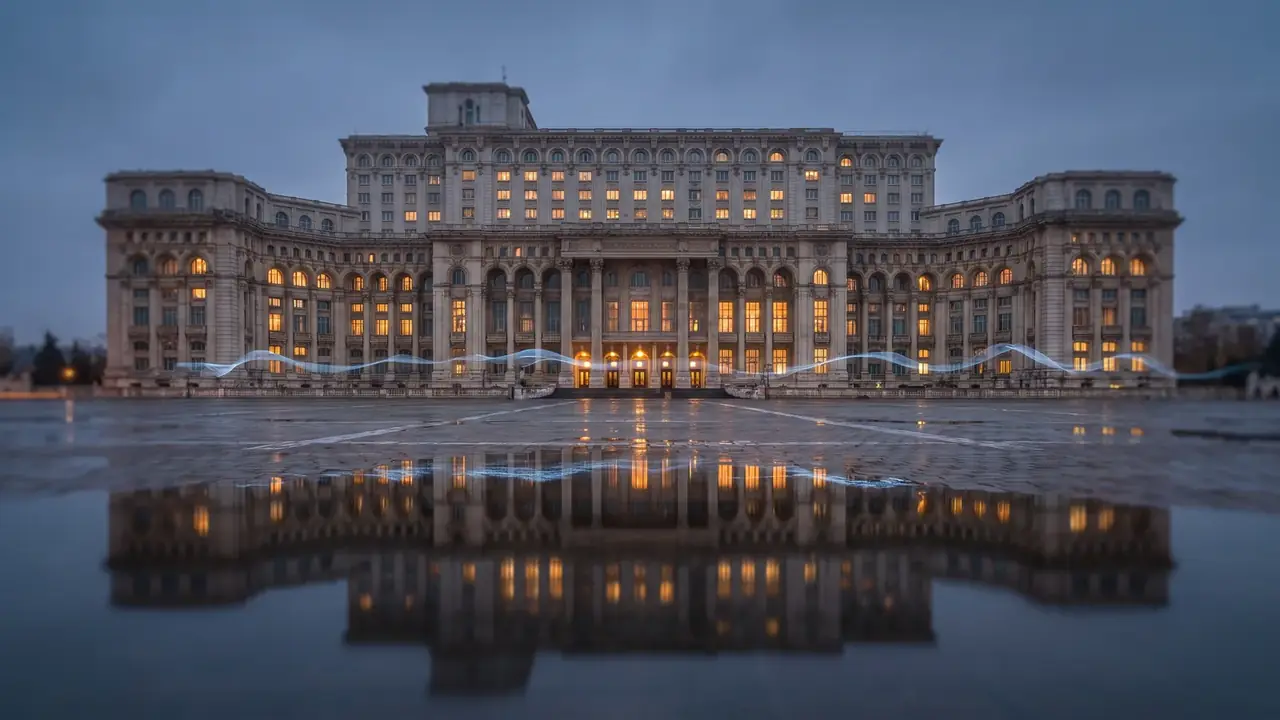
The Bolojan government was ousted in a no-confidence vote by a majority of 281 votes, and has since served as a caretaker government.
On 30.9.2026 Siegfried Mureșan received 182 votes out of the 233 required. In early October a fourth candidate was proposed.
Ownership is registered with ANCPI and protected by Article 44 of the constitution and EU law. Registration and notaries do not stop when a coalition falls.
The BNR has kept the rate at 6.5% since August 2024. As long as the crisis continues, a quick cut is hard to expect.
The three rating agencies keep Romania at the lowest investment grade, with a negative outlook.
Romania's political crisis: the short answer
As of October 2026, Romania has no permanent government: Ilie Bolojan's government was ousted in a no-confidence vote on 5 May 2026, and has since served as a caretaker government, while three candidates for prime minister have failed to win a majority. President Nicușor Dan nominated a fourth candidate in early October. For homeowners, ownership and registration do not depend on the government. What is affected: taxes, interest rates, the leu exchange rate and the pace of infrastructure investment.
I have been asked this question in almost every conversation since May: "Moti, is there even a government there?". So here is the full picture, including what is worrying.
How we got here: the timeline
| Date | What happened |
|---|---|
| 6.12.2024 | The Constitutional Court annulled the presidential election, over suspected Russian interference |
| 18.5.2025 | Nicușor Dan is elected president in the second round, with 53.6% against George Simion |
| June 2025 | Bolojan forms a coalition of four pro-European parties, including the Social Democrats (PSD) |
| 1.8.2025 | VAT rises from 19% to 21%, part of the austerity package |
| 20.4.2026 | The PSD leaves the coalition and files a no-confidence motion together with the far right (AUR) |
| 5.5.2026 | The government is ousted by a majority of 281 votes, and remains as a caretaker government |
| June 2026 | Two candidates for prime minister fail |
| 31.8.2026 | The European recovery plan (PNRR) ends, and Romania loses about €770 million over a reform that did not pass |
| 30.9.2026 | The third candidate, Siegfried Mureșan, receives 182 votes out of the 233 required |
| Early October 2026 | The president proposes Luca Niculescu, an independent diplomat |
Sources: BIRN, Balkan Insight, CNN and Business Review.
Why did the government fall?
In short: austerity. In 2024 Romania ran a deficit of 9.3% of GDP, the highest in the EU. Bolojan's government raised taxes and cut spending to bring the deficit down and unlock European funds. These measures hurt PSD voters, and in the end the party preferred to break up the coalition.
This is not a "right versus left" crisis in the Israeli sense. It is an argument about the pace of fixing the budget, and at the same time a rise in the strength of the far right.
What does not change when there is no government
This is the important part for homeowners:
- Your ownership is registered in the land register of ANCPI, not in the prime minister's office. Registration, the notarial contract and the mortgage do not stop when the coalition breaks up.
- Property is protected by the constitution (Article 44 of the Constitution of Romania), and Romania is subject to EU law and the EU Court of Justice.
- Laws already passed remain in force. For example the Nordis law, which protects buyers of off-plan apartments.
A government can fall without your home moving an inch in the land register.
What does change: four channels
1. Taxes
VAT rose in August 2025, and in January 2026 dividend tax and annual property tax rose. A new government may change things again, in either direction. On property tax, see our article on annual property tax in Romania.
2. Interest rates and the exchange rate
The National Bank of Romania has kept its rate at 6.5% since August 2024, and speaks of "very high uncertainty". Annual inflation reached 10.7% in April 2026, partly because of the tax rises. As long as the crisis continues, it is hard to expect a quick rate cut.
3. The credit rating
The three major rating agencies keep Romania at the lowest investment grade (BBB- or Baa3), with a negative outlook. S&P affirmed the rating in an unscheduled review following the crisis. A downgrade to "junk" would make state financing more expensive, and indirectly mortgages too.
A government can fall without your home moving an inch in the land register.
4. European funds and infrastructure
Of the recovery plan, revised to €20.1 billion, Romania had received about €12.97 billion by September 2026. Under the timetable, the final payment request had to be submitted by the end of September. Regular EU cohesion funds continue, but political delays slow projects down. On what is being built around Bucharest, see our article on EU funds and infrastructure.
The next scenarios
- A new government takes office. The fourth candidate wins a majority. This is the scenario the president is trying to achieve, and he has said early elections would not solve the crisis.
- Early elections. Under the constitution, if parliament rejects two proposals within 60 days, the president may dissolve it. President Dan has ruled this out so far.
- A prolonged transition. A caretaker government with limited powers, and a 2027 budget that is hard to pass without a majority.
The next regular parliamentary elections are expected in 2028, and presidential elections in 2030.
What this means for someone considering buying now
There are two sides, and I present both.
The worrying side: taxes and interest rates may change again, and the budget is open. Anyone dependent on a loan in lei is exposed to the interest rate and the exchange rate.
The other side: the market knows all this, and prices it in. In a year of uncertainty there are fewer buyers around the table. We wrote about this dynamic in our article on the transition year.
My rule does not change: only buy a property that makes sense even if the politics do not settle down. And check the current taxes on the day of signing, not from an article written six months ago.
And for those who already own property in Romania: a political crisis does not require you to do anything immediately. It does require you to stay up to date. Check the property tax notice from the local authority every year, and follow tax changes through ANAF or your accountant, especially if you let the property.
Frequently asked questions
Does Romania have a government today?
There is a caretaker government led by Ilie Bolojan, since it was ousted in a no-confidence vote on 5 May 2026. Three candidates failed to win a majority, and in early October 2026 President Nicușor Dan proposed Luca Niculescu as a fourth candidate.
Does the political crisis affect property ownership in Romania?
No. Ownership is registered in the ANCPI land register and protected by the constitution and EU law. The crisis affects taxes, interest rates and the exchange rate, not registration.
Why was the 2024 presidential election annulled?
The Constitutional Court annulled it on 6 December 2024, over suspected Russian interference in the election campaign. The rerun took place in May 2025, and Nicușor Dan won with 53.6% of the vote.
Will there be early elections in Romania?
Possibly, but not certainly. The constitution allows the president to dissolve parliament if two government proposals are rejected within 60 days, and the president has stated that he does not favour early elections.
What is Romania's credit rating?
BBB- at S&P and Fitch and Baa3 at Moody's, all with a negative outlook. It is the lowest grade in the investment category.
The bottom line
The Romania of 2026 is a turbulent democracy inside the EU: a government falls, a president looks for a majority, and the rating agencies are watching. But the institutions that protect the homeowner, registration, notary, courts and EU law, are working.
If you would like to go through what the crisis changes in your transaction together, book a 30-minute call with me. For the economic side, see our article on Romania's economy in 2026.
Moti Azulay, Compass Group Romania
Sources and data: Balkan Insight (BIRN), 30.9.2026 · Balkan Insight, the government's ousting 5.5.2026 · CNN, election results 18.5.2025 · OSW, analysis July 2026 · Business Review, the end of the PNRR · Romania Insider, Luca Niculescu's nomination · National Bank of Romania (BNR) · Erste Group, S&P on Romania · ANCPI · ANAF
This article is for general information only and is not legal, tax or financial advice. The political situation in Romania changes from day to day; the data is correct as of 8 October 2026. The article does not express a political position.
Now you know more.

This article is general information, not legal, tax or financial advice. Consult local professionals before any transaction.