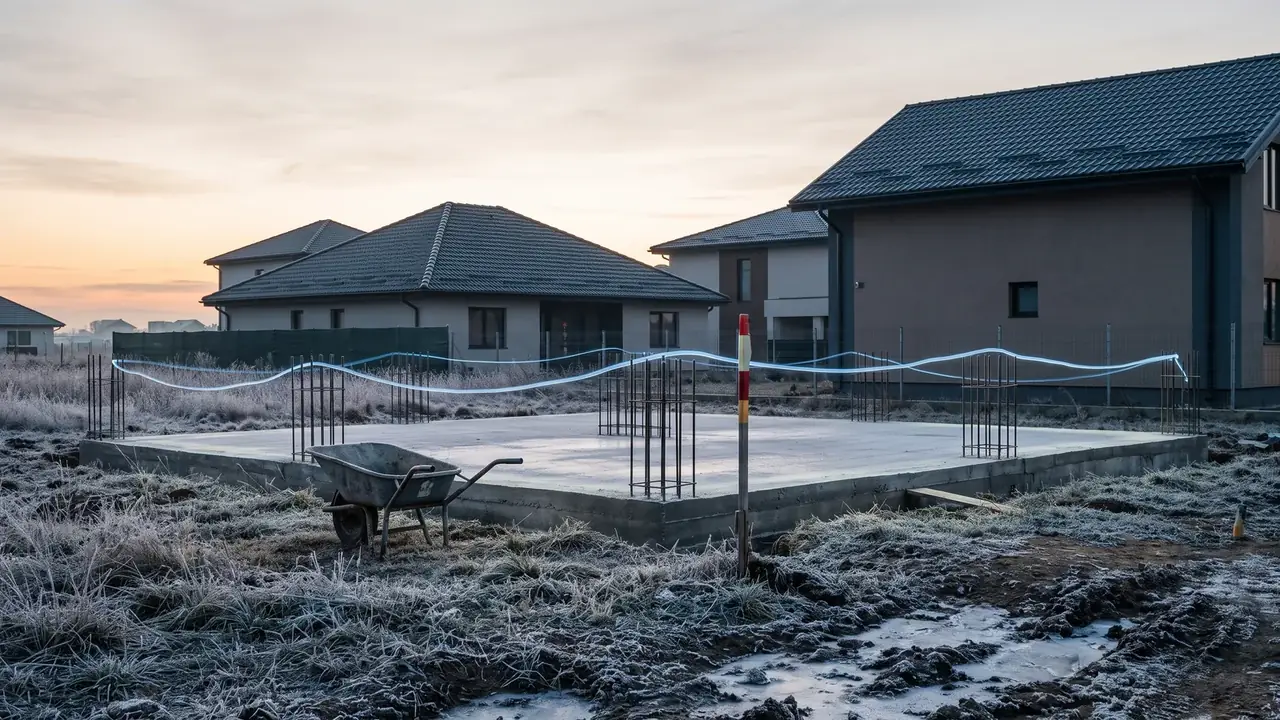
Non-EU citizens cannot register land directly in their own name, so building starts with a company or superficies structure.
Urbanism certificate, approvals, certified design and a building permit, all under Law 50/1991.
For a residential building, the local fee is 0.5% of the authorised value of the works, under the Fiscal Code.
Construction works and materials carry 21% VAT; so does a new home bought from a developer, usually included in the price.
When you build, you are the developer: permits, contractors, budget and delays are yours.
Build or buy a house in Romania: the short answer
Building your own house in Romania can give you full control over design, but it means buying land, getting an urbanism certificate and a building permit under Law 50/1991, managing contractors and carrying the risk of delays and overruns. For a non-EU buyer there is an extra hurdle: land cannot be registered directly in their own name. Buying a new villa from a developer means a known price and timetable, with the permit risk already behind you.
"Why pay a developer? I'll buy a plot and build." I hear this mostly from buyers who have built in Israel, or whose parents did. It is a legitimate option, and in some cases the right one. But in Romania it looks different, especially for someone who is not an EU citizen. Here is the honest comparison, including where building comes out ahead.
The first question: can you own the land?
Before any architect, there is the land. Under Law 312/2005, citizens of non-EU countries, Israelis included, cannot register land directly in their own name in Romania. They can own a building, but not the plot under it.
That means anyone who is not an EU citizen and wants to build has to choose a structure first: a Romanian company that buys the plot, or a superficies right over land owned by someone else. Each route has consequences for the bank, for inheritance and for a future sale. We explain them in our article on land ownership in Romania.
When buying a finished villa in a project, the structure is usually already designed by the developer. When you build alone, you design it, and pay for it, yourself.
The permits: from urbanism certificate to building permit
Building in Romania is governed by Law 50/1991 on authorising construction works. The main stages:
- Urbanism certificate (certificat de urbanism). Issued by the local authority, it states what may be built on the plot under the local zoning plan, and which approvals are needed.
- Approvals and permits. Typically utilities (electricity, water, gas), environment, fire safety where relevant, and others listed in the certificate.
- Design. An architectural and structural project by certified designers, checked by a certified verifier, including the seismic design under the P100 code.
- Building permit (autorizație de construire). Issued by the mayor of the commune or town. The local fee for a residential building is 0.5% of the authorised value of the works, under the Fiscal Code.
- Construction, inspections and acceptance. At the end, the acceptance on completion of works and registration of the building in the land register.
If the plot is not yet zoned for housing, a zoning plan (PUZ) may be needed first, a process that can take much longer than the permit itself.
Side by side: building vs buying
| Building your own house | Buying a new villa from a developer | |
|---|---|---|
| Land for a non-EU buyer | You set up the structure (company or superficies) | Structure usually prepared by the developer; check it |
| Permits | Your responsibility, from certificate to acceptance | Already obtained; check the building permit |
| Price certainty | Depends on the contractor and materials; overruns are common | Fixed price in the contract |
| VAT | 21% on construction works and materials invoiced to you | 21% on the price of a new home, usually stated in the price |
| Timeline | Plot search + permits + construction | Contractual handover date |
| Your time | Many trips, decisions, site supervision | Choices and inspections at set stages |
| Design freedom | Full | Within the project's plans |
| Neighbourhood | Whatever happens on the plots around you | Planned as one project |
| Mortgage | Construction loan or staged financing; harder for non-residents | Standard mortgage on a defined property |
| Defects liability | Your contractor and designers, under Law 10/1995 | The developer and its contractors, under Law 10/1995 |
The real difference is not the price per m². It is who carries the risk. When you build, you are the developer.
The hidden costs of building
Builders' quotes usually cover the house itself. When comparing with a villa sold at an all-inclusive price, add the lines that are easy to forget:
The real difference is not the price per m². It is who carries the risk.
- The land, its notary and registration costs, and the company or superficies structure if you need one.
- Design and checks: architect, structural engineer, verifier, topographic survey, geotechnical study.
- Fees: urbanism certificate, approvals, the 0.5% local permit fee and the quality-control levies paid to the State Construction Inspectorate.
- Connections: electricity, water, sewage or a septic system, gas. On a plot outside a developed area, these can be significant.
- Access road, fence, landscaping and gate.
- Site supervision: a site manager (diriginte de șantier) to represent you during the works.
- The cost of your time and travel, if you live abroad.
Ask each builder for a written quote that separates these items, and compare the total with the total price of a finished villa, not just the price of the shell.
When does building make sense?
Building is a sound choice when:
- You already own a plot, or are an EU citizen who can register one directly.
- You live in Romania, or have someone trusted on the ground.
- You need a design that no project offers.
- You have the time, and a budget reserve for overruns.
Buying a finished or off-plan villa suits those who want a defined price, a contractual timeline and one counterparty, especially from abroad. When buying off-plan, check the developer and the project account under the Nordis law: see our checklist for off-plan purchases and our comparison of off-plan and ready property.
Where we stand
To be transparent about my own interest: we are a developer. Compass on the Lake is a project of 29 villas in Balotești, north of Bucharest, from €299,900 all-inclusive (VAT, notary and legal fees included), with handovers planned from December 2027. That is exactly why I try to tell buyers when building suits them better. If it does, you should know before you sign anything.
Frequently asked questions
Can a foreigner build a house in Romania?
Yes, but a non-EU citizen cannot register land directly in their own name. They need a structure such as a Romanian company that owns the plot or a superficies right, and then a building permit like any owner.
What permits do you need to build a house in Romania?
An urbanism certificate from the local authority, the approvals it lists, a certified design and a building permit under Law 50/1991. A zoning plan may be needed first if the plot is not zoned for housing.
How much is the building permit fee in Romania?
For a residential building, the local fee is 0.5% of the authorised value of the works under the Fiscal Code, plus the levies for the State Construction Inspectorate and other approval costs.
Is it cheaper to build or to buy a house in Romania?
It depends on the land, the connections, the contractor and your own time. Compare the full total of building, including land, design, fees, connections and supervision, with the all-inclusive price of a finished villa.
Who is liable for defects in a house I build?
Under Law 10/1995, the designers, the contractor and the other parties involved are liable for hidden defects for 10 years after acceptance, and for structural defects for the life of the building.
The bottom line
Building your own house in Romania is possible and sometimes the right choice. But it turns you into a developer: land, permits, contractors, budget and risk are all yours, and for a non-EU buyer the land question comes first.
If you are weighing both options, book a 30-minute call with me. We will put both routes in one table with your numbers, and see which one really fits.
Moti Azulay, Compass Group Romania
Sources and data: Romanian legislation portal (Law 50/1991 on authorising construction works; Law 312/2005 on land acquisition by foreigners; Law 10/1995 on quality in construction; Fiscal Code, Law 227/2015) · State Construction Inspectorate (ISC) · ANCPI land register.
This article is for general information only and is not legal, tax or technical advice. Permit requirements differ between local authorities; check them with the local town hall and a licensed architect.
Now you know more.
This article is general information, not legal, tax or financial advice. Consult local professionals before any transaction.