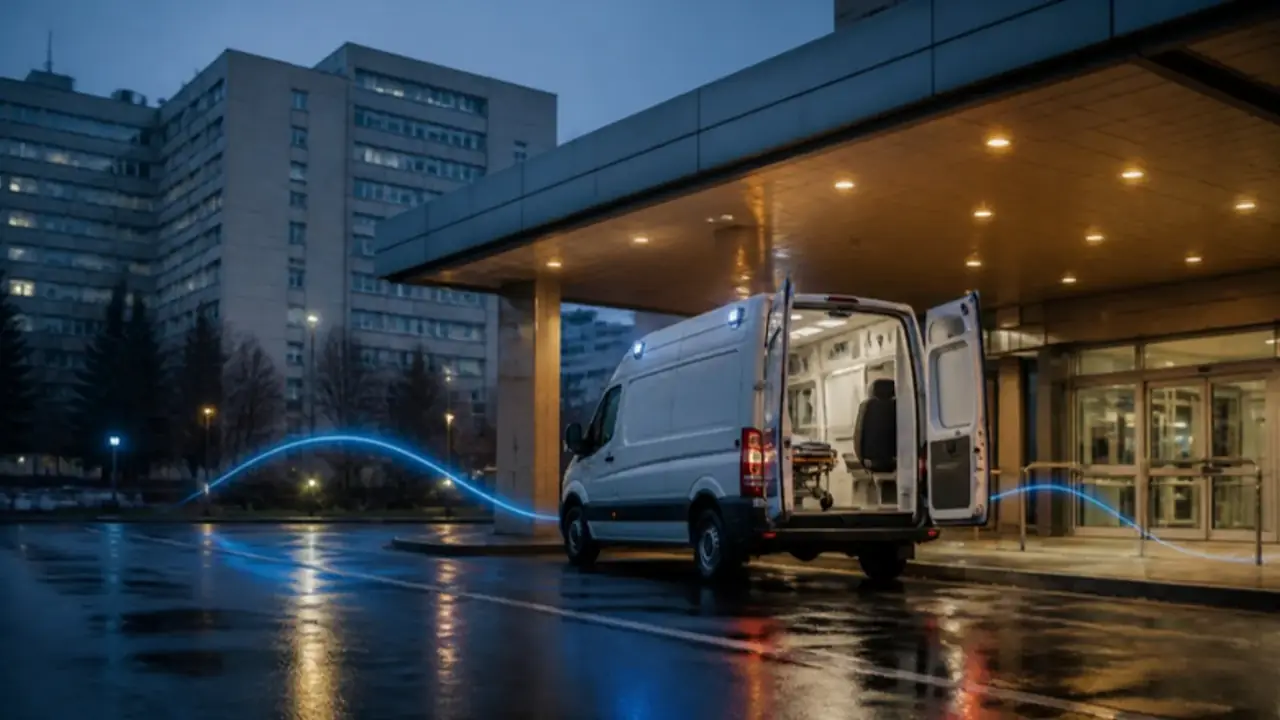
Ambulance, SMURD, fire brigade and police: one free number from any phone. People with hearing or speech impairments can text 113.
For adults: Floreasca (Calea Floreasca 8) and Elias (Bd. Mărăști 17). For children: Grigore Alexandrescu (Sector 1) and Marie Curie (Sector 4).
Under Law 95/2006, emergency care is given without discrimination, including by citizenship, whether or not the patient is insured.
Emergencies in north Bucharest: the short answer
In Romania, every emergency starts with 112. It is the single number for ambulance, SMURD, fire brigade and police, and the call is free from any phone. The dispatcher decides whether to send an ambulance from the Bucharest-Ilfov Ambulance Service or a SMURD crew, and which hospital the patient goes to.
For adults living in Balotești, Otopeni or Pipera, the main public emergency hospitals are in the north of Bucharest: the Bucharest Clinical Emergency Hospital, known as Floreasca, and the Elias University Emergency Hospital. For children, Bucharest has two dedicated emergency hospitals: Grigore Alexandrescu in Sector 1 and Marie Curie in Sector 4.
Under Law 95/2006, emergency care is given without discrimination, including by citizenship, whether or not the patient is insured.
In plain words: save 112 in your head, know the two adult hospitals and the two children's hospitals in advance, and keep your ID and insurance card in the same place every day.
This article is about the first hours of an emergency. For how the health system works in general, see our guide to healthcare in Romania for expats.
When to call 112, and when to drive
| Situation | What to do |
|---|---|
| Chest pain, signs of stroke, serious breathing difficulty, unconsciousness, heavy bleeding | Call 112. Do not drive the patient yourself. |
| A road accident with injured people or people trapped | Call 112. SMURD crews handle rescue and extrication. |
| A child with a high fever who is alert, a minor cut, a sprain | Go to a children's emergency unit or an adult emergency unit, or call your family doctor or private clinic |
| A non-urgent problem out of hours | A private clinic, or your family doctor the next day |
Public emergency units in Bucharest are busy. Doctors at children's emergency units have described large numbers of non-urgent visits. If the problem can wait, a clinic is usually faster for you and fairer to the people who cannot wait.
How the 112 call works
- Call 112. The call is free from a landline or mobile, and it works even when your phone has no signal from its own network.
- Say what happened and where. Give the commune, the street and the house number. In a gated villa community, give the name of the community, the gate and the house number, and say if the gate is locked.
- Answer the dispatcher's questions and stay on the line. The dispatcher may give instructions until the crew arrives.
- Send someone to the gate or the road to guide the ambulance, especially at night.
The Special Telecommunications Service (STS), which runs 112, can receive a phone's location automatically on compatible phones (Advanced Mobile Location), and it also offers a free app, Apel 112. According to STS, the app does not send the location automatically if the number is not from a Romanian mobile operator or if the phone is roaming. With a foreign SIM card, do not rely on automatic location: say the address out loud. People with hearing or speech impairments can also send an SMS to 113.
SMURD and the ambulance: what is the difference?
Both arrive through 112, and you do not have to choose.
- The Bucharest-Ilfov Ambulance Service (SABIF) is the public ambulance service for the capital and Ilfov County, funded by the Ministry of Health.
- SMURD (Mobile Emergency Service for Resuscitation and Extrication) is an integrated public service that works within the Inspectorates for Emergency Situations, together with hospital emergency units. Under Law 95/2006, its intensive care crews include a specially trained doctor from a hospital emergency unit. SMURD also handles rescue, extrication and air rescue.
The nearest public emergency hospitals for adults
| Hospital | Address | Note |
|---|---|---|
| Bucharest Clinical Emergency Hospital (Floreasca) | Calea Floreasca 8, Sector 1 | The main emergency hospital in north Bucharest, with a UPU-SMURD emergency unit |
| Elias University Emergency Hospital | Bd. Mărăști 17, Sector 1 | An emergency hospital close to Herăstrău and Băneasa |
For residents of Balotești, Otopeni and Pipera, both are a drive into the city. The time depends heavily on traffic on DN1 and the access roads. In a real emergency, the 112 dispatcher decides where the patient goes, based on the case and the hospitals' capacity, and not necessarily the closest one.
Specialised cases may be taken to other hospitals in the city. Always tell the crew about chronic conditions and medication.
An emergency is not the moment to search for addresses.
Children's emergencies
| Hospital | Address | Note |
|---|---|---|
| Grigore Alexandrescu Clinical Emergency Hospital for Children | Bd. Iancu de Hunedoara 30–32, Sector 1 | A large paediatric emergency unit; its burns section is the only one in the country treating extensive burns in children |
| Marie Curie Clinical Emergency Hospital for Children | Bd. Constantin Brâncoveanu 20, Sector 4 | A children's emergency hospital in the south of the city |
For families in the north, Grigore Alexandrescu is closer. Save both addresses in your phone before you need them.
Private emergency options
Private hospitals and clinics in Bucharest offer urgent care and their own ambulance services, paid directly, through a subscription or through private insurance. Law 95/2006 sets clear rules:
- Private emergency care is a contract service. Private ambulances and private hospitals work under a contract with you or your insurer.
- Their numbers are not free. Advertising for private emergency services must say clearly that the call numbers are not free and that services are paid.
- In a life-threatening case, a private hospital must give first aid free of charge until the patient can be transferred safely to a public hospital.
A private clinic is a good option for urgent but not life-threatening problems. For a heart attack, a stroke or a serious accident, call 112.
What to carry, and what to keep at home
- An identity document: passport, ID card or residence permit.
- Proof of health cover: the Romanian national health card if you are insured with CNAS; the European Health Insurance Card (EHIC) if you are an EU citizen on a temporary stay; the policy number and the insurer's assistance number if you have travel or private insurance.
- A list of medication, allergies and chronic conditions, in English or Romanian.
- Phone numbers: the family doctor, the private clinic, and a relative.
- For children: the vaccination record and any recent medical letters.
Keep a copy of everything in one folder at home and a photo on your phone. If you are not insured in Romania, emergency care is given anyway, but later treatment may be charged. Arrange cover before you move.
Prepare before you move into a villa
- Check the address works for navigation. New streets in villa communities are not always on maps. Ask the developer or the administrator for the official address and a location pin to give to 112.
- Know who opens the gate at night. Ask whether the community has a guard or an access code, and keep it written down.
- Plan the route to Floreasca, Elias and Grigore Alexandrescu once, in daylight.
- Register with a family doctor as soon as you are insured, so you have someone to call for non-urgent problems.
These questions are worth asking during the villa tour. Our villa tour checklist and our guide to villa security in Bucharest's suburbs cover more.
Frequently asked questions
What is the emergency number in Romania?
112 is the single emergency number for ambulance, SMURD, fire brigade and police. The call is free from any phone, and people with hearing or speech impairments can send an SMS to 113.
Is emergency care free for foreigners in Romania?
Law 95/2006 says emergency medical care is given without discrimination, including by citizenship, whether or not the patient is insured. Treatment after the emergency phase may be charged to people who are not insured.
Which hospital is closest to Balotești for an adult emergency?
The main public emergency hospitals for the north are Floreasca (Calea Floreasca 8) and Elias (Bd. Mărăști 17), both in Sector 1. In a real emergency, call 112: the dispatcher decides where the patient goes.
Where do you take a child in an emergency in Bucharest?
To one of the two children's emergency hospitals: Grigore Alexandrescu (Bd. Iancu de Hunedoara 30–32, Sector 1) or Marie Curie (Bd. Constantin Brâncoveanu 20, Sector 4). If the child is in serious condition, call 112.
Does the EHIC cover me in Romania?
The EHIC covers EU citizens on a temporary stay for necessary care in the public system. Residents need Romanian health insurance, and non-EU citizens, such as Israelis, need travel or private insurance.
The bottom line
An emergency is not the moment to search for addresses. Know 112, know Floreasca and Elias for adults and Grigore Alexandrescu and Marie Curie for children, and keep your documents and insurance card ready. In a villa community, make sure an ambulance can find you and get through the gate.
If you are planning a move to north Bucharest and want to talk through the practical side, including distances to hospitals and schools, book a half-hour call with me.
Moti Azulay, Compass Group Romania
Sources: Law 95/2006 on healthcare reform, consolidated April 2026 (Romanian College of Physicians), Art. 100–105 and 119–120 · SMURD · Grigore Alexandrescu Clinical Emergency Hospital for Children · Elias University Emergency Hospital · Bucharest Public Health Directorate, list of health units · European Commission: European Health Insurance Card
This article is for general information only and is not medical, legal or financial advice. The information is current as of 22 October 2026. In an emergency, always call 112.
Now you know more.
This article is general information, not legal, tax or financial advice. Consult local professionals before any transaction.

