We found no definition of la roșu, la gri or la cheie in Law 169/2026 or the Civil Code. The specification attached to the contract decides.
Law 169/2026 lets a developer spend up to 25% of the price from advances on the structure, then up to 20% on installations (Art. 422(10)).
Under the Civil Code, the buyer checks the property right after handover and reports defects without delay, or delivery is deemed proper.
Finishing levels in Romania: the short answer
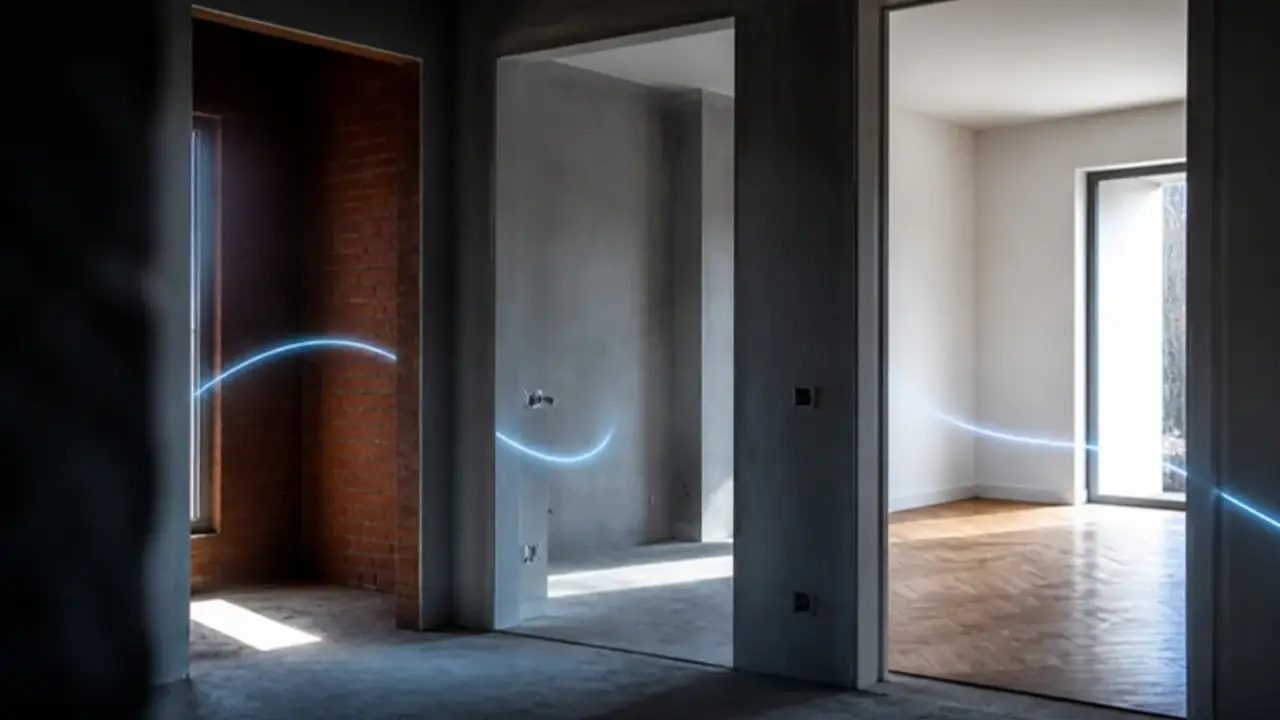
Romanian property ads describe homes as "la roșu" (shell, literally "at red", after the colour of bare brick), "la gri" (grey, after the colour of plaster) or "la cheie" (turnkey). You will also see "la alb" (white). These are market terms. We found no definition of them in the Planning and Construction Code (Law 169/2026) or in the Civil Code, and two developers can use the same word for quite different homes.
What decides what you get is the contract. A contract's object must be "determined" or at least "determinable" (Civil Code, Art. 1225 and 1226), and for a home that means a written, itemised specification attached to it. In a standard-form contract, the clauses are interpreted against the party that proposed them (Art. 1269(2)).
In plain words: "la cheie" is a sales word. The list attached to your contract is the legal one.
Our article on what the price does not include covers costs outside the contract. This one covers what the contract itself should list.
What the law does say about stages
The law does not define finishing levels, but it does distinguish construction stages. For homes sold off-plan, Law 169/2026 limits how much of the buyers' advances a developer may spend: up to 25% of the price for the structure ("partea de rezistență") and, once the structure is complete, up to 20% for the installations ("partea de instalații"), each payment approved by the site supervisor (Art. 422(10)). These are payment stages, not a definition of "la roșu" or "la gri". They are useful, though, because they show that structure and installations are separate milestones you can check.
The table: item by item
The columns below describe how the terms are commonly used in the Romanian market. They are not a standard. Use the table as a list of questions, and get the answer for each row in writing.
| Item | La roșu (shell) | La gri (grey) | La cheie (turnkey) |
|---|---|---|---|
| Foundation, structure, masonry, roof | Yes | Yes | Yes |
| Exterior windows and entrance door | Often not | Usually yes | Yes |
| Thermal insulation and façade render | Usually not | Varies | Yes |
| Interior plaster | No | Yes | Yes |
| Floor screed | No | Usually yes | Yes |
| Electrical wiring in the walls | No | Yes, often without sockets and switches | Complete |
| Water and sewage pipes | No | Yes, without sanitary ware | Complete |
| Heat source (boiler or heat pump) | No | Varies | Usually yes: name the model |
| Radiators or underfloor heating | No | Pipes sometimes | Yes |
| Floor finishes and tiles | No | No | Yes |
| Painting | No | No, or primer only | Yes |
| Interior doors | No | No | Yes |
| Sanitary ware and taps | No | No | Yes |
| Kitchen furniture and appliances | No | No | Varies: often not |
| Light fixtures | No | No | Often not |
| Fence, gate, paving, garden | Varies | Varies | Varies |
| Connections to water, sewage, power, gas | Varies | Varies | Must be stated |
The bottom rows are where most disputes start. "Turnkey" rarely means furniture, and it often does not mean light fixtures, a kitchen or landscaping.
Which level suits a buyer from abroad
The choice is not only about budget. It is also about how much you can supervise from a distance:
- La roșu means hiring your own architect, contractors and installers in Romania, and coordinating them over months. From abroad, that is a project in itself.
- La gri leaves the finishes to you. You choose tiles, flooring and bathrooms, but someone still has to manage the work on site, check quality and sign off each stage.
- La cheie is usually the simplest to control remotely: one contract, one handover, one list to check. It is also the level where the specification annex matters most, because you are paying for everything on it.
Whichever you choose, ask the developer five questions before you sign:
- Is there a written specification annex, and will it be attached to the preliminary contract?
- Which items in the brochure or the renderings are not in the annex?
- Can I choose finishes, and is there a deadline for my choices?
- If I want an upgrade, how is it priced and recorded?
- Who connects the utilities, and who pays the connection fees?
What a good specification annex contains
A useful specification is not a brochure. It reads like a list that someone could check with a tape measure:
"La cheie" is a sales word. The list attached to your contract is the legal one.
- Every room and space, with its area, matching the plans attached to the contract.
- For each item: the product, the brand or an equivalent standard, and the quantity. "Parquet" is not enough. "Engineered oak parquet, 14 mm, in living areas" can be checked.
- Technical systems by name: the heating source and its capacity, the type of windows and glazing, the electrical board.
- What is outside the house: fence, gate, paving, parking, garden and drainage.
- Utility connections: which networks are connected and who pays the connection fees.
- What is excluded, written out, so that nobody assumes.
- A substitution rule: materials may change only to equivalent or better, with written notice and your consent. Under Law 193/2000, a clause letting a professional change the characteristics of the product without the consumer's consent is listed as abusive (Annex, point 1(e)).
As an example: at Compass on the Lake, the binding specification is the one attached to the sale agreement. Light fixtures and furniture are not included, even though some interior renderings show them.
Acceptance at handover: checking the list against the house
The building first goes through acceptance on completion of works under Law 169/2026, and only then is your home handed over to you. On the day, the specification annex becomes your checklist.
This matters legally. Under the Civil Code, the buyer must check the condition of the property immediately after taking it over, and must inform the seller of defects without delay. If not, the seller is considered to have delivered properly (Art. 1690(2) and (3)). Hidden defects are treated separately and remain covered (Art. 1690(4)).
So on handover day:
- Bring the annex, not the brochure.
- Go row by row: product, brand, quantity, location.
- Record every difference in the handover report or a signed snag list: a missing item, a different product, an unfinished task.
- Agree a deadline for each item in writing.
- Photograph what you found, with the date.
- Keep the documents for the systems: manuals and warranties for the heat source, windows and appliances.
Our full handover checklist covers the rest of the day: meters, utilities, insurance and registration. If something is missing or different, our article on warranty and defects explains the next steps.
If a home is delivered only partly finished compared with the contract, the Civil Code allows the buyer of a future property to ask either for the sale to be cancelled or for a corresponding price reduction (Art. 1658(3)). That is a dispute you want to avoid, which is why the list has to be precise from the start.
Frequently asked questions
Is "la cheie" defined by Romanian law?
We found no legal definition in the Planning and Construction Code (Law 169/2026) or the Civil Code. It is a market term. What you are entitled to is what the contract and its specification annex describe.
What is the difference between "la gri" and "la alb"?
Both are informal. "La gri" usually means plastered walls and the main installations without final finishes. "La alb" is used for homes that go further, often with painted walls. Ask for the item-by-item list in either case.
Can the developer change the materials in the specification?
Only within what the contract allows. Under Law 193/2000, a clause allowing the professional to change the product's characteristics without your consent is listed as abusive. Ask for an "equivalent or better" rule with written notice.
What happens if I sign the handover report without noting a missing item?
Under Article 1690 of the Civil Code, a buyer who does not report visible defects without delay may be considered to have accepted proper delivery. Hidden defects remain covered. Note every difference in writing on the day.
Can I upgrade items in the specification?
Usually yes, if the developer agrees. Make sure every upgrade is recorded in a written addendum to the contract, with the product, the price and the date. An upgrade agreed only verbally is hard to claim on handover day.
The bottom line
"Shell", "grey" and "turnkey" start a conversation. The specification annex ends it. If a row is not written, it is not yours.
If you have a specification from a developer, ours or any other, and want to check it row by row, book a half-hour call with me.
Moti Azulay, Compass Group Romania
Sources: Law 169/2026, Planning and Construction Code, Monitorul Oficial no. 661 of 10.08.2026, Art. 422 · Civil Code, Law 287/2009 (legislatie.just.ro), Art. 1225, 1226, 1269, 1658 and 1690 · Law 193/2000 on abusive clauses, with annex (text reproduced by InfoCons)
This article is for general information only and is not legal, tax or financial advice. The rules are correct as of 22 October 2026. The table reflects common market usage and is not a legal standard; only your contract and its annexes are binding.
Now you know more.
This article is general information, not legal, tax or financial advice. Consult local professionals before any transaction.

