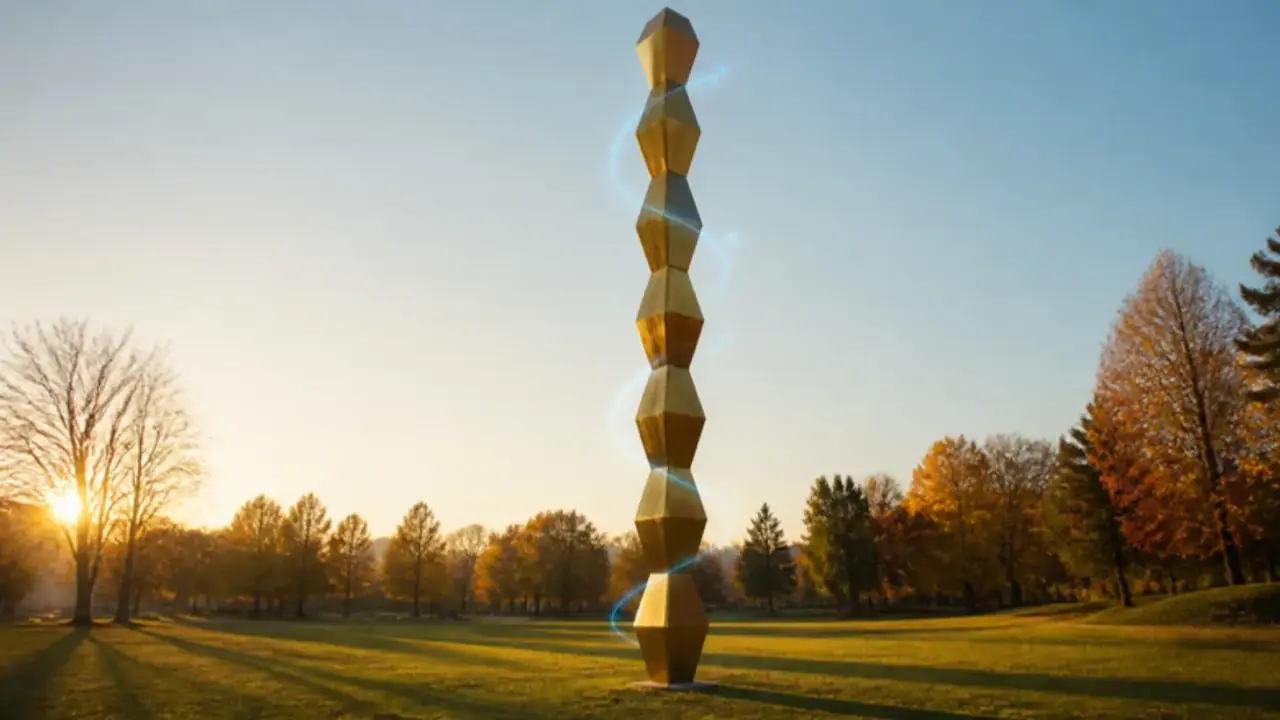
The Târgu Jiu ensemble, the Table of Silence, the Gate of the Kiss and the Endless Column, was inscribed as a World Heritage Site at the Committee's 46th session.
According to Forbes România, the Brâncuși sculpture sold at Christie's in New York on 18 May 2026, a new record for the artist.
The column in Târgu Jiu is made of 16 modules, and the whole ensemble was inaugurated on 27 October 1938.
According to ArtRabbit, the first Romanian Art Week, 17–25 October 2026, includes more than 50 galleries, museums and spaces in Bucharest.
Art: the short answer
Romania gave the world Constantin Brâncuși, considered one of the fathers of modern sculpture. In 2024 UNESCO inscribed the ensemble he designed in the town of Târgu Jiu as a World Heritage Site, and in May 2026 his sculpture Danaïde sold at Christie's in New York for $107.6 million, a new record for him. In Romania itself, this art is not confined to museums: the Târgu Jiu ensemble stands in the street and in parks, open to everyone.
Bucharest has two major institutions: the National Museum of Art of Romania, in the former Royal Palace, and the National Museum of Contemporary Art, MNAC, inside the Palace of the Parliament. And Cluj produced a generation of painters, among them Adrian Ghenie and Victor Man, whose exhibitions and sales have reached London, Berlin and the Venice Biennale.
In plain words: you see Brâncuși in Târgu Jiu, Romanian classics in the national collection on Calea Victoriei, and contemporary art at MNAC and in the galleries. And this week, 17–25 October 2026, Bucharest is hosting the first Romanian Art Week.
Brâncuși: the village, Paris and the world
According to Wikipedia, Brâncuși was born in 1876 in the village of Hobița in Gorj County, studied in Craiova, Bucharest, Munich and Paris, and worked briefly for Rodin in 1907. He died in Paris in 1957. He left his studio to the French state on condition that it be reconstructed. The reconstruction, designed by Renzo Piano, opened next to the Centre Pompidou in 1997.
The global market values him highly. According to Forbes România, on 18 May 2026 Danaïde sold at Christie's in New York for $107.6 million including fees. His previous record was about $71 million, in 2018. It is the second-highest price ever paid for a sculpture at auction.
And what of him remains in Romania? According to Wikipedia, the National Museum of Art in Bucharest holds the sculpture "The Prayer", and the Art Museum in Craiova, the city where he studied, has further works. In the village of Hobița there is a memorial house in his name. But the place where you truly feel his presence is Târgu Jiu, in the same county where he was born, Gorj.
Târgu Jiu: art in the open air
The ensemble was commissioned by the Gorj Women's League in memory of the soldiers who fell in the First World War. Brâncuși created it in 1937 and 1938, and it was inaugurated on 27 October 1938. The three main works are the Table of Silence, the Gate of the Kiss and the Endless Column, along an axis of about 1.3 km that crosses the town from west to east. The Endless Column rises about 29.3 metres and is made of 16 modules.
UNESCO inscribed the ensemble in 2024, at the 46th session of the World Heritage Committee. From Balotești the drive is about 353 km, close to five hours. This is a weekend trip.
The National Museum of Art: the Royal Palace on Calea Victoriei
The headquarters of the National Museum of Art of Romania (MNAR) is in the former Royal Palace on Calea Victoriei. According to the museum's 2024 announcement, it includes the Gallery of Old Romanian Art, the Gallery of Modern Romanian Art, the Gallery of European Art and the Gallery of European Decorative Art, as well as the palace's historic rooms.
The museum has several branches. The Theodor Pallady Museum is housed in Casa Melik, which the museum describes as the oldest house in Bucharest. The Art Collections Museum is in the former Romanit Palace, and there is also the Zambaccian Museum.
Art in Romania comes in three layers: Brâncuși, who is global, the national collection, which is classical, and today's galleries, which are young and on the move.
According to the same announcement, since 2024 the headquarters has been open Wednesday to Friday 10:00–18:00 and Saturday and Sunday 11:00–19:00, and closed on Mondays and Tuesdays. Admission is free on the first Wednesday of every month. We found no current official price list, so check the museum's website before you visit. Prices and hours for other museums in the city, such as the Village Museum, are in our Bucharest culture guide.
MNAC: contemporary art inside the Palace of the Parliament
According to Wikipedia, the National Museum of Contemporary Art opened in the Palace of the Parliament in 2004. In 2024 it marked 20 years there, with exhibitions across several floors. The contrast is part of the experience: contemporary art inside the most symbolic building of the Ceaușescu era. We wrote about the building itself in our article on architecture.
Cluj: the painters who went global
Adrian Ghenie was born in 1977 in Baia Mare and graduated in 2001 from the University of Art and Design in Cluj. In 2005 he co-founded the Plan B gallery in Cluj with Mihai Pop, which opened a permanent space in Berlin in 2008. According to Economica, in 2016 his painting Nickelodeon sold at Christie's in London for about £7.1 million, a record for him at the time.
Victor Man, born in 1974, studied in Cluj, and between 2000 and 2004 studied in Jerusalem. He represented Romania at the Venice Biennale in 2007, and Deutsche Bank named him its Artist of the Year for 2014. Plan B still represents both, and its website lists a current exhibition in Berlin in autumn 2026.
Sibiu: the Brukenthal collection
In Sibiu, the Brukenthal Museum presents more than 200 years of history, according to its website. It grew out of the collection of Baron Samuel von Brukenthal. The European Art Gallery is in the Brukenthal Palace, and the National Gallery of Romanian Art is in the Blue House (Casa Albastră). From Balotești the drive is about 282 km.
Romanian Art Week: happening now in Bucharest
According to ArtRabbit, the official navigation partner, Romanian Art Week is taking place for the first time from 17 to 25 October 2026, with more than 50 galleries, museums, artist-run spaces and cultural institutions. The official opening was at MNAC, and there are eight routes by neighbourhood, among them Floreasca, the Old Town and Piața Presei. The opening night continued with exhibition openings at Combinatul Fondului Plastic, and the talks programme is held at the Universul Palace. Participating spaces include Sector 1 Gallery and /SAC Bucharest. Even after the week is over, these routes are a good way to get to know the city's galleries, neighbourhood by neighbourhood. The full programme is at artweek.ro. We wrote about festivals, film and literature in our article Culture: festivals, film and music.
The places at a glance
| Place | Where | Driving distance from Balotești | Why go |
|---|---|---|---|
| National Museum of Art (MNAR) | Calea Victoriei, Bucharest | About 25 minutes | Romanian and European art in the Royal Palace |
| MNAC | Palace of the Parliament, Bucharest | About 25 minutes | Contemporary art in Ceaușescu's building |
| Theodor Pallady Museum | Casa Melik, Bucharest | About 25 minutes | The oldest house in the city, according to the museum |
| Brâncuși ensemble | Târgu Jiu | About 353 km | UNESCO, in the open air |
| Brukenthal Museum | Sibiu | About 282 km | A collection more than 200 years old |
Distances to cities from OpenStreetMap routing without traffic, 23 October 2026. The time to central Bucharest is from the project map.
Sample route: an art Saturday in Bucharest
- Morning at MNAR. According to the hours published in 2024, it opens at 11:00 on Saturdays. Start with the modern Romanian gallery.
- Midday on Calea Victoriei. A walk along the street, with palaces and cafés.
- Afternoon at MNAC. A contemporary exhibition, then a look at the palace from outside.
Frequently asked questions
Where can you see Brâncuși in Romania?
Mainly in Târgu Jiu, in the ensemble on the UNESCO list since 2024: the Table of Silence, the Gate of the Kiss and the Endless Column. According to Wikipedia, there are also works by him at the National Museum of Art in Bucharest and the Art Museum in Craiova.
Is the Târgu Jiu ensemble really on the UNESCO list?
Yes. It was inscribed in 2024, at the 46th session of the World Heritage Committee, together with the Frontiers of the Roman Empire in Dacia.
When is admission free at MNAR?
According to the museum's 2024 announcement, on the first Wednesday of every month, at the headquarters and at the Zambaccian and Pallady branches. Check on the website that the rule still applies.
Who are the Cluj painters?
The name given to a generation of painters who studied and worked in Cluj, among them Adrian Ghenie and Victor Man. The Plan B gallery, which Ghenie co-founded with Mihai Pop in 2005, is one of their homes.
The bottom line
Art in Romania comes in three layers: Brâncuși, who is global, the national collection, which is classical, and today's galleries, which are young and on the move. All of them are open, and most are close to Bucharest. If you come during Art Week, you get more than 50 art spaces open at once. If you live in the north of the city, you can finish a working week and be in a museum within about half an hour.
Moti Azulay, Compass Group Romania
Sources: Wikipedia: Constantin Brâncuși · Forbes România: a record for Brâncuși, Danaïde sold for $107.6 million (in Romanian) · Wikipedia: Sculptural Ensemble of Constantin Brâncuși at Târgu Jiu · Wikipedia: World Heritage Sites in Romania · G4Media: MNAR's new visiting hours, February 2024 (in Romanian) · Wikipedia: Palace of the Parliament · Zile și Nopți: MNAC's exhibition season, June 2024 (in Romanian) · Wikipedia: Adrian Ghenie · Economica: Ghenie's Nickelodeon sold for £7.1 million (in Romanian) · Wikipedia: Victor Man · Deutsche Bank: Victor Man, Artist of the Year 2014 · Plan B · Brukenthal Museum · ArtRabbit: Romanian Art Week 2026 · OpenStreetMap routing (OSRM), distances without traffic, 23.10.2026
This article is for general information only. Opening hours, prices and exhibitions change, so check each museum's website before you visit. Auction prices are given as reported and are not a recommendation to buy art. The information is correct as of 23 October 2026.
The good life in Romania
Now you know more.
This article is general information, not legal, tax or financial advice. Consult local professionals before any transaction.

