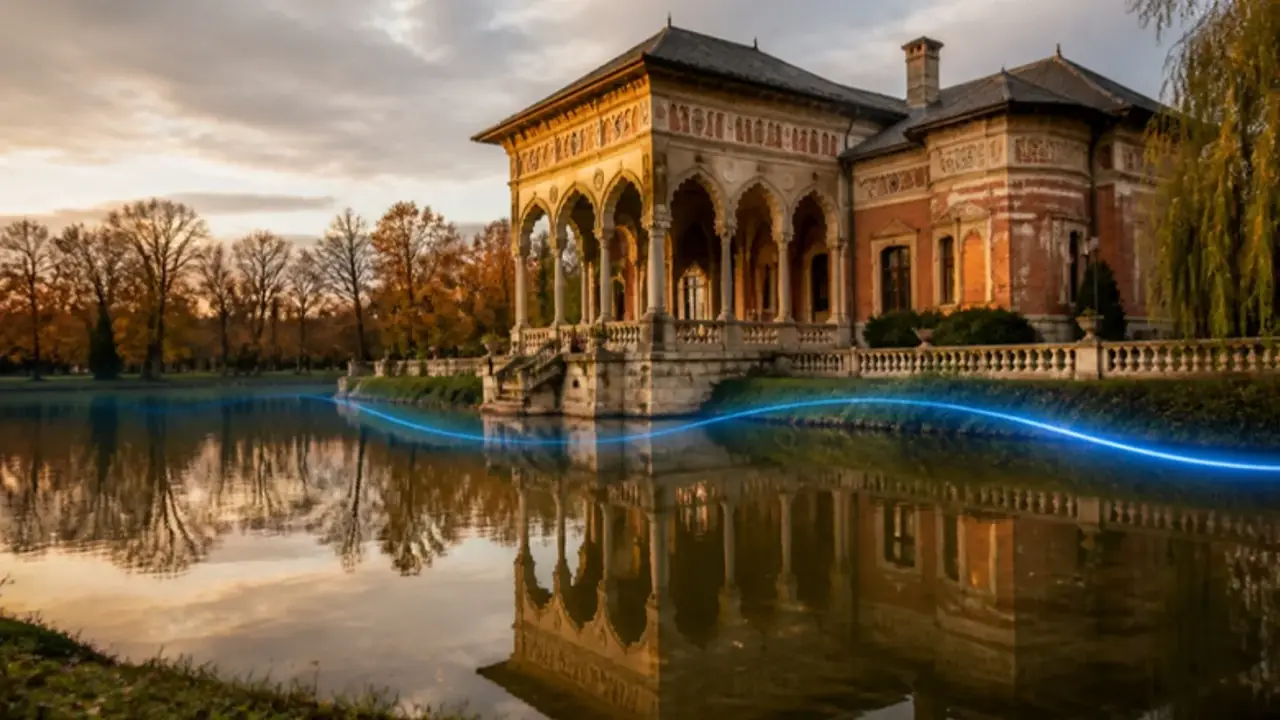
According to the Brâncoveanu Palaces cultural centre, Constantin Brâncoveanu built the palace in September 1702. About 17 km from Balotești.
The Romanian Athenaeum was inaugurated on 14 February 1888, with money raised from the public.
According to the official website, the standard tour costs 85 lei for adults. A physical passport or ID card is required.
Eight churches in Bucovina, from the 15th and 16th centuries, with murals on their outer walls. Seven were inscribed in 1993 and Sucevița in 2010.
Architecture: the short answer
Romania is a country you can travel through by style. Bucharest has the "Little Paris" of the late 19th century, modernist buildings from the 1930s and the Palace of the Parliament from the 1980s. About 20 minutes' drive from Balotești stands Mogoșoaia Palace, built by Constantin Brâncoveanu in 1702, the nearest example of Romania's most distinctive style, the Brâncovenesc. About an hour and 40 minutes from there is Peleș Castle in Sinaia.
Further away, in Transylvania, Bucovina and Maramureș, are some of the sites UNESCO has inscribed: villages with Saxon fortified churches, churches whose outer walls are covered in murals, and wooden churches with tall, slender spires.
In plain words: you can see Bucharest and Mogoșoaia in one day, Peleș on a day trip, and the UNESCO churches on a long weekend, because they are 270–510 km away.
We described the building styles from a buyer's point of view, including conservation and seismic risk, in our guide to Bucharest's architectural styles. The history of "Little Paris" is in the article Bucharest, Little Paris. Here we talk about the pleasure: where to stand, what to see and how to plan.
Bucharest: from the Athenaeum to Art Deco
The building to start with is the Romanian Athenaeum on Calea Victoriei. According to the Romanian Cultural Institute (ICR), the plans were drawn by the French architect Albert Galleron, construction was completed in 1888 and the building was inaugurated on 14 February 1888 (extension work continued until 1897). The money was raised from the public under the slogan "Give one leu for the Athenaeum". The façade has eight Ionic columns inspired by the Erechtheion in Athens, and inside is a circular fresco by Costin Petrescu, unveiled in 1938, telling the history of Romania.
According to the ICR, the Athenaeum, the Palace of Justice, the CEC Palace and the National Bank are the symbols of French-influenced modernisation. The same source describes Magheru Boulevard as "the city's first coherent modern axis". On the same street, Calea Victoriei, stands the Telephone Palace of 1933, with Art Deco elements. According to HotNews, it is listed as a historic monument, and in mid-October 2026 it was put up for sale.
The Brâncovenesc style: Mogoșoaia Palace
The Brâncovenesc style is named after Constantin Brâncoveanu, ruler of Wallachia in the late 17th century. According to the National Museum of the Romanian Peasant, its hallmarks are exposed red brick, large windows beneath arches, loggias with columns and balustrades, and plant and animal ornaments used in balanced measure.
The nearest place to see it is Mogoșoaia Palace. According to the "Brâncoveanu Palaces" cultural centre, the palace was built in September 1702 by Brâncoveanu for his second son, Ștefan. Today it houses a museum and about ten temporary exhibitions a year. The complex is active: in October 2026 it listed concerts, an exhibition and a children's show. From Balotești the drive is about 17 km, roughly 23 minutes without traffic.
The style did not disappear with Brâncoveanu. In the late 19th century it returned as the inspiration for the Neo-Romanian style, and you can see it in Bucharest itself: the building of the National Museum of the Romanian Peasant was designed by Nicolae Ghica-Budești and completed in 1941, after 29 years of interruptions. The museum describes it as a building inspired by Brâncovenesc architecture: red brick, arches and a central tower recalling the bell towers of old monasteries.
If you want the original: Horezu Monastery in Vâlcea, founded by Brâncoveanu in 1690, has been on the UNESCO list since 1993 and is considered the masterpiece of the style.
Peleș Castle: German Renaissance in the Carpathians
Peleș Castle in Sinaia was built on the initiative of Carol I, Romania's first king. The foundation stone was laid in 1873 and the castle was inaugurated in 1883. The style combines Neo-Renaissance and Gothic, and inside there are more than 170 rooms.
An 18th-century palace around the corner, a royal castle in the mountains, and wooden churches that look like they come from a storybook.
Two practical points, according to the Peleș National Museum: tickets are sold for a time slot, and a timed ticket cannot be moved to another date. More importantly, the castle is closed from 2 November to 1 December 2026 for cleaning and conservation. The neighbouring Pelișor is closed until 3 November.
The Palace of the Parliament: the building you cannot miss
Construction began in 1984, on Ceaușescu's orders, under the architect Anca Petrescu. The floor area is about 365,000 m². The official website calls it "the largest administrative palace in the world". It houses the Chamber of Deputies and the Senate, and one wing holds the National Museum of Contemporary Art.
According to the official website, the standard tour costs 85 lei for adults, 55 lei for students and 40 lei for children aged 7–18. Tickets are bought on site, at 2–4 Izvor Street. Small groups book by phone 24 hours ahead. A physical ID card or passport is required, a driving licence is not accepted, and liquids are not allowed. Note: the site announced that there are no visits between 20 and 24 October 2026.
Transylvania: fortified churches and a medieval town
UNESCO lists seven villages with fortified churches, six Saxon and one Székely: Biertan, Câlnic, Dârjiu, Prejmer, Saschiz, Valea Viilor and Viscri. The churches were built between the 13th and 16th centuries, and the site was inscribed in 1993 and extended in 1999.
On the way you can stop in Sighișoara, a fortified historic centre founded by the Saxons in the 12th century and on the UNESCO list since 1999.
Bucovina: the painted churches
Eight churches in northern Moldavia are on the UNESCO list, seven since 1993 and Sucevița since 2010. They were built in the 15th and 16th centuries, and their outer walls are covered with murals of biblical scenes. The oldest are Pătrăuți (1487) and Voroneț (1488), both from the time of Stephen the Great. If you only have time for two, Voroneț and Moldovița are close to each other.
Maramureș: the wooden churches
Eight wooden churches in Maramureș were inscribed by UNESCO in 1999, among them Bârsana, Ieud, Desești and Surdești. They are built of thick timber beams, with a tall, slender bell tower on the western side, and inside are folk paintings of biblical scenes, mostly by local painters. This is the furthest trip on the list, so plan several days for it.
The places at a glance
| Place | Where | Driving distance from Balotești | Why go |
|---|---|---|---|
| Mogoșoaia Palace | Mogoșoaia, Ilfov | About 17 km, about 23 minutes | Brâncovenesc palace from 1702, exhibitions and concerts |
| The Athenaeum and the Palace of the Parliament | Central Bucharest | About 25 minutes | Little Paris and the 1980s monument |
| Peleș Castle | Sinaia | About 104 km, about 1 hour 40 minutes | The royal castle, closed in November 2026 |
| Horezu Monastery | Horezu, Vâlcea | About 238 km | Masterpiece of the Brâncovenesc style, UNESCO |
| Sighișoara | Mureș | About 269 km | Medieval fortified town, UNESCO |
| Biertan | Sibiu | About 295 km | Saxon fortified church, UNESCO |
| Voroneț | Suceava | About 451 km | Painted church from 1488, UNESCO |
| Bârsana | Maramureș | About 512 km | Wooden church, UNESCO |
Distances from OpenStreetMap routing, without traffic, measured on 23 October 2026. The time to central Bucharest is from the project map.
Sample route: one day, three eras
- Morning at Mogoșoaia. The 1702 palace and its courtyard. Phone ahead to check that day's opening hours.
- Midday at the Palace of the Parliament. A tour booked in advance, with a physical passport. Afterwards you can continue to the Museum of Contemporary Art in the same building.
- Afternoon on Calea Victoriei. A walk along the street to the Telephone Palace and the Athenaeum. If there is a concert in the evening, stay.
For more day trips, see day trips from Bucharest.
Frequently asked questions
What is the Brâncovenesc style?
A style named after the ruler Constantin Brâncoveanu, from the late 17th century. Exposed brick, arches, loggias with columns and plant ornaments. The nearest example to Bucharest is Mogoșoaia Palace from 1702.
Can you visit the Palace of the Parliament without booking?
Tickets are sold on site, but according to the official website groups of up to nine people book by phone 24 hours ahead. A physical ID card or passport is required.
Is Peleș Castle open in November?
Not in 2026. The museum announced that the castle is closed from 2 November to 1 December 2026.
How many UNESCO architecture sites does Romania have?
Romania has nine World Heritage Sites in the cultural category. The fortified churches, the painted churches, the wooden churches, Horezu Monastery and Sighișoara make up the architectural part. In 2024 the Brâncuși ensemble in Târgu Jiu was added as well.
The bottom line
Romania offers a journey through time within a reasonable drive: an 18th-century palace around the corner, a royal castle in the mountains and, further north, villages with fortified churches and wooden churches that look like they come from a storybook. If you live in north Bucharest, that journey starts about 20 minutes from home.
Moti Azulay, Compass Group Romania
Sources: Romanian Cultural Institute: the Romanian Athenaeum · Romanian Cultural Institute: Bucharest, Memory Walled-In · HotNews: the Telephone Palace put up for sale, 15.10.2026 (in Romanian) · National Museum of the Romanian Peasant: the building · Brâncoveanu Palaces cultural centre: about the institution (in Romanian) · Peleș National Museum: announcements · Wikipedia: Peleș Castle · Palace of the Parliament, International Conference Centre: visits and prices · Wikipedia: Palace of the Parliament · Wikipedia: World Heritage Sites in Romania · Wikipedia: Painted churches of northern Moldavia · Wikipedia: Wooden Churches of Maramureș · Wikipedia: Villages with fortified churches in Transylvania · OpenStreetMap routing (OSRM), distances without traffic, 23.10.2026
This article is for general information only. Opening hours, prices and closures for restoration change, so check each venue's website before you travel. The information is correct as of 23 October 2026.
The good life in Romania
Now you know more.
This article is general information, not legal, tax or financial advice. Consult local professionals before any transaction.

