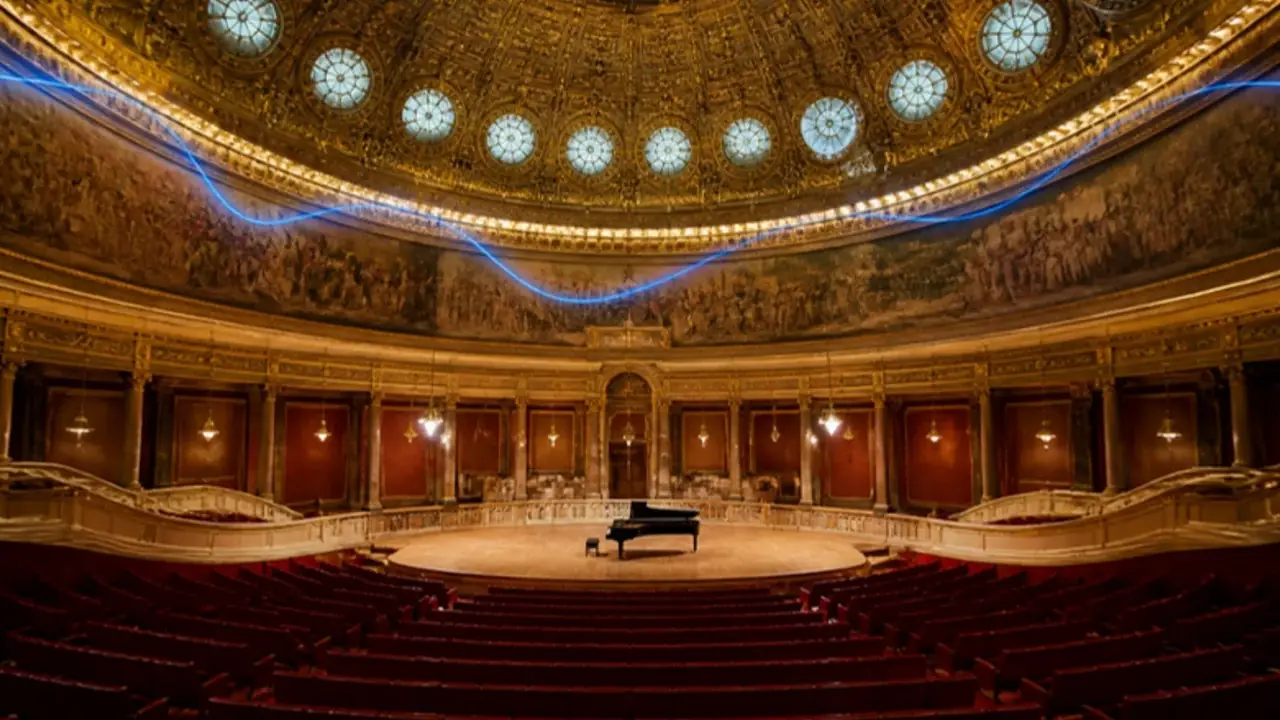
The Romanian Athenaeum, by the architect Albert Galleron, was inaugurated on 14 February 1888, partly funded by public donations. Today it is home to the George Enescu Philharmonic.
The first festival opened on 4 September 1958, with Yehudi Menuhin and David Oistrakh. Today it takes place in odd-numbered years, and the next one is in 2027.
According to OpenStreetMap routing, the Știrbey Estate in Buftea, home of Summer Well, is about 17 km by road from Balotești.
According to the organisers, more than 500,000 attendees over four days in Cluj-Napoca, 6–9 August 2026. Next edition: 5–8 August 2027.
The doina, an improvised lyrical song, was inscribed in 2009 on UNESCO's Representative List of the Intangible Cultural Heritage. The Căluș ritual was inscribed in 2008.
Music in Romania: the short answer
In Romania, music works all year round. On winter evenings there is a concert at the Romanian Athenaeum, a hall inaugurated on 14 February 1888, or an opera at the National Opera, whose first official performance, "Lohengrin" in 1921, was conducted by George Enescu. In summer people head out to the fields: UNTOLD and Electric Castle near Cluj, Summer Well in Buftea, about 17 km from Balotești. And every two years, in odd-numbered years, the George Enescu Festival turns Bucharest into a stage for orchestras from all over the world.
Beneath all this are two layers fewer people know. One is Bucharest's electronic sound, "Romanian minimal", which made a name for itself abroad around 2007. The other is far older: the doina, an improvised lyrical song that UNESCO inscribed in 2009 as intangible cultural heritage, and the lăutari, the traditional musicians of weddings and villages.
In plain words: music needs no translation. It is the easiest way into cultural life in Romania, and almost every month there is a reason to go out.
George Enescu: the name you will hear everywhere
Enescu was born on 19 August 1881 in the village of Liveni, now named after him, and died in Paris on 4 May 1955. He was a composer, violinist, pianist, conductor and teacher. His best-known works are the two Romanian Rhapsodies (1901–1902), and his opera "Œdipe" premiered in Paris in 1936. One of his pupils was Yehudi Menuhin.
In Bucharest his name is everywhere: on the Philharmonic, the festival and the competition. Start with the first Romanian Rhapsody. It is built on folk melodies, and in ten minutes it explains why Romanians are so proud of him.
The Athenaeum and the Opera: an evening in Bucharest
The Romanian Athenaeum (Ateneul Român) was designed by the French architect Albert Galleron and inaugurated in 1888. Part of the money was raised through public donations, under the slogan "Give one leu for the Athenaeum" (Dați un leu pentru Ateneu). Above the boxes, a large fresco of scenes from Romanian history encircles the dome. It is the home of the George Enescu Philharmonic, which opened its 2026–2027 season this autumn.
The Bucharest National Opera was declared a state institution in 1921. The current building, by the architect Octav Doicescu, was inaugurated on 9 January 1954 with Tchaikovsky's "The Queen of Spades".
According to OpenStreetMap, the Athenaeum is about 22 km by road from Balotești and the Opera about 24 km. In the evening without traffic it is a drive of about half an hour. How to buy tickets, which language the surtitles are in and the box-office hours are covered in our guide to Bucharest culture: opera, theatre and concerts.
The Enescu Festival: mark 2027
The first festival opened on 4 September 1958, three years after Enescu's death. At the very first edition Yehudi Menuhin and David Oistrakh played Bach's Concerto for Two Violins. Today it takes place in odd-numbered years, and in even-numbered years the George Enescu International Competition is held. The most recent edition ran from 24 August to 21 September 2025.
There is plenty to hear in the even year too. The George Enescu International Competition took place in Bucharest from 23 August to 19 September 2026. If you enjoy hearing young musicians before they become famous, it is a good reason to go out at the end of summer.
Music needs no translation. It is the easiest way into cultural life in Romania.
The next edition of the festival will be in 2027. As of 23 October 2026 we found no dates on the official website, so we will not publish them here. Check the festival's website in early 2027.
The summer festivals: the table
The figures are the organisers'. They count entries, not unique people. Distances are driving distances from Balotești according to OpenStreetMap.
| Festival | Where | When (2026) | Distance from Balotești | Why go |
|---|---|---|---|---|
| Jazz in the Park | "Romulus Vuia" Ethnographic Park, Cluj-Napoca | 5–7 June | About 455 km | Jazz among old wooden houses. According to the organisers, more than 20,000 attendees |
| Electric Castle | Bánffy Castle estate, Bonțida, near Cluj | 16–19 July | About 455 km (to Cluj) | A festival in a castle courtyard. According to the organisers, 262,000 attendees. 2027: 15–18 July |
| UNTOLD | Cluj-Napoca | 6–9 August | About 455 km | The biggest music event in the country. According to the organisers, more than 500,000 attendees. 2027: 5–8 August |
| Summer Well | Știrbey Estate, Buftea | 7–9 August | About 17 km | An indie and rock festival in a historic park, close to home |
We set out the festivals' economic figures, and what they say about culture as an industry, in our article on Romania's culture: festivals, film and literature.
Summer Well: the festival close to home
Summer Well has been held since its first edition at the Știrbey Estate (Domeniul Știrbey) in Buftea. In 2026 it celebrated 15 years, with Nick Cave & The Bad Seeds on the closing night. According to Wall-Street.ro, the train from Gara de Nord to Buftea takes less than 20 minutes, and from the station it is about a half-hour walk. Special buses leave from near Străulești metro station. There is no public parking for festivalgoers, and the organisers recommend public transport.
"The Romanian sound": minimal from Bucharest
In the early 2000s a minimal techno scene grew up in Bucharest: long, hypnotic tracks, sometimes with no melody at all. According to a story published on Google Arts & Culture, around 2007 people abroad started calling it "the Romanian sound". The central names are Rhadoo, Petre Inspirescu and Raresh, who together founded the label [a:rpia:r]. Their sets sometimes last five or six hours, and the music is released mainly on vinyl in small runs.
The scene's classic home was the Sunwaves festival on the beach at Mamaia, founded in 2007. According to Mixmag, the May 2025 edition was its last in Romania, after 18 years, and the festival moved to another country. If you are looking for this sound today, you will find it mainly in clubs and at festivals, so check the artists' own gig listings.
Doina, căluș and lăutari: the music of the village
Two Romanian musical elements are on UNESCO's Representative List of the Intangible Cultural Heritage:
- The doina (2009): a lyrical, solemn song, improvised and spontaneous. It is sung solo, sometimes with a flute or bagpipes. According to UNESCO, the tradition has weakened because transmission from parents to children has been interrupted.
- The Căluș ritual (2008): a men's dance from the Olt region of southern Romania, with games, songs and dances, accompanied by two violins and an accordion. Small bells hang from the dancers' trousers.
The lăutari are the traditional musicians who play at weddings, baptisms and village events. The best-known group abroad is Taraf de Haïdouks from the village of Clejani, which appeared in Tony Gatlif's film "Latcho Drom" and toured the West.
A sample musical year
- June: a weekend in Cluj for Jazz in the Park.
- July: Electric Castle in Bonțida. 2027: 15–18 July.
- August: UNTOLD in Cluj (2027: 5–8 August), or Summer Well, 17 km from home.
- Late August to September, in odd-numbered years: the Enescu Festival in Bucharest.
- From autumn to spring: the Philharmonic's season at the Athenaeum and the National Opera's repertoire.
Frequently asked questions
When is the next George Enescu Festival?
In 2027. The festival takes place in odd-numbered years. The 2025 edition ran from 24 August to 21 September. Check the official website for the 2027 dates.
Do you need Romanian to enjoy concerts?
No. A concert at the Athenaeum or a festival requires no language. At the National Opera, operas are sung in the original language, but the surtitles we checked were in Romanian.
Which festival is closest to north Bucharest?
Of the festivals in the table, Summer Well in Buftea, about 17 km from Balotești according to OpenStreetMap. In 2026 it took place on 7–9 August.
What is "Romanian minimal"?
A style of minimal techno that grew up in Bucharest, with long tracks and sets lasting hours. The best-known names are Rhadoo, Petre Inspirescu and Raresh, who founded the label [a:rpia:r].
The bottom line
Romania offers the whole range: a hall from 1888, a classical festival with a tradition going back to 1958, festival fields of hundreds of thousands of people, an electronic sound born in Bucharest and village song protected by UNESCO. If you live in north Bucharest, you are about half an hour from the Athenaeum and about 17 km from Summer Well.
Moti Azulay, Compass Group Romania
Sources: Wikipedia, George Enescu · Wikipedia, Romanian Athenaeum · Infocons, Ateneul Român (in Romanian) · George Enescu Philharmonic · Playtech, a century of the National Opera (in Romanian) · Wikipedia, George Enescu Festival · Zile și Nopți, Enescu Festival 2025 wrap-up (in Romanian) · Pollstar, UNTOLD 2026 · Revista Biz, Electric Castle 2026 (in Romanian) · Actual de Cluj, Electric Castle 2027 (in Romanian) · Stiripesurse, Jazz in the Park 2026 · Zile și Nopți, Summer Well turns 15 (in Romanian) · Wall-Street.ro, Summer Well 2026 guide (in Romanian) · Google Arts & Culture, Sunrise in Bucharest · Mixmag, the end of Sunwaves in Romania · UNESCO, Doina · UNESCO, Căluș ritual · Wikipedia, Taraf de Haïdouks · OSRM on OpenStreetMap, driving routes
This article is for general information only. Festival dates, line-ups, prices and hours change, and festival attendance figures are the organisers'. Always check the official websites. The information is correct as of 23 October 2026.
The good life in Romania
Now you know more.
This article is general information, not legal, tax or financial advice. Consult local professionals before any transaction.

