Developers may collect a deposit of only 5%, unless full bank guarantees are in place.
Buyers' funds sit in a dedicated bank account and are released only to pay for actual construction, by milestones set in law.
The unit is entered as a separate property in the Cartea Funciară at the preliminary-contract stage, with a caveat in your favour.
Standard VAT has been 21% since August 2025. The transitional 9% rate for buyers with a preliminary agreement ended on 30 September 2026.
Only 5.5% of market supply has 3 or more bedrooms. Compass Group targets that gap with villas built to Nordis standards.
Real Estate Investment in Romania 2026: A Guide to the Nordis Law and the New Era of Investor Protection in Bucharest
Navigating the new roadmap: how Romania's groundbreaking regulation is making Bucharest a safer and more attractive destination for international investors.
Romania's 2026 real estate market reflects an institutional maturity that places Bucharest on a par with the leading capitals of Central and Eastern Europe (CEE). Impressive economic growth has brought Romania to a PPS (purchasing power) convergence of 79% of the EU average – a figure that puts it ahead of countries such as Hungary, Greece and Slovakia.
For the strategic investor, Romania's move to full membership of the Schengen Area (from 1 January 2025) is the single most significant factor in improving asset liquidity. The inflow of institutional capital on a global scale strengthens market confidence and demand for quality properties. In this climate, the Nordis Law is not a regulatory obstacle but an essential risk-filtering mechanism that safeguards long-term market stability.
The Nordis Law – the new standard of legal certainty
The Nordis Law came into force in response to the need to standardise consumer protection in off-plan projects. At a time when construction costs are volatile and the standard VAT rate has risen to 21% (in August 2025), the law creates a protective buffer between the investor's capital and the developer's financial stability.
Key provisions and taxation
- Cap on deposits: Developers may collect a deposit of only 5%, except where full bank guarantees are in place.
- VAT on new homes: The standard VAT rate is 21%. The transitional reduced rate of 9% for buyers who had signed a preliminary agreement ended on 30 September 2026, so every new home is now subject to the full 21% VAT.
- Buyers' funds are deposited in a dedicated bank account and released only to pay for actual construction, according to milestones set by law.
- The unit is registered as a separate property unit in the Romanian Land Register (Cartea Funciară) already at the preliminary-contract stage, together with a caveat noted in the buyer's favour.
An evolutionary comparison: from the "Wild West" to institutional security
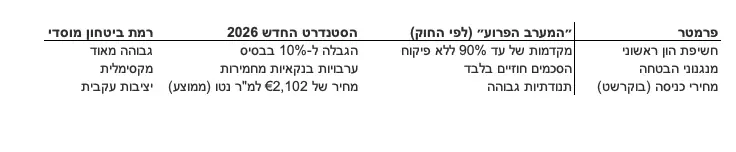
The Israeli angle: This law makes buying in Romania as safe as Israel's Sale (Apartments) Law does at home, but with a clear relative advantage: while Israeli property prices are scraping the ceiling, an average price of €2,232 per m² in Bucharest allows entry into prime assets in top locations in a growing European capital.
The economic dynamics of 2026: managing risk in an inflationary environment
The Romanian economy presents a fascinating duality: inflation of 9.9% (September 2025) alongside a policy rate of 6.5%. For investors, this is a "negative real interest rate" environment that underlines the importance of tangible assets.
The Nordis Law is not a regulatory obstacle but an essential risk-filtering mechanism that safeguards long-term market stability.
Critical macro data
- FDI (foreign direct investment): The investment stock has passed €125 billion, with 65.4% concentrated in the Bucharest-Ilfov region.
- Regional growth: GDP per capita in the Bucharest-Ilfov region stands at €47,200 – significantly above the EU average.
- Dividend tax warning: It is important to note that from 1 January 2026, dividend tax rose to 16%. As a strategic adviser, I recommend reviewing your holding structure (SPV) now so that it fits the change.
Bucharest's Airbnb market: an analysis of the premium segment
Bucharest's short-term rental (STR) market is undergoing a demographic revolution. The data show that 80% of guests are international (mainly from the UK and the US), with 50% belonging to Gen Z and Gen Alpha. This calls for investment in properties with modern design and advanced technology.
- Performance: The top properties on the market (Top 10) stand out for design, location and professional management, and enjoy significantly higher demand than the average.
- Seasonal peak: October is the peak month for demand, while January is the weakest.
- The large-unit niche: Properties that accommodate 6 or more guests (3+ bedrooms) enjoy strong demand owing to a severe supply shortage (only 5.5% of the market consists of 3+ bedroom properties).
Pipera Tech Park, Romania
The "golden neighbourhoods" for investment
- Pipera: The FDI hub. An average salary of €1,462 in this district supports demand from expats.
- Old Town: A classic tourist hub with a high ADR, but it requires meticulous management.
- Herăstrău: A blend of luxury and nature, attracting the international segment willing to pay a premium for quality of life.
Putting it into practice: the Compass Group villa model
Compass Group applies the strict standards of the Nordis Law to capitalise on the significant supply gap in the market for villas and large apartments. As noted, only 5.5% of market supply consists of properties with 3 or more bedrooms – this is the "blue ocean" of Bucharest real estate. A Walla Nadlan report (in Hebrew) toured our Compass on the Lake villas in Balotești.
Frequently asked questions
What is the Nordis Law in Romania?
Law 207/2025, known as the Nordis Law, sets a uniform standard of buyer protection in off-plan projects. It creates a buffer between the buyer's capital and the developer's financial stability, and acts as a risk filter for the whole market.
How much deposit can a Romanian developer ask for?
Under the law, a developer may collect a deposit of only 5%, unless full bank guarantees are in place. Further payments go into a dedicated bank account and are released only to pay for actual construction, according to milestones set by law.
When is the unit entered in the Romanian land register?
The unit is registered as a separate property unit in the Romanian Land Register (Cartea Funciară) already at the preliminary-contract stage, together with a caveat in the buyer's favour. This prevents the same apartment from being sold to another buyer.
What VAT applies to a new home in Romania?
The standard VAT rate has been 21% since August 2025. A transitional reduced rate of 9% ended on 30 September 2026, so every new home is now subject to 21% VAT.
Do I have to travel to Romania to sign?
The notarial signing cannot be done remotely, but you can give a power of attorney to someone who signs on your behalf. Before any signature, have a local lawyer review the contract.
In summary: Romania's momentum
2026 marks a more mature, better-regulated market for the informed investor. With a motorway network that has expanded to 1,329 km and regulation that protects client funds, Romania has completed its transformation into a safe investment destination.
The combination of regulation that protects buyers' money and entry prices of €2,232 per m² in a growing European capital makes Bucharest a destination worth considering seriously.
Secure your edge in the market. Contact the Compass Group experts for a personalised investment portfolio analysis tailored to the tax and regulatory trends of 2026. Bucharest is not just an investment destination – it is the fastest-growing financial centre in the CEE.
This article is for general information purposes only and does not constitute tax, legal or financial advice.
Before entering into any transaction, we recommend consulting local experts.
Now you know more.
This article is general information, not legal, tax or financial advice. Consult local professionals before any transaction.