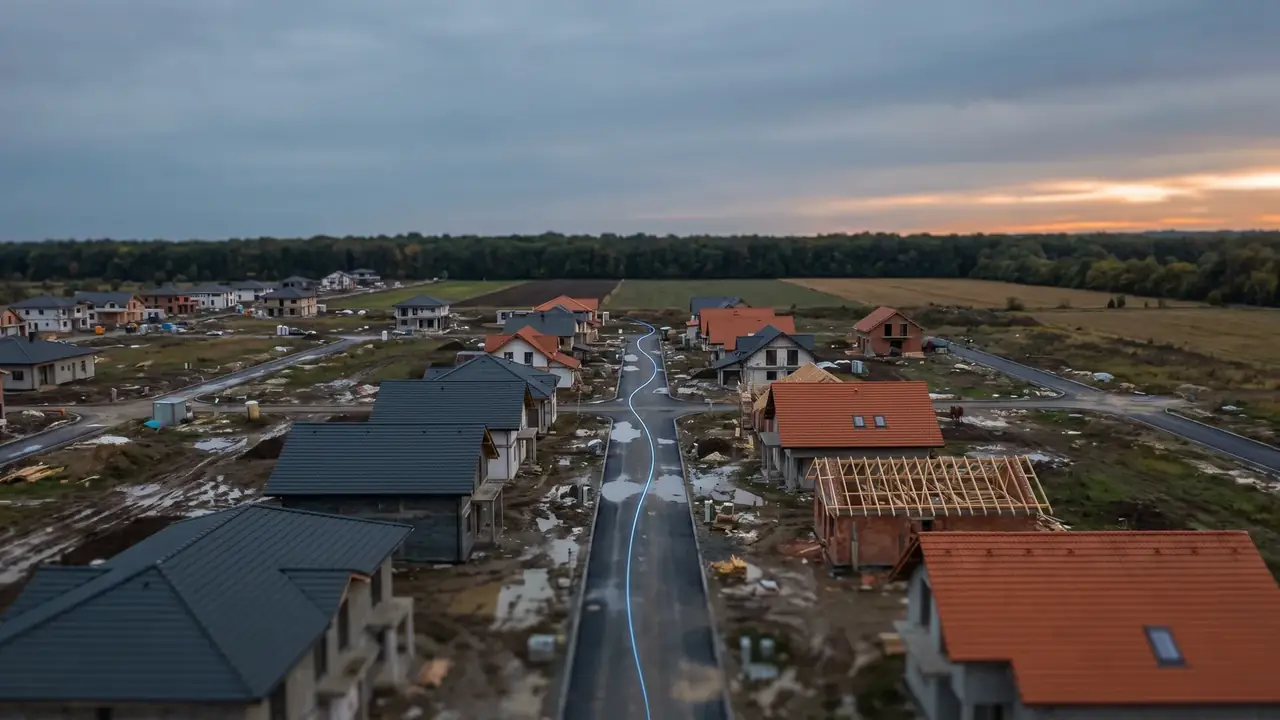
Ilfov grew from 388,738 residents in 2011 to 542,686 in 2021, according to INS censuses.
About 17,300 new dwellings were completed in the Bucharest–Ilfov region in 2025, according to INS.
The Bucharest–Ilfov region accounted for about 29% of the 59,062 dwellings completed in Romania in 2025.
Balotești grew from 8,314 residents in 2011 to 11,210 in 2021.
Utilities, access road, zoning around you, the peak-hour drive, school places and the local authority.
Ilfov County growth: the short answer
Ilfov is the county that surrounds Bucharest, and it was Romania's fastest-growing county between the last two censuses: from 388,738 residents in 2011 to 542,686 in 2021, an increase of about 40%, according to the National Institute of Statistics (INS). Families moving out of the capital for houses with gardens drove much of that growth. In 2025, the Bucharest–Ilfov region accounted for about 29% of all new dwellings completed in Romania.
When I show buyers a map of Bucharest, I always zoom out one level. The city itself is only part of the story. Around it is a ring of towns and communes, Voluntari, Otopeni, Chiajna, Popești-Leordeni, Balotești, that has changed beyond recognition in twenty years. Here is that ring in numbers, and what they mean for someone looking for a home.
Ilfov in numbers
| Indicator | Figure | Source |
|---|---|---|
| Population, 2011 census | 388,738 | INS |
| Population, 2021 census | 542,686 | INS |
| Change 2011–2021 | about +154,000, about +40% | Calculated from INS |
| New dwellings completed in Romania, 2025 | 59,062 (-3.14% on 2024) | INS, via AGERPRES |
| New dwellings completed, Bucharest–Ilfov region, 2025 | about 17,300, about 29% of Romania's total; +314 on 2024 | INS |
| Example: Balotești, 2011 → 2021 | 8,314 → 11,210 (about +35%) | INS |
One county, adding more than 150,000 residents in a decade, while Romania's overall population fell. That is the context for every price and every new project you will see in the area.
Why are people moving to Ilfov?
- Space. A house with a garden instead of an apartment in a block.
- Proximity to the capital's jobs. The office hubs of northern Bucharest, Pipera and Băneasa, are close to the northern suburbs. See our guide to Pipera.
- Infrastructure. The A0 ring road, the airport, and the M6 metro line under construction. See our guide to the A0 and our guide to the M6.
- Schools. Several international schools are in northern Bucharest and Ilfov, and new campuses have been announced. See our guide to international schools.
- Local taxes and services that differ from one commune to the next, since each is a separate local authority.
North and south: two different Ilfovs
| Northern Ilfov | Southern and western Ilfov | |
|---|---|---|
| Examples | Otopeni, Balotești, Corbeanca, Snagov, Voluntari, Pipera | Popești-Leordeni, Bragadiru, Chiajna, Măgurele |
| Character | More houses and villas, lakes and forests, the airport | Denser new apartment complexes in many areas |
| Main roads | DN1, A3, A0 north | A1, A2, A0 south, ring road |
| Proximity | Airport and the northern office hubs | Southern and western parts of the city |
This is a generalisation, and every commune has exceptions. We go deeper in our comparison of north and south Bucharest and in our local guides to Otopeni, Balotești and Corbeanca and Snagov.
Fast growth has a price: what to check
When a county grows by 40% in ten years, infrastructure does not always keep up. Before buying in any suburb:
- Utilities in place, not "planned". Water, sewage, gas and electricity connected to the public networks.
- The access road. Paved and lit up to the house, and who maintains it.
- Zoning around you. Ask at the town hall what the zoning plan allows on the empty plots nearby.
- The peak-hour drive. Test the route to work or school at the time you will actually drive it.
- Schools and kindergartens. Places available, not just buildings.
- The local authority. Each commune sets its own local tax and services; see our guide to the annual property tax.
Where we fit in
To be transparent: we build in northern Ilfov. Compass on the Lake is a project of 29 villas in Balotești, by a lake, from €299,900 all-inclusive, with handovers planned from December 2027. I mention it once, so you know where I am writing from. The checks above apply to every project, ours included.
One county, adding more than 150,000 residents in a decade, while Romania's overall population fell.
Frequently asked questions
What is Ilfov County?
Ilfov is the county that surrounds Bucharest on all sides. It includes towns such as Voluntari, Otopeni, Buftea and Popești-Leordeni, and communes such as Balotești, Corbeanca and Snagov.
How fast is Ilfov growing?
According to INS censuses, Ilfov grew from 388,738 residents in 2011 to 542,686 in 2021, about 40%, the fastest growth of any Romanian county in that period.
How many new homes are being built around Bucharest?
According to INS, about 17,300 new dwellings were completed in the Bucharest–Ilfov region in 2025, about 29% of the 59,062 completed in Romania that year.
Is Ilfov part of Bucharest?
No. Ilfov is a separate county with its own towns and communes, each with its own local authority, local taxes and services. Together with Bucharest it forms the Bucharest–Ilfov development region.
Which part of Ilfov is best for families?
It depends on where you work and study. Northern Ilfov has more houses, lakes and forests and is close to the airport and the northern office hubs; the south has more new apartment complexes. Test the commute before you choose.
The bottom line
Ilfov is where Bucharest is growing. Its population rose by about 40% in a decade, and the region builds almost a third of Romania's new homes. That growth brings opportunity, and also roads, utilities and schools that sometimes lag behind.
If you are looking at a home in Ilfov, book a 30-minute call with me. We will go through the map together, commune by commune, and the questions to ask before each visit.
Moti Azulay, Compass Group Romania
Sources and data: National Institute of Statistics (INS), 2011 and 2021 population and housing censuses · AGERPRES, INS data on dwellings completed in 2025 · Ilfov County Council.
This article is for general information only. Statistical figures are as published by INS; local conditions differ from commune to commune.
Now you know more.
This article is general information, not legal, tax or financial advice. Consult local professionals before any transaction.