On the AMCCRS list updated on 6 October 2026, 136 addresses on ten main Old Town streets appear: 36 in class RsI and 27 consolidated.
Law 282/2015 bans activities that gather people in listed spaces of class RsI buildings until they are strengthened. Fines: 50,000 to 70,000 lei.
A draft regulation put to public debate in June 2026 bans music on terraces after 22:00. Its adoption was not confirmed when we checked.
Bucharest's Old Town: the short answer
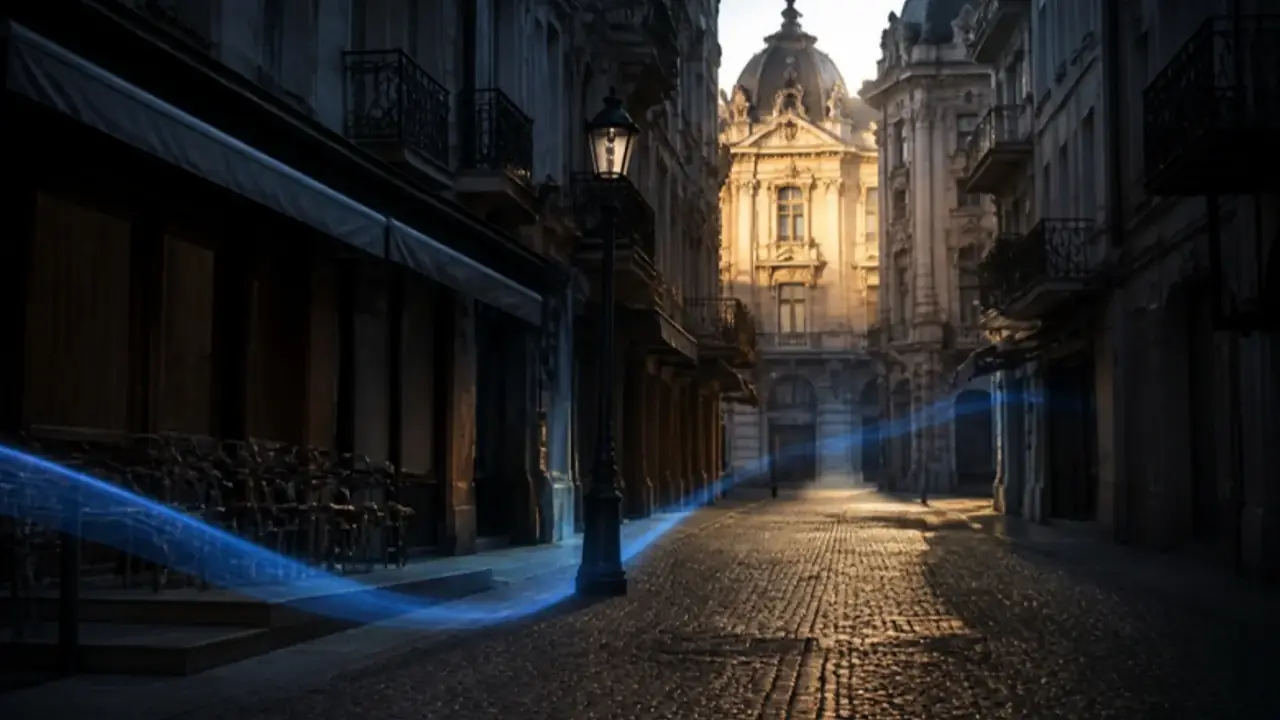
The Old Town (Centrul Istoric, or Centrul Vechi) is the area around Lipscani street, between Calea Victoriei, the Dâmbovița embankment (Splaiul Independenței) and Bulevardul I.C. Brătianu, in Sector 3. It grew around the old princely court, and most of its buildings date from the 19th and early 20th centuries. Bucharest City Hall protects it as two zones: no. 26a, the traditional commercial core of Lipscani, and no. 27, the monumental core around Stavropoleos, both with the highest degree of protection.
Living here means a historic street outside your door, cafés and museums within a few minutes' walk, and the metro close by. It also means three things buyers elsewhere rarely face together: many buildings on the official seismic risk list, nightlife noise, and almost no parking.
In plain words: you can live well in the Old Town, but only in the right building and on the right floor, and only after checking the seismic list, the noise at night and where your car will go.
A short history you can see from the window
According to the Bucharest Municipal Museum, the Old Princely Court (Curtea Veche) holds the oldest historical evidence in the city, dating from the 13th century, and was a residence of the rulers of Wallachia from the 14th century. Between 1459 and 1660, Bucharest was the rulers' residence alongside Târgoviște, and after 1660 it became the sole capital. Under Constantin Brâncoveanu (1688–1714), the palace and gardens covered about 25,000 m². After 1798 the land was auctioned and the streets of today appeared on it. The museum has been closed since November 2015 for consolidation works.
Stavropoleos church, a short walk away, was founded in 1724 by the archimandrite Ioanichie, according to the monastery. It was restored in 1890–1940 and has been a monastery again since 2007.
The City Hall regulation for zone 26a calls Lipscani a traditional commercial area, "unique in Bucharest" and rare in Romania. Most buildings kept their original layout: shops on the ground floor, homes above.
What the protected-zone rules mean for an owner
| Rule (zone 26a, Lipscani) | What the regulation says |
|---|---|
| Plots | Sizes and shapes stay as they are |
| Street front | Buildings on the street line, in a continuous front |
| Height | Existing heights are kept, taking the level of the neighbours |
| Plot coverage (POT) | Up to 80% |
| Floor area ratio (CUT) | 2.5 on narrow commercial streets, up to 3.5 elsewhere |
| Ground floors | Shop windows; blind walls are forbidden |
| Parking | Only inside the plot; the zone is mainly for pedestrians |
| Air conditioning, satellite dishes | Not on street facades, not visible from the street |
| Building permit | Requires the approval of the Ministry of Culture |
In practice, a flat here is a flat in a protected building. A new kitchen is your business; new windows, a closed balcony, an air conditioning unit on the facade or an attic conversion are not. Check the urbanism certificate (certificat de urbanism) for the address before you plan any works.
The seismic list: the first thing to check
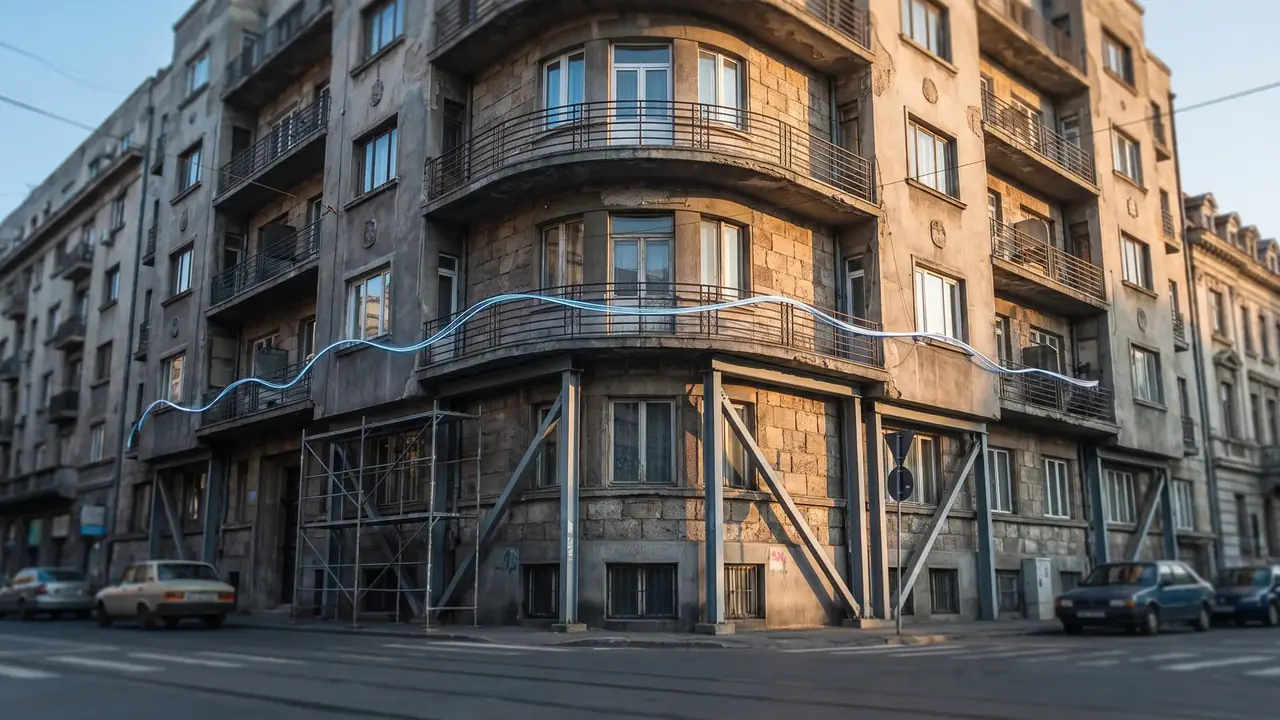
The Municipal Administration for the Consolidation of Buildings with Seismic Risk (AMCCRS) publishes the official list of assessed buildings. The version updated on 6 October 2026 holds 2,798 entries for the whole city, 415 of them in class RsI, the highest risk.
We filtered it for ten streets of the Old Town: Lipscani, Smârdan, Gabroveni, Covaci, Stavropoleos, Franceză, Șelari, Blănari, Băcani and Halelor.
| Status on the AMCCRS list, 6 October 2026 | Addresses on the 10 streets |
|---|---|
| Class RsI (highest risk) | 36 |
| Class RsII | 8 |
| Class RsIII | 8 |
| Class RsIV | 1 |
| Consolidated | 27 |
| Older emergency categories (U1–U3), no class yet | 52 |
| Not classified | 4 |
| Total | 136 |
Most of these buildings were built between about 1860 and 1940. In short, a class RsI building has a high risk of collapse in the design earthquake, while a class RsIV building is expected to behave roughly like a new one. Our guide to earthquake risk in Bucharest explains the classes.
The Old Town is not a place to buy by photo. It is a place to buy by address.
Three legal points matter for a buyer:
- The class goes in the land register. Under Government Ordinance 20/1994, as amended by Law 282/2015, the owners must send the assessment and the risk class to the local authority and to the land registry (ANCPI), to be recorded in part I of the land register extract.
- Crowded activities are banned in RsI buildings. The same law forbids activities that involve gatherings of people in the spaces it lists in class RsI buildings until the strengthening works are finished, with fines of 50,000 to 70,000 lei. That is why some ground floors in the Old Town stand empty.
- Not on the list does not mean safe. The list includes only buildings that were assessed.
Consolidation does happen. In October 2026, AMCCRS was reporting on works at Blănari 2, a building from 1865 in class RsI.
Noise: the Old Town at 23:00 on a Friday
Most of the Old Town's ground floors are restaurants, bars and clubs, open mainly in the evening and at night. In July 2026, the mayor of Bucharest said that "half of the Old Town is dead", as many businesses had left, and asked the local police to be more present.
New rules may come. In June 2026, City Hall put a new terrace regulation up for public debate. The draft bans music on terraces before 10:00, between 13:00 and 14:00 and after 22:00, and requires terraces in residential areas to close at 22:00. When we checked, we could not confirm that it had been adopted. For the general quiet hours that apply to every building, see our article on noise rules in Romania.
What to do before you buy:
- Visit the flat on a Friday or Saturday night, not only on a weekday morning.
- Ask what the ground floor is used for, and whether the use is changing.
- Prefer upper floors and windows onto the courtyard.
- Check the windows. In a protected building, replacing them may need approval.
Cars and parking
The zone is mostly pedestrian, and the protected-zone rules allow parking only inside the plot. Few buildings have a courtyard where a car can stand. In July 2026, the mayor said he had no plan to bring cars back into the Old Town, and described only a one-way street of about 100 metres, without parking, to give access to a future parking area near Strada Franceză. No decision or timetable had been announced.
The Old Town also lies inside the first stage of the planned low-emission zone. Many residents here simply live without a car: the metro at Piața Unirii and Universitate is close. Our guide to parking and car ownership in Bucharest covers residents' options.
Old Town flat or a newer building?
| Flat in an Old Town building | Flat in a newer building | |
|---|---|---|
| Age | Mostly 1860–1940 | Recent |
| Seismic check | AMCCRS list, land register, assessment | Design under the P100 code |
| Changes allowed | Ministry of Culture approval for most exterior works | Building rules and the association |
| Noise at night | Often high on the main streets | Depends on the area |
| Parking | Rarely available | Often a space in the building |
| Daily life | Walk to everything | Depends on the area |
Before you buy in the Old Town: a checklist
- Search the AMCCRS list for the exact address, including the corner number if the building has two.
- Read part I of the land register extract for any recorded seismic risk class.
- Ask for the technical assessment (expertiză tehnică) and whether consolidation is planned or financed.
- Hire a structural engineer to look at the building, and an architect who knows protected zones.
- Check the ground floor use and the night-time noise yourself.
- Check every past change to the flat: attics, mezzanines and joined units need permits and Ministry of Culture approval.
- Ask the owners' association about repairs, debts and planned works.
- Hire an independent lawyer to check the title, the charges and the permits.
Frequently asked questions
Is it safe to live in Bucharest's Old Town?
It depends on the building. On the AMCCRS list updated on 6 October 2026, 36 addresses on ten main Old Town streets are in class RsI, and 27 have been consolidated. Check the exact address and the land register before buying.
Can I live above a bar in the Old Town?
Yes, many people do, but expect noise late at night, especially at weekends. Visit at night, prefer upper floors facing the courtyard, and ask what the ground floor is used for.
Is there parking in the Old Town?
Very little. The zone is mainly pedestrian and the rules allow parking only inside the plot. Most residents rely on the metro and on parking outside the zone.
Can I renovate a flat in a protected building?
Interior works are usually possible. Changes to the facade, windows, roof or structure need permits and, in the protected zone, the approval of the Ministry of Culture.
What happens to a business in an RsI building?
Under Law 282/2015, activities that gather people in the listed spaces of a class RsI building are banned until it is strengthened. Fines are 50,000 to 70,000 lei.
The bottom line
The Old Town is not a place to buy by photo. It is a place to buy by address: the seismic class, the floor, the ground floor below and the street outside decide whether a flat here is a good home or a constant problem. With the right checks, it can be a remarkable place to live.
If you are weighing a historic flat in the centre against a home elsewhere, book a half-hour call with me. We will go through the checks together, even if you end up buying elsewhere.
Moti Azulay, Compass Group Romania
Sources: AMCCRS, list of buildings assessed for seismic risk, updated 6 October 2026 · Bucharest City Hall, protected zone 26a, Lipscani (PDF, archived copy) · Bucharest City Hall, protected zone 27, Stavropoleos (PDF, archived copy) · Law 282/2015 amending Government Ordinance 20/1994 · Bucharest Municipal Museum, Old Princely Court · Stavropoleos Monastery · Digi24, draft terrace regulation, 15 June 2026 · Playtech, the mayor on cars in the Old Town, 26–28 July 2026
This article is for general information only and is not legal, tax, engineering or financial advice. Rules and figures are current as of 22 October 2026. Seismic classes change after new assessments or works; check the AMCCRS list and the land register for the exact address, and consult an independent lawyer and a structural engineer before any transaction.
Now you know more.
This article is general information, not legal, tax or financial advice. Consult local professionals before any transaction.

