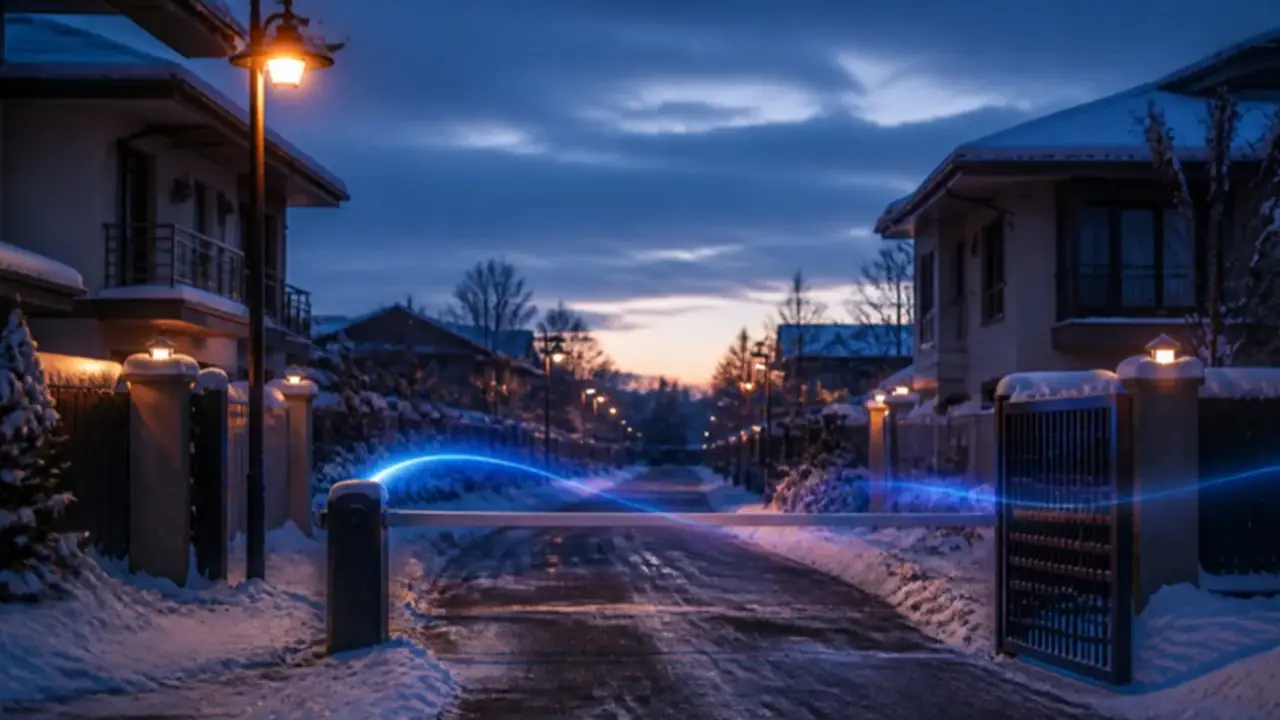
Under Romania's Ordinance 43/1997, a private-use road is administered by whoever owns it. Maintenance, snow and lighting are theirs.
The Civil Code lists a common road in a residential neighbourhood as forced co-ownership. Each owner pays according to their share.
The road usually has its own plot and land book. Check it too: who owns it, and whether a mortgage is registered on it.
The road to a gated villa: the short answer
In a gated villa project near Bucharest, the street in front of your house is usually not a public street. Romanian law distinguishes two kinds of roads. Public roads are public property and are maintained from public funds. Private-use roads are administered by the persons who own them (Government Ordinance 43/1997 on the road regime, Art. 3).
That difference decides almost everything in daily life. The local authority's sanitation service covers clearing snow from public ways (Law 101/2006, Art. 2(3)(g)). On a private road, the owners organise and pay for it themselves. The same goes for lighting, repairs and drainage.
In plain words: before you buy, find out who owns the road on paper. Whoever owns it pays for it in winter, and controls your access the rest of the year.
We covered the association and its fees in our article on gated community management. This article is about the road itself.
Three kinds of road, three sets of rules
| Type of road | Who owns it | Who maintains it | The main risk |
|---|---|---|---|
| Public street | The commune or the state (public domain) | The local authority, from public funds (OG 43/1997, Art. 3(a)) | Low. Service levels depend on the commune |
| Private road owned by the developer | The developer's company | The owner (OG 43/1997, Art. 3(b)) | The developer sells the road, mortgages it, or goes out of business while owning your only access |
| Road in forced co-ownership of the homeowners | All villa owners, in shares | The owners, sharing costs in proportion to their shares (Civil Code, Art. 647(3)) | Decisions and payments depend on your neighbours |
The Civil Code expressly lists "a common road in a residential neighbourhood" as a case of forced co-ownership (Art. 646(3)). Your share of such a road cannot be sold separately from your villa (Art. 647(2)).
There is a fourth case: a right of way (servitute de trecere) over land owned by someone else. A servitude is a charge on one property for the use of another (Art. 755), and it is created by a legal act or by usucapion, with land book rules applying (Art. 756).
Law 169/2026 (the Planning and Construction Code) also defines a private road: a private-use road sized according to the planning regulations and standards in force, to ensure good conditions for car and pedestrian traffic and access for emergency vehicles. Ask whether the road in your project was designed and approved as such.
Who clears the snow and who lights the road
| Service | Public street | Private road |
|---|---|---|
| Snow clearing and anti-icing | The local sanitation service: "cleaning and transporting snow from public ways" (Law 101/2006, Art. 2(3)(g)) | The owners, usually through the association and a paid contractor |
| Street lighting | The local public lighting service (Law 230/2006) | The owners: poles, fixtures and the electricity bill |
| Repairs to the asphalt | The commune | The owners |
| Rainwater drainage | The commune | The owners |
| Gate, barrier, cameras | Not applicable | The owners |
Winters around Bucharest can bring snow and ice. On a private road, someone must have a contract and a budget before the first snowfall. Ask the developer:
- Who will clear the road in the first winter, before the association exists?
- Is snow clearing in the draft association budget, and at what cost?
- Who pays the electricity for the street lights, and on whose meter?
The association: when Law 196/2018 applies to villas
Under Law 196/2018, a "residential complex" is land on which homes stand, detached, terraced or semi-detached, with common and individual property (Art. 2(b)). Such a complex is a condominium for the purposes of the law (Art. 3(3)(c)), and the law applies from three property units upwards (Art. 1(1)).
In practice, the owners' association is the body that signs the snow-clearing contract, pays for the lighting and collects contributions. The law allows the association to set late-payment penalties of up to 0.2% per day, applied only after 30 days and never exceeding the debt itself (Art. 77(1)), and to sue an owner who has not paid for more than 60 days after the due date (Art. 78(2)).
Whoever owns the road pays for it in winter, and controls your access the rest of the year.
Why the bank wants legal access
Physical access is not the same as legal access. A car can drive to your door over a road that you have no right to use.
Banks lending on a property care about this, because the property is their security. An article in the Romanian notaries' bulletin (Buletinul Notarilor Publici, 2019) explains that banks want access secured when they take a property without direct access to a public road as collateral, and that the creditor is exposed because a servitude can end, for example if the owner of the property it serves renounces it (Civil Code, Art. 770(1)(b)). The same article notes that a servitude cannot validly exist while both plots belong to the same owner, because it is extinguished by consolidation (Art. 770(1)(a)).
Two practical consequences:
- Your access must be registered. A share in the road plot, or a servitude written in the land books.
- Ask your bank early. If you finance part of the price, a Romanian bank may lend up to 70% of it, with at least 30% equity, and it will check the access before it approves. Ask the bank what it needs to see. Our Romanian mortgage guide covers the rest of the bank's checks.
If a plot has no access to a public road, the Civil Code gives its owner a right of passage over a neighbour's land (Art. 617). But if the lack of access was caused by the owner who now claims passage, it can be established only with the neighbour's consent and against double compensation (Art. 618(2)). That is not a position to buy into.
What to check in the land book
The road has its own plot and usually its own land book. Order an extract for it as well as for your villa. Under Law 7/1996 (Art. 23):
| Where | What to look for |
|---|---|
| Your villa's extract, Part II | Servitudes in favour of your property (Art. 23(B)(e)), and your share of the road if it is co-owned |
| The road's extract, Part I | That the plot is a road, with its cadastral number and area |
| The road's extract, Part II | Who owns it: the commune, the developer, or all the homeowners |
| The road's extract, Part III | Mortgages and servitudes burdening the road. A developer's bank mortgage on the road matters too |
Our guide to the land register extract explains how to order and read one.
Checklist before you sign
- Ask for the cadastral number and land book of the access road.
- Order both extracts: your villa and the road.
- Confirm in writing who will own the road after the last villa is sold.
- If the developer keeps the road, ask for a registered servitude in favour of your plot.
- Ask whether the road is planned to become a public street, and whether the commune has decided anything. Until a local council decides, the road stays private.
- Ask for the first-year budget for snow clearing, lighting and repairs.
- Ask your bank what proof of access it requires.
- Have an independent lawyer check the access clauses. Our company lawyer represents the company only.
Frequently asked questions
Does the commune clear snow on a private road in a gated complex?
The local sanitation service covers public ways (Law 101/2006, Art. 2(3)(g)). A private road is administered by its owners (OG 43/1997, Art. 3(b)), so snow clearing is their responsibility, usually through the association.
Who owns the road in a villa complex?
It depends on the land book. It may be the developer, all the homeowners in forced co-ownership (Civil Code, Art. 646(3)), or the commune. Order an extract for the road plot and read Part II.
Can the developer keep the road after selling the villas?
It can, if the contracts allow it. Then your access depends on a servitude or on the developer's goodwill. Ask for a registered servitude, or for the road to be transferred to the homeowners.
Will a bank lend on a villa without registered access?
Banks look at the access as part of the security. Physical access is not enough. Ask your bank in advance what it needs: a share in the road plot, or a servitude registered in the land books.
What changes if the road becomes a public street?
If the road is transferred to the commune and becomes public property, its upkeep passes to the local authority, from public funds (OG 43/1997, Art. 3(a)). The transfer needs a decision of the local council. Until that decision is taken and registered in the land book, the road stays private, and the costs stay with its owners.
The bottom line
The road is part of the deal, even if it is not in the price. Know who owns it, who pays for it in January, and what the land book says, before you sign.
If you are looking at a villa on a private road, ours or anyone else's, book a half-hour call with me. We will go through the two extracts together.
Moti Azulay, Compass Group Romania
Sources: Government Ordinance 43/1997 on the road regime, republished, consolidated (legislatie.just.ro), Art. 3 · Law 101/2006 on local sanitation services, republished (consolidated text, commune of Întregalde), Art. 2 · Law 196/2018 on owners' associations (text published by Slobozia municipality), Art. 1-3, 77, 78 · Civil Code, Law 287/2009 (legislatie.just.ro), Art. 617, 618, 646, 647, 755, 756 and 770 · Law 7/1996 on cadastre and land registration (legislatie.just.ro), Art. 23 · Law 169/2026, Monitorul Oficial no. 661 of 10.08.2026, definitions annex · Buletinul Notarilor Publici, 2019: registering a mortgage on a property with a right of way
This article is for general information only and is not legal, tax or financial advice. The rules are correct as of 22 October 2026. Local rules and bank requirements vary; check with the commune, your bank and an independent lawyer.
Now you know more.
This article is general information, not legal, tax or financial advice. Consult local professionals before any transaction.

