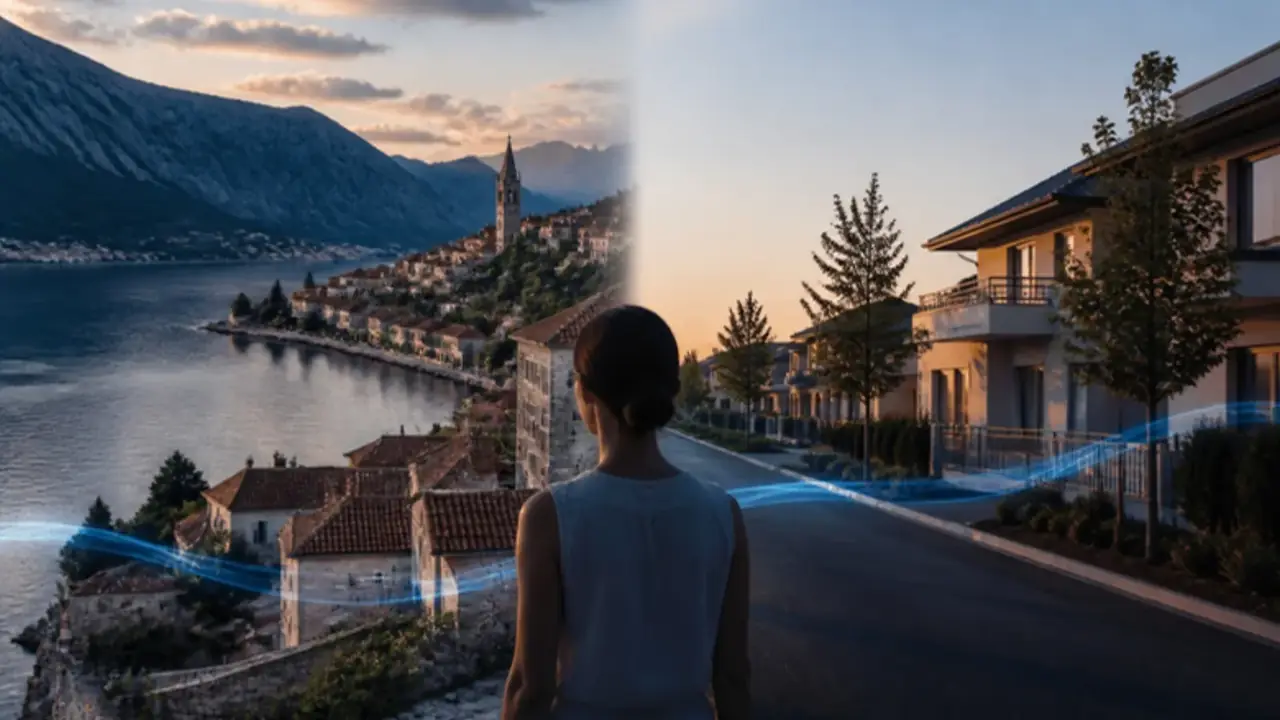
Foreigners in Montenegro cannot own farmland, forests, islands or property within 1 km of the border, except up to 5,000 m² of farmland with a house on it.
Under Article 56 of Montenegro's Law on Foreigners, an owner whose property has a tax base of at least €150,000 can get temporary residence for up to one year at a time.
A resale buyer in Montenegro pays 3% up to €150,000, then 5% and 6% on higher values. In Romania the buyer pays no transfer tax; the seller pays 1% or 3%.
Romania vs Montenegro property: the short answer
The two countries differ at the most basic level. Romania is a member of the EU and of Schengen. Montenegro is outside both: it is a candidate for EU membership and uses the euro. In Montenegro, a foreigner can own an apartment or a house on the same terms as a citizen, but not natural resources, agricultural land, forests, important cultural property, islands, or property within 1 km of the border. One exception: up to 5,000 m² of agricultural land with a house on it. In Romania, a non-EU citizen registers the building in their own name, but not the land.
On costs, a buyer in Montenegro pays a transfer tax on resale property: 3% up to €150,000, and higher rates above that. A new building is sold with VAT instead. In Romania the buyer pays no transfer tax, and a new home carries 21% VAT. The biggest difference is status: in Montenegro, owning a home worth at least €150,000 can support a one-year temporary residence permit. In Romania, property gives no residence.
In plain words: Montenegro gives more to the owner (a residence route, the euro) but sits outside the EU; Romania gives the EU and Schengen, without a residence route through property.
As in our comparisons with Bulgaria and Greece, here are the rules, costs and status side by side.
The big picture
| Romania | Montenegro | |
|---|---|---|
| EU | Member since 2007 | Candidate, not a member |
| Schengen | Full member since 1 January 2025 | Not a member |
| Currency | Romanian leu | Euro, outside the eurozone |
| Permit to buy a home | Not required | Not required |
| Land for non-EU buyers | Not directly in their own name | Building land yes; farmland, forests and border zone no |
| Residence through property | No | Temporary residence from €150,000 |
For a buyer who wants to live inside the EU, this table is the decision. Schengen days, the EU single market and EU law apply in Romania. In Montenegro, they do not, until it joins.
Purchase rules for foreigners
Montenegro: open, with listed exclusions
Under the Law on Property Relations, as summarised by the Municipality of Žabljak's 2025 investor guide, foreigners acquire real estate on the same terms as Montenegrin citizens, with these exclusions:
- natural resources and goods of general interest;
- agricultural land, forests and forest land;
- cultural property of exceptional importance;
- real estate in the border belt up to 1 km from the state border;
- islands, and zones declared protected for state security.
The exception: a foreigner can own up to 5,000 m² of agricultural land if a residential building that is the subject of the deal stands on it.
A 2025 amendment, adopted by the Montenegrin Assembly on 18 March 2025, adds that citizens and companies of EU member states will acquire ownership on the same terms as Montenegrins. That rule applies only from the day Montenegro joins the EU.
Romania: the building yes, the land through a structure
In Romania nobody needs a permit to buy an apartment or a house. A citizen of a non-EU state, such as an Israeli without an EU passport, registers the building in their own name. The land is different: under Article 44(2) of the Constitution and Article 6 of Law 312/2005, non-EU citizens acquire land only under an international treaty, on a reciprocity basis. For a villa, the usual routes are a superficies right (superficie) or a Romanian company. We explain both in our guide to land ownership in Romania.
Prices: what the official data says
| Price per m² (euro) | Source | |
|---|---|---|
| Montenegro, new apartment, national average | 2,557 | MONSTAT, Q2 2026, signed contracts |
| Montenegro, coastal region | 2,838 | MONSTAT, Q2 2026 |
| Podgorica | 2,510 | MONSTAT, Q2 2026 |
| Bucharest, new apartment | about 2,636 | Imobiliare.ro index, summer 2026 |
The methods differ: MONSTAT counts first sales under signed contracts, while Imobiliare.ro is an index of listed prices. Treat the comparison as a starting point, not a verdict.
Purchase costs and taxes
| Romania | Montenegro | |
|---|---|---|
| New home from a developer | 21% VAT | VAT instead of transfer tax on a newly built property; general VAT rate 21% |
| Resale home | No transfer tax for the buyer | Transfer tax paid by the buyer: 3% up to €150,000, 5% between €150,000 and €500,000, 6% above |
| Filing | Handled through the notary at signing | The buyer files and pays the transfer tax within 15 days |
| Registration | Land register fee of 0.15% for individuals | Cadastre registration; ask for the fee in writing |
The transfer tax law says the buyer is the taxpayer and that the purchase of a newly built property subject to VAT is not a "transfer" for this tax. So on a new building, ask the developer whether the price includes VAT. For the Romanian side, see our guide to property buying costs in Romania.
Montenegro gives more to the owner, a residence route and the euro, but sits outside the EU; Romania gives the EU and Schengen, without a residence route through property.
Ownership costs
Romania: an annual local tax on the building, 0.08% to 0.2% of its taxable value, set by the local council, plus a land tax. The base rose from 2026 under Law 239/2025.
Montenegro: an annual real estate tax on the market value, with the rate set by each municipality. According to Montenegro's Ministry of Finance, as reported in October 2025, the basic range stays 0.25% to 1%. Amendments in October and November 2025 gave municipalities the detailed criteria. Coastal and inland municipalities can therefore charge quite different amounts, so ask the municipality for its current decision.
Selling tax
- Romania: a tax on the sale price, not on the gain: 3% if you held the property for up to three years, 1% if longer. The notary collects it on signing day. See our guide to tax on selling property in Romania.
- Montenegro: the gain on a sale is taxed as a capital gain under the personal income tax law. Secondary sources disagree on the rate and the exemptions, so get the current figure in writing from a Montenegrin tax adviser before you buy.
Financing for non-residents
Romania: for foreign buyers, financing of up to 70% of the price is possible, with equity of at least 30%.
Montenegro: there is no single published rule for non-resident borrowers. Each bank decides which foreign income it accepts and how much it lends. Ask for the terms in writing.
Residency: the biggest difference
Montenegro: under Article 56 of the Law on Foreigners (consolidated with amendments up to 2026), a foreigner who owns property in Montenegro can get a temporary residence permit "to use and dispose of" it. The conditions:
- proof of ownership from the cadastre, for a house, holiday home, villa, apartment or business premises; co-owners need at least half;
- proof of value: the transfer tax assessment must show a tax base of at least €150,000 (EU, EEA and Swiss citizens are exempt from this proof);
- the general conditions: means of support, accommodation, health insurance and a clean record.
The permit is issued for up to one year at a time; to renew it, you show that the property taxes were paid.
Romania: no residence through property. You need work, business, family, studies or the digital nomad route. See our guide to the residence permit in Romania.
Remember the other side: Montenegro is outside Schengen, so a Montenegrin permit does not give the right to live in the EU.
Lifestyle: the Adriatic coast or a European capital
Montenegro suits those looking for a home by the sea, on the Adriatic coast, or in Podgorica. Romania's market is centred on Bucharest–Ilfov, an EU capital region. According to the National Institute of Statistics, about 17,300 new dwellings were completed there in 2025, about 29% of the national total. The northern suburbs, near the airport and the international schools, are a market of family homes with gardens.
Checklist before you choose
- Your goal. A residence permit, or a home inside the EU and Schengen?
- The location. In Montenegro, check the border belt and the land category. In Romania, check the land register extract.
- New or resale. In Montenegro, VAT on new builds, transfer tax on resale. In Romania, VAT on new homes only.
- Local tax. Ask the Montenegrin municipality for its current rate.
- The exit. Get the selling tax in writing in both countries.
- An independent lawyer in the country where you buy, who represents only you.
Frequently asked questions
Can foreigners buy property in Montenegro?
Yes. Foreigners acquire apartments and houses on the same terms as citizens. They cannot own natural resources, agricultural land, forests, important cultural property, islands or property within 1 km of the border, except up to 5,000 m² of farmland with a house on it.
Does buying property in Montenegro give residency?
It can. The Law on Foreigners allows a temporary residence permit for an owner whose property has a tax base of at least €150,000, with means of support, accommodation and health insurance. The permit is issued for up to one year at a time.
What is the property transfer tax in Montenegro?
The buyer pays 3% on transfers up to €150,000, 5% between €150,000 and €500,000, and 6% above, under the rates in force since 1 January 2024. A newly built property sold with VAT is outside this tax.
Is Montenegro in the EU or Schengen?
No. Montenegro is a candidate for EU membership and is not in Schengen, although it uses the euro. Romania is in both.
The bottom line
Montenegro offers what Romania does not: a residence route through property and the euro. Romania offers what Montenegro does not yet have: the EU and Schengen, and no transfer tax for the buyer. Decide first whether you need a permit or a home inside the EU; the rest follows.
If you are weighing the two, book a half-hour call with me. We will put the property you are looking at in each country into one table: the rules, the full cost and the exit.
Moti Azulay, Compass Group Romania
Sources: Montenegro, Law amending the Law on Property Relations, Official Gazette 2025 (sluzbenilist.me) · Municipality of Žabljak, investor guide 2025: purchase of real estate by foreigners · Montenegro, Law on Real Estate Transfer Tax (gov.me), Articles 6, 7, 16 · KPMG Montenegro: transfer tax rates from 1 January 2024 · Montenegro, amendments to the Law on Real Estate Tax, 2025 (sluzbenilist.me) · Montenegro, Law on Foreigners, consolidated to 2026 (zzzcg.me), Articles 43, 56 · MONSTAT: new apartment prices, Q2 2026 · Romania, Law 312/2005 · Romania, Fiscal Code, Law 227/2015 · ANCPI · National Institute of Statistics, Romania (INS)
This article is for general information only and is not legal, tax or financial advice. The rules are current as of 22 October 2026 and change in both countries. Before a transaction, consult an independent lawyer and a tax adviser in the country where you buy.
Now you know more.
This article is general information, not legal, tax or financial advice. Consult local professionals before any transaction.

