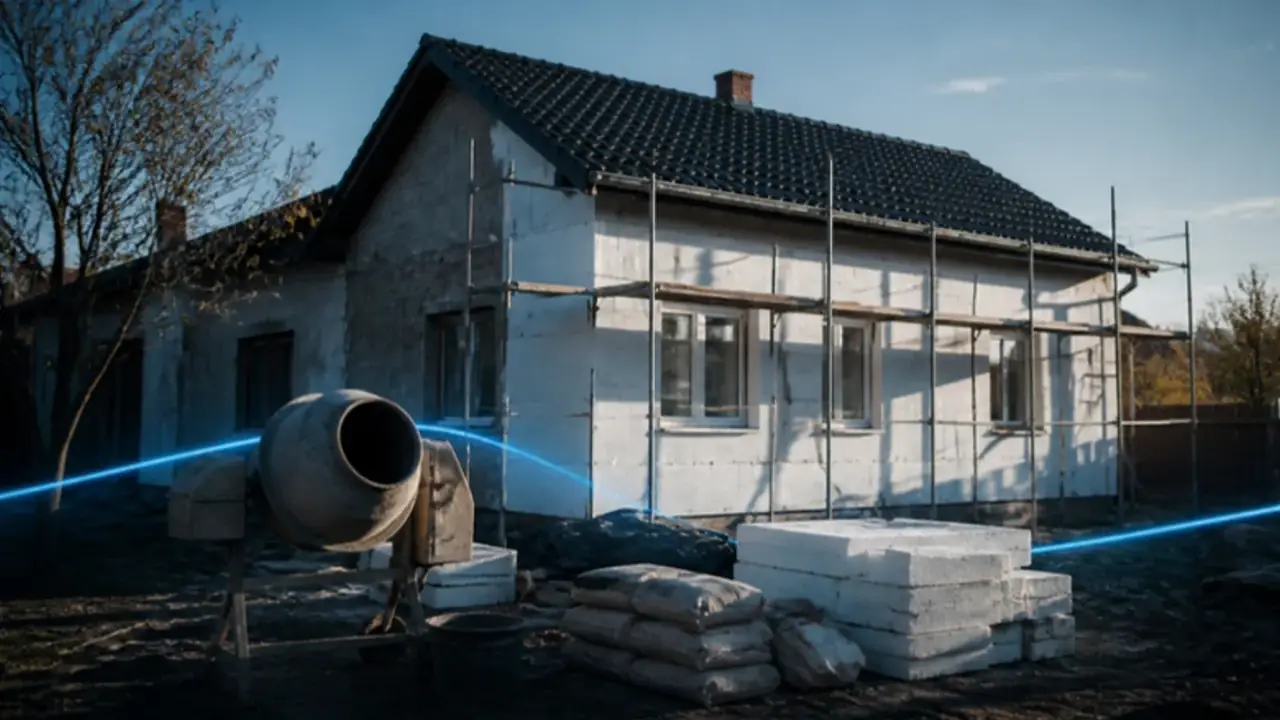
The town hall has 15 working days to respond to a notification; then works start 15 calendar days later (Law 169/2026, Art. 296).
Energy renovation of the whole envelope or roof of a family house of up to 3 levels goes through notification, if the roof system stays (Art. 294).
The tax for a building permit for a residential building is 0.5% of the authorised value of the works (Fiscal Code, Art. 474(5)).
Renovating an older house in Romania: the short answer
Since 25 August 2026, renovation in Romania follows one law: the Planning and Construction Code, Law 169/2026. It sorts works into three routes. Repairs that keep the house as it is need no formality at all (Art. 299). A list of larger interventions, including a new roof of the same shape, insulating the whole envelope of a family house or converting an existing attic, can be done on a notification to the town hall (Art. 294). Anything that touches the structure, or falls outside those lists, needs a building permit.
The legal route is only half of the job. The other half is the contract with the builder: what price you agreed, when you pay, and who is liable when something goes wrong.
In plain words: the code tells you whether to ask the town hall. The contract tells you what you get for your money. An older house needs both in writing before the first wall comes down.
This article is about renovating a house you already own, or are about to buy. For additions such as a pool, a pergola or a fence, see our guide to villa additions and permits.
Typical renovation works and their route
| Work on an older house | Route | Law 169/2026 |
|---|---|---|
| Repairing the roof without changing its shape or look | No formality | Art. 299(2)(a) point 2 |
| Replacing windows and exterior doors, same shape and opening size, even in a new material | No formality | Art. 299(2)(a) point 4 |
| New interior finishes, floors, plaster and paint | No formality | Art. 299(2)(a) point 7 |
| Repairing or replacing interior installations | No formality | Art. 299(2)(a) point 9 |
| Repairing stoves and chimneys | No formality | Art. 299(2)(a) point 8 |
| Local heating, hot water systems, individual air conditioners | No formality | Art. 299(2)(a) point 10 |
| Solar panels for your own use | No formality, with prior notice to the town hall | Art. 299(2)(a) point 13 |
| Replacing the roof in the same shape, or raised by up to 0.5 m within the height allowed | Notification | Art. 294(2)(b)(ii) |
| Converting an existing attic, if no strengthening is needed | Notification | Art. 294(2)(b)(iii) |
| Moving non-structural walls, without changing the size of the house | Notification | Art. 294(2)(b)(v) |
| Remodelling a non-load-bearing façade | Notification | Art. 294(2)(b)(vi) |
| Energy renovation of the whole envelope or roof of a family house of up to 3 levels, without changing the roof system | Notification | Art. 294(2)(b)(vii) |
| Extending to add a bathroom or technical room of up to 25 m² | Notification | Art. 294(2)(b)(x) |
| Strengthening the structure, adding a floor, a real extension | Building permit | Art. 282 and the permit procedure |
All of this applies outside protected built zones and the protection zones of historic monuments. Inside them, stricter rules apply, with the heritage authority's written agreement (Art. 294(3)).
"No formality" still has rules
A work that needs no paperwork is not a work without obligations. Planning rules and technical quality rules still apply. You, as the owner, are liable for breaking them together with the designer and the builder (Art. 299(3)–(4)). And the reception of the finished works is mandatory, recorded under your contract with the builder and entered in the building's technical book and in the National Register of Constructions (Art. 299(5)).
For an older house, that technical book (cartea tehnică a construcției) may not exist yet. Start one. It is the file the next buyer will ask for.
How the notification route works
- Prepare the file. A notification form, plus a simplified technical project signed by an architect with signing rights and the relevant engineers, and the fees the law sets for permits (Art. 295(4)).
- Submit it to the town hall, on paper or digitally. A digital submission is confirmed automatically (Art. 295(5)–(6)).
- Wait 15 working days. The town hall may approve tacitly, ask for clarifications, ask for further approvals, tell you a permit is needed, or reject the notification (Art. 296(1)).
- Start 15 calendar days later. Works begin 15 calendar days after the tacit approval takes effect (Art. 296(6)).
- Finish within 3 years. The notified works are valid for 3 years (Art. 296(5)).
Notification saves time, not the architect: a simplified project is still a project.
When you need a building permit
Anything that touches the load-bearing structure, adds a floor, extends the house beyond the notification list, or changes the roof system needs a permit. For interventions on an existing building, the permit project adds a detailed survey of the house, technical expert reports for the relevant quality requirements and a diagnostic analysis of the building (Art. 282).
The code tells you whether to ask the town hall. The contract tells you what you get for your money.
That is where an older house differs most from a new one. The expert report tells you what the structure can take before the design starts. Our guide to earthquake risk in Bucharest explains why this matters in this region.
Energy renovation: the work and the money
The code makes the most common energy upgrade simpler: insulating the whole envelope or roof of a family house of up to 3 levels goes through notification, as long as the roof system does not change (Art. 294(2)(b)(vii)). Solar panels for your own use need only prior notice (Art. 299(2)(a) point 13), as our guide to solar panels on a villa explains.
On grants, be careful. The Environmental Fund Administration (AFM) runs support programmes in sessions, such as Casa Verde, with terms that change from one session to the next. As of 22 October 2026 we could not confirm, from an official source, an open national programme for individuals to insulate or renovate an existing house. Check afm.ro before you plan, and do not build your budget on a grant that has not opened. After the works, an improved energy class may help with a green mortgage if you refinance.
The contractor and the contract
Under the Civil Code, a renovation is a works contract (contract de antrepriză, Art. 1851). Three ways to set the price have different consequences:
| Price | What it means | Civil Code |
|---|---|---|
| Estimate | The builder must justify any increase. You pay it only for work that could not have been foreseen | Art. 1865 |
| By value of the works | The builder must account, on request, for progress, services and costs | Art. 1866 |
| Fixed global price | Neither side can change it because the work cost more or less than expected | Art. 1867 |
Four more points belong in every contract:
- When you pay. Unless agreed otherwise, the price is due at the reception of the whole work (Art. 1864). Instalments tied to finished stages protect you better than a large advance.
- The builder's legal mortgage. A builder has a legal mortgage on the work to secure the price, limited to the increase in value (Art. 1869 and Art. 2386 point 6). Pay against invoices and keep the receipts.
- Liability. Builders are liable for hidden defects appearing within 10 years of reception, and for structural defects for the life of the building (Law 169/2026, Art. 451(3)).
- Reception. Do it in writing, with a list of defects to fix and a deadline.
Costs you can check in published sources
| Item | Amount | Source |
|---|---|---|
| Building permit tax, residential building | 0.5% of the authorised value of the works | Fiscal Code, Art. 474(5) |
| Planning certificate, urban area | 5 to 14 lei and more, by surface; 50% in rural areas | Fiscal Code, Art. 474(1)–(2) |
| Updating the technical data of the property in the land book | 75 lei per property | ANCPI tariff code 2.6.3 |
| Registering a new construction in the land book | 60 lei plus 0.05% of its taxable value | ANCPI tariff code 2.6.1 |
The construction work itself has no official price list. Ask at least three builders for a detailed estimate (deviz) on the same project, so that you compare like with like.
Your checklist before you start
- Check the land book: does the house on paper match the house you will renovate?
- Classify every planned work: no formality, notification or permit.
- Hire an architect for anything beyond repairs, and a structural expert for anything structural.
- Check whether the house is in a protected zone.
- Ask the town hall for a planning certificate if you are unsure what is allowed on the plot.
- Get at least three detailed estimates on the same project.
- Sign a written works contract: price type, stages, payments, deadline, penalties.
- Do a written reception at the end, and update the technical book.
- If the area or the structure changed, update the land book.
Frequently asked questions
Do I need a permit to replace the roof of my house in Romania?
Repairing it without changing its shape needs no formality. Replacing it in the same shape, or raising it by up to 0.5 m within the height allowed, goes through a notification to the town hall. Changing the roof system needs a permit (Law 169/2026, Art. 294 and 299).
Do I need a permit to insulate my house?
For a family house of up to 3 levels, insulating the whole envelope or roof goes through notification, as long as the roof system does not change (Art. 294(2)(b)(vii)). Outside protected zones only.
How long does the notification route take?
The town hall has 15 working days to respond. Without a response, the notification is tacitly approved, and works can start 15 calendar days later (Art. 296).
Is there a state grant for renovating an old house in 2026?
As of 22 October 2026 we could not confirm an open national programme for individuals to insulate or renovate an existing house. AFM programmes open in sessions, so check afm.ro.
The bottom line
An older house can become an excellent home, and the new code makes many renovation works simpler. But simpler is not the same as free of rules: every route still has a project, a reception and a liability.
If you are weighing whether to renovate an older house or buy a new one, book a half-hour call with me. We will go through the costs honestly.
Moti Azulay, Compass Group Romania
Sources: Law 169/2026, Planning and Construction Code, Monitorul Oficial no. 661 of 10.08.2026, Art. 282, 294–296, 299, 451 · Civil Code (legislatie.just.ro), Art. 1851, 1864–1869, 2386 · Fiscal Code, Law 227/2015 (legislatie.just.ro), Art. 474 · ANCPI tariffs, Order 16/2019 as amended by Order 1498/2024 (reproduction) · Environmental Fund Administration (AFM)
This article is general information only and is not legal, tax or financial advice. The rules are current as of 22 October 2026. Before starting works, consult an architect and an independent lawyer.
Now you know more.
This article is general information, not legal, tax or financial advice. Consult local professionals before any transaction.

