Romania's national reference level for indoor radon is 300 Bq/m³ as an annual average, the maximum the EU directive allows. WHO recommends 100.
Under CNCAN Order 153/2023, a home is measured for at least 3 months, preferably in winter, with at least two detectors, by a designated laboratory.
CNCAN's methodology says the radon index of the site must be determined for any new construction, so prevention can be planned in.
Radon in Romania: the short answer
Radon is a natural radioactive gas that rises from the ground. You cannot see it or smell it, and it collects indoors, mainly in basements and on the ground floor. The World Health Organization describes it as one of the leading causes of lung cancer and estimates that it causes 3% to 14% of lung cancers in a country.
Romania follows the EU directive 2013/59/Euratom. The national reference level for the annual average radon concentration indoors is 300 Bq/m³, set under Article 66 of Romania's basic radiation safety norms. A national radon action plan has been in place since 2018 (Government Decision 526/2018), and the measurement method is set by the nuclear regulator CNCAN, in Order 153/2023. For new buildings, that method says the site's radon index must be determined, so that prevention can be designed in.
In plain words: radon is not a reason to avoid a house, but it is a reason to measure. In a new house, prevention is cheap if it is planned under the slab. Afterwards, it costs more.
The legal framework, layer by layer
| Layer | What it says | Where |
|---|---|---|
| EU directive 2013/59/Euratom | National reference levels for indoor radon, not higher than 300 Bq/m³ (annual average); a national action plan; measures to prevent radon entering new buildings, which may include building code requirements | Articles 74 and 103 |
| Law 111/1996 on nuclear activities | The legal basis on which the national radon action plan was adopted | Article 35(w), cited in HG 526/2018 |
| Government Decision 526/2018 | Approves the national radon action plan (PNAR), covering homes, public buildings and workplaces, from soil, building materials and water; first revision after 5 years | Published in Monitorul Oficial no. 645 of 25 July 2018 |
| Basic radiation safety norms (joint order 752/3978/136/2018) | The national reference level of 300 Bq/m³ | Article 66 |
| CNCAN Order 153/2023 | The methodology for measuring radon in buildings and workplaces; replaced Order 185/2019 | Published in Monitorul Oficial no. 729 of 9 August 2023 |
The ministries involved in the action plan include the Health Ministry, the ministry responsible for construction (then MDRAP, today MDLPA), CNCAN and local authorities, together with professional associations of architects and builders.
What 300 Bq/m³ means, and what WHO recommends
Bq/m³ (becquerels per cubic metre) measures how many radioactive decays happen per second in one cubic metre of air. The reference level is not a safety line below which the risk is zero. It is the level above which a building owner is expected to act.
WHO recommends a national reference level of 100 Bq/m³, and, where that is not possible, no more than 300 Bq/m³. Romania uses 300, the maximum allowed by the EU directive. CNCAN's methodology adds a practical recommendation: even below 300, keep the concentration as low as possible.
How radon is measured in a home
The 2023 methodology sets out how a home is tested:
- Who measures: laboratories designated by CNCAN.
- How many detectors: at least two in the home, placed according to the methodology's rules, for example not next to a window, door or ventilation opening.
- How long: at least 3 months, preferably during the cold season, when windows stay closed and radon builds up.
- What comes out: the annual average concentration (the "CARIA" indicator), corrected with seasonal factors when the measurement is shorter than 12 months.
- What happens next: the result is compared with 300 Bq/m³.
| Result | What the methodology says |
|---|---|
| Below 300 Bq/m³ in every room measured | Keep levels as low as possible. Repeat at least every 10 years, and after any structural change, including thermal insulation work or anything that changes ventilation |
| At least one result above 300 Bq/m³ | Identify the sources and entry routes, draw up a remediation plan, apply it through design and construction firms, and measure again afterwards |
The point about insulation matters for a family. When a house is sealed better to save energy, less outside air comes in, and radon can rise. That is why ventilation and radon belong in the same conversation.
A new house: the radon index of the plot
Under Article 21 of the 2023 methodology, for any new construction the radon index of the site must be determined, so that preventive measures can be applied. The index is based on two measurements of the soil: the radon concentration in soil gas, and the soil's permeability to gas.
| Radon index | Low permeability soil | Medium permeability | High permeability |
|---|---|---|---|
| High | 100 kBq/m³ or more | 70 kBq/m³ or more | 30 kBq/m³ or more |
| Medium | 30 to 100 | 20 to 70 | 10 to 30 |
| Low | below 30 | below 20 | below 10 |
The index then sets the level of protection to build in. The methodology refers to a technical guide by the construction ministry (MDLPA) that describes three protection levels for new buildings.
Radon is not a reason to avoid a house, but it is a reason to measure.
CNCAN also publishes a national radon map with priority areas. The methodology notes that architects, designers and builders can use it. You can look up your area on cncan.ro before you buy.
What prevention in a new house looks like
The methodology lists the measures that can be part of prevention in new buildings:
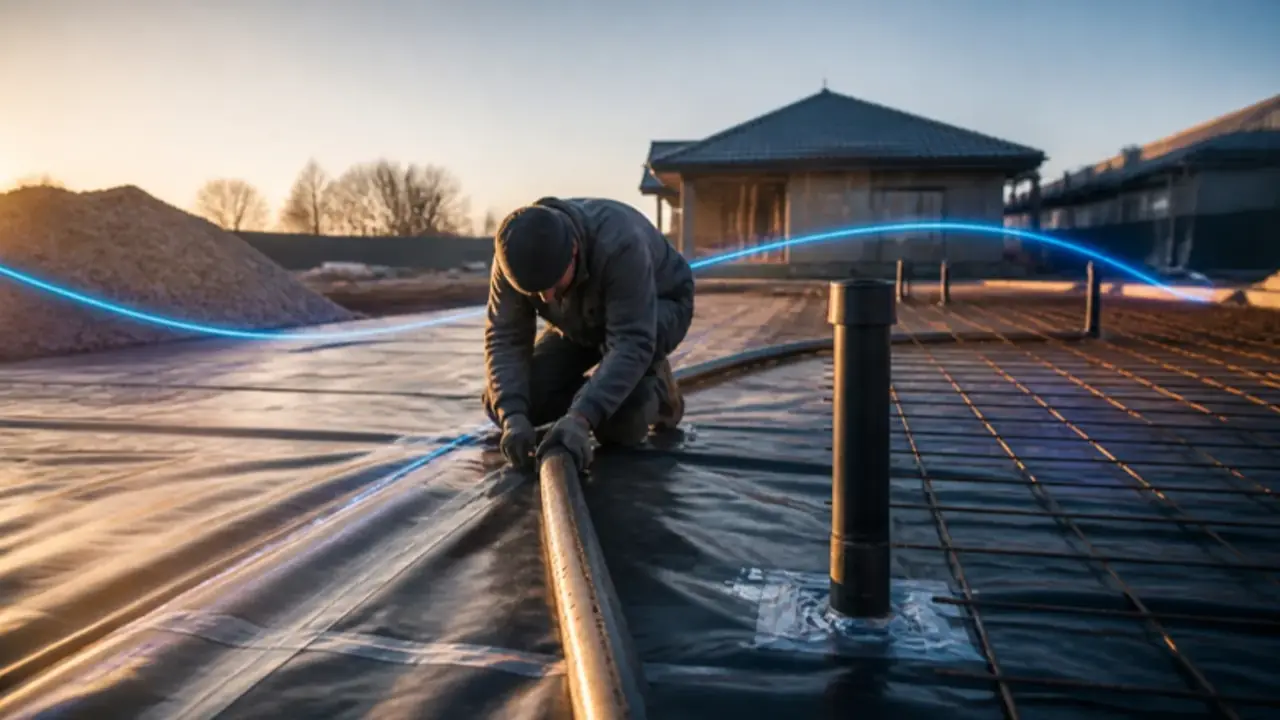
- A radon-proof membrane between the soil and the foundation slab, with sealed joints and sealed pipe penetrations.
- Soil depressurisation: pipes under the slab that can draw soil gas away, passively or with a small fan.
- Passive ventilation under the slab or of a crawl space.
- Controlled mechanical ventilation of the house or the basement.
- Monitoring: detectors that warn when radon rises and can switch ventilation on.
- Materials: avoiding building materials that emit radon.
Most of these measures are easy to add during construction and difficult afterwards, when the slab is poured and the floors are finished. Ask about them before the foundation stage, not at handover. More on how a house is built in our guide to villa construction quality.
And in a house that is already built
For existing homes, the methodology lists remediation measures that depend on the measured level:
- Airing rooms and more natural ventilation can be enough when the measured level is below 400 Bq/m³.
- Sealing cracks in the floor and foundation and around pipes.
- Controlled mechanical ventilation or a minimally invasive soil depressurisation system.
- Changing the use of a room, for example not using a basement room as a bedroom.
Remediation should always be followed by a new measurement, to prove that it worked.
Checklist: 7 radon questions before you buy
- Was the radon index of the plot measured before construction? Ask for the report.
- Which protection level was chosen, and what does it include?
- Is there a membrane under the slab, and how were the pipe penetrations sealed?
- Is there a pipe for soil depressurisation that can be activated later, if needed?
- How is the house ventilated, especially when it is sealed for energy efficiency?
- Is the plot in a priority area on CNCAN's radon map?
- After moving in: plan a 3-month measurement by a CNCAN-designated laboratory, in your first winter.
These questions apply to any project, including ours. If a developer does not know the answer, that is information too.
Frequently asked questions
What is the radon reference level in Romania?
300 Bq/m³ as an annual average indoors, set under Article 66 of the basic radiation safety norms (joint order 752/3978/136/2018). It is the maximum allowed by EU directive 2013/59/Euratom. WHO recommends 100 Bq/m³ where possible.
Is a radon test mandatory when buying a home in Romania?
We found no rule that requires a radon test for the sale of a private home. Measurement is mandatory for certain workplaces and for public buildings such as schools and kindergartens, under CNCAN's methodology. For a new building, the methodology requires the site's radon index to be determined.
How long does a radon test take?
At least 3 months with passive detectors, preferably in the cold season, according to CNCAN Order 153/2023. Short measurements can help find the source, but the comparison with 300 Bq/m³ is made on the annual average.
Can radon be kept out of a new house?
Yes. WHO notes that well-tested, durable and cost-effective prevention methods exist for new buildings. The usual measures are a sealed membrane under the slab, soil depressurisation and controlled ventilation, designed according to the plot's radon index.
Does energy-efficient insulation increase radon?
It can, because a tighter house exchanges less air. CNCAN's methodology recommends measuring again after insulation work or any change to ventilation. Good ventilation solves both problems. See also our guide to an energy-efficient home.
The bottom line
Radon is a quiet issue: no smell, no symptoms, no warning. The good news is that it is measurable, and in a new house it is preventable at low cost, if someone thought about it before the slab was poured.
If you are looking at a house in Romania, with us or anywhere else, book a 30-minute call with me. We will go through the questions on the list together, and what to ask for in writing. On air quality outside the home, see our article on air quality in Bucharest and Ilfov, and on handover checks, our new home handover guide.
Moti Azulay, Compass Group Romania
Sources: Directive 2013/59/Euratom, Article 74 and Article 103 · Government Decision 526/2018 approving the National Radon Action Plan (CNCAN copy) · CNCAN Order 153/2023, methodology for measuring radon in buildings, as published in MO 729/2023 (Avocatul Poporului bulletin), Articles 2, 8, 15 to 21, 23 and Annex 9 · World Health Organization: Radon and health · CNCAN
This article is for general information only and is not legal, medical or engineering advice. The rules are correct as of 22 October 2026. For a specific house, rely on a CNCAN-designated laboratory and a qualified engineer.
Now you know more.
This article is general information, not legal, tax or financial advice. Consult local professionals before any transaction.

