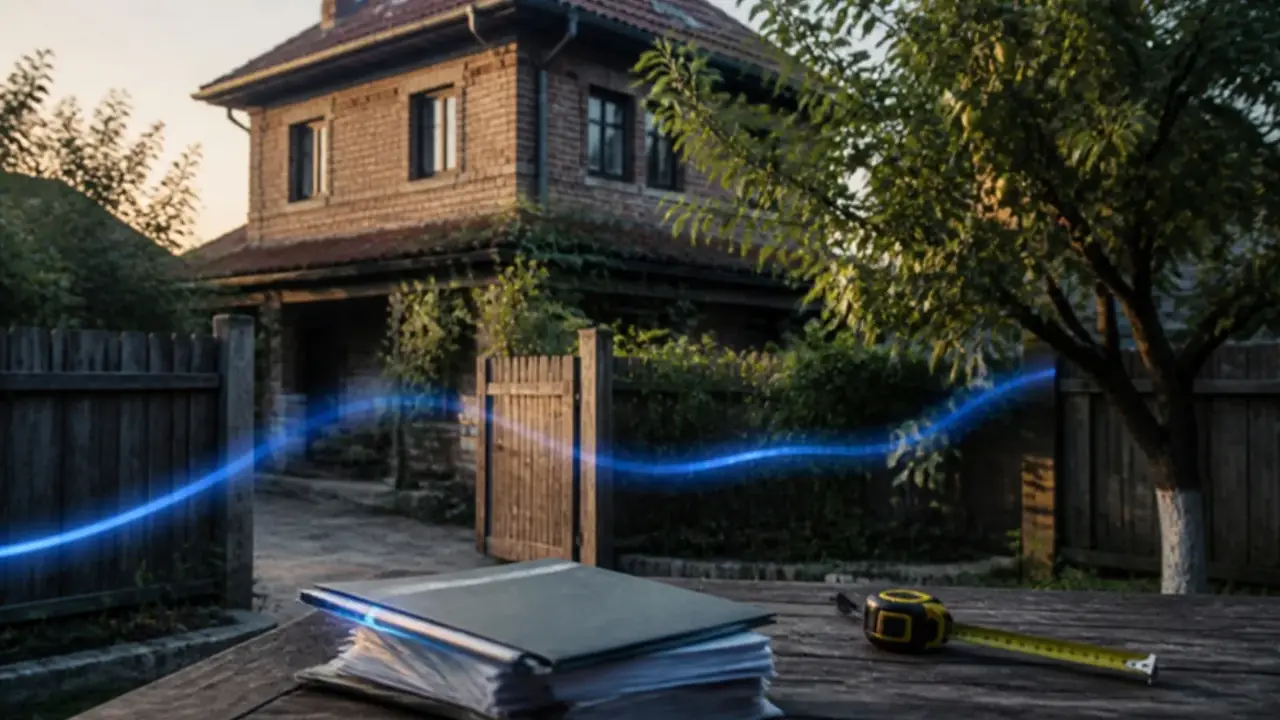
Notarial deeds transferring a real right are signed only if the property is registered in the land book, with limited exceptions (Law 7/1996, Art. 36).
Houses built before 1 August 2001 can be registered with a fiscal certificate showing the real area. Later ones need permit and reception (Law 7/1996, Art. 37).
In a building, a hidden defect must appear within 3 years of handover, and you must tell the seller within a reasonable time (Civil Code, Art. 2531, 1709).
Buying an existing house in Romania: the short answer
A house that has stood for 15 or 40 years has a history, and in Romania most of that history is written in four places: the land book (Cartea Funciară), the town hall's permit file, the local tax office and the building itself. A new build comes with a fresh permit, a reception report and a builder who is liable for defects. An existing house comes with whatever its owners did, or did not do, over the years.
The legal starting point is simple. A notary can sell a building only if it is registered in the land book (Law 7/1996, Art. 36). A house is registered on the basis of a certificate from the town hall confirming that it was built according to its permit and that a reception report exists, or, for houses built before 1 August 2001, a fiscal certificate showing the real area (Art. 37).
In plain words: in an existing house you are not only buying walls. You are buying every extension, repair and unpaid bill of the previous owners, so check the papers as carefully as the roof.
If you are still choosing between building, buying new or buying existing, start with our guide on whether to build or buy a house in Romania.
New build or existing house: what changes
| Topic | New build from a developer | Existing house from an individual |
|---|---|---|
| Building in the land book | Registered after reception, on the basis of the permit | Registered years ago, maybe without later extensions |
| Permit and reception | Recent, in one file | May be old, partial or missing for parts of the house |
| Hidden defects | The seller under the Civil Code, plus the builders for 10 years, and for the structure, for the life of the building | The seller under the Civil Code; the builders only if the house is recent |
| Energy certificate | Issued at reception | The seller must provide one at sale (Law 372/2005) |
| VAT | Included in the price of a new home | Normally not charged when an individual sells a home |
| Condition | New, not yet lived in | Wear, past repairs, old installations |
The warranty clocks for new homes are explained in our guide to defects and warranty in a new home.
Check 1: is the house in the land book, and does it match reality?
Order a land book extract for information. Part I describes the property: the plot, its area and each building on it. Our guide to the land register extract explains how to read it.
Then compare the paper with what you see:
- Is the house registered at all? Some plots show only the land. Then the house exists on the ground but not on paper, and a notary cannot sell it as such.
- Does the area match? A house of 180 m² registered as 120 m² usually means an extension that was never registered.
- Garage, annex, second floor? Each built part should appear in Part I.
For houses built before 1 August 2001, the law allows registration on the basis of a fiscal certificate from the town hall that shows the real area, plus a cadastral file (Law 7/1996, Art. 37(2)). For anything built later, the town hall must confirm that it was built according to a permit and that a reception report exists (Art. 37(1)).
Check 2: the permit and the reception for each part of the house
Ask the seller for the building permit (autorizație de construire) and the reception report at completion (proces-verbal de recepție la terminarea lucrărilor), for the original house and for every extension.
Since 25 August 2026, building rules come from the new code, Law 169/2026, which repealed Law 50/1991. Some small works need only a notification or no formality at all. Our guide to villa additions and permits lists them. But an extension, an added floor or a converted attic that should have had a permit and did not is a problem that moves to the buyer on the day of signing.
In an existing house you buy every extension, repair and unpaid bill of the previous owners. Check the papers as carefully as the roof.
Ask also for the technical book of the building (cartea tehnică a construcției). Under the new code, the owner must keep it up to date and hand it over to the new owner when the building is sold (Law 169/2026, Art. 420(1)(l)). Older houses often have none, which means you know less about what is inside the walls.
Check 3: the energy performance certificate
Under Law 372/2005, the seller must give the buyer a copy of the energy performance certificate before the contract and hand over the original at signing (Art. 22(1)–(2)). A sale signed without that prior copy can be annulled at the buyer's request (Art. 22(4)). Read it before you agree on the price, not at the notary. An energy class of E or F in an old house means insulation, windows and heating are likely to be on your budget soon. Our guide to energy-efficient homes explains what the certificate shows.
Check 4: local taxes and utility bills
- Local taxes. The notary asks the seller for a fiscal certificate from the town hall, showing that the local taxes on the property are paid. Ask to see it early.
- Utilities. Electricity, gas, water and sewage contracts are in the seller's name. Ask for the latest bills and proof of payment, read the meters together on handover day, and transfer the contracts to your name.
- Sewage. In villages near Bucharest, an older house may use a septic tank rather than the public network. Ask which, and where the tank is. Our guide to utility connections in Ilfov covers the networks.
Check 5: the structure and the earthquake question
Bucharest and Ilfov sit in the zone affected by Vrancea earthquakes. A low-rise house is a different risk from an old tall block, but its age, materials and past alterations matter. Our article on earthquake risk in Bucharest explains the codes by period.
Before you sign, pay a structural engineer to look at the house. If you plan to remove walls or add a floor, the project will need a technical expert's report on the existing building (Law 169/2026, Art. 282), so price that in.
Typical defects in older houses
| Area | What to look for | Who checks |
|---|---|---|
| Roof | Damp stains under the roof, sagging, old tiles, gutters | A roofer or engineer |
| Walls and foundation | Diagonal cracks, cracks around windows, damp at the base | A structural engineer |
| Damp and mould | Smell, stains in corners and behind furniture | Engineer; see our guide on damp and mould |
| Electrical | Old panel, few circuits, no earthing | An authorised electrician |
| Heating | Age of the boiler, radiators, chimney | A heating technician |
| Plumbing | Old pipes, water pressure, sewage outflow | A plumber |
None of these is a reason not to buy. Each is a reason to measure, price and negotiate.
If a defect appears after you buy
The seller is liable for hidden defects that existed on handover day, even if the seller did not know about them, unless the contract says otherwise (Civil Code, Art. 1707 and 1708). A clause that removes this liability is void for defects the seller knew or should have known about (Art. 1708(2)). You must tell the seller within a reasonable time after discovering the defect (Art. 1709). For a building, the warranty period in which a hidden defect must appear is 3 years from handover (Art. 2531).
What you saw at the viewing is not hidden, so a dated engineer's report from before signing is your best evidence.
Your checklist before signing
- Order a land book extract and compare Part I with the house and the plot.
- Ask for the permit and reception report for the house and every extension.
- Ask for the technical book, if it exists, and every invoice for major repairs.
- Read the energy performance certificate before agreeing on the price.
- Ask for the town hall's fiscal certificate and the last utility bills.
- Bring a structural engineer, and an electrician for an older house.
- Check Part III of the extract for mortgages, seizures and legal actions.
- Put the price, the inventory and the handover date in writing.
- Use an independent lawyer. The seller's lawyer, if there is one, works for the seller. Our guide to choosing a lawyer explains what to ask.
Frequently asked questions
Can I buy a house in Romania that is not in the land book?
A notary signs a sale of a real right over a property only if the property is registered in the land book, with limited exceptions (Law 7/1996, Art. 36). In practice, the house should be registered before the sale. Ask your lawyer how long that will take and who pays for it.
What if the house has an extension without a permit?
The extension cannot be registered in the land book on the basis of a permit it does not have, and it remains a risk for the new owner. Ask your lawyer whether it can be regularised and at what cost, and negotiate the price or the timetable accordingly.
Is an energy certificate required when buying an existing house?
Yes. Under Law 372/2005, the seller must give the buyer a copy before the contract and the original at signing (Art. 22). Without the prior copy, the sale can be annulled at the buyer's request.
How long is the seller liable for hidden defects in a house?
For a building, a hidden defect must appear within 3 years of handover (Civil Code, Art. 2531), and you must notify the seller within a reasonable time after you discover it (Art. 1709).
The bottom line
An existing house in Romania can be good value and full of character. The price only makes sense once the papers match the walls: the land book, the permit file, the certificate and an engineer's report.
If you are comparing an existing house with a new one, book a half-hour call with me. For reference, our own project, Compass on the Lake in Balotești, has 29 new villas from €299,900, including 21% VAT, notary and lawyer. We will go through both options honestly.
Moti Azulay, Compass Group Romania
Sources: Law 7/1996 on cadastre and land registration, consolidated (legislatie.just.ro), Art. 36–37 · Law 169/2026, Planning and Construction Code, Monitorul Oficial no. 661 of 10.08.2026, Art. 282, 420, 576 · Civil Code (legislatie.just.ro), Art. 1707–1710, 2531 · Law 372/2005 on the energy performance of buildings, consolidated copy, Art. 22
This article is general information only and is not legal, tax or financial advice. The rules are current as of 22 October 2026. Before buying, consult an independent lawyer and a qualified engineer.
Now you know more.
This article is general information, not legal, tax or financial advice. Consult local professionals before any transaction.

